Ratio and Proportion in Similarity for the ESAT
Updated July 2026
This lesson covers the fundamental relationships between linear, area, and volume ratios in mathematically similar shapes. It explains how scale factors change across dimensions and why trigonometric ratios remain constant during enlargement. These concepts are essential for solving complex geometry problems on the ESAT Mathematics 1 paper.
If two shapes are similar, their corresponding lengths are in the ratio , their corresponding areas are in the ratio , and their volumes are in the ratio .
The Definition of Similarity
In mathematics, two shapes are considered similar if one is a perfect enlargement of the other. For similarity to exist, the shapes must be the same shape and have the same interior angles in the same order. Consequently, the ratios of all corresponding sides must be equal. If two shapes are similar, they are not necessarily the same size, but their proportions are identical.
Area and Volume Ratios from a Linear Scale Factor
When we compare two similar shapes, A and B, we often use a linear scale factor, which we will call . This factor describes how many times larger the lengths of shape B are compared to the lengths of shape A. The relationships for higher dimensions are as follows:
- The lengths of the sides of B are times the corresponding lengths of A.
- The area of the surfaces of B are times the corresponding areas of A.
- The volume of B is times the volume of A.
Ratios in Similarity
We can also express these relationships using ratio notation. If the ratio of corresponding lengths on shape A to those on shape B is , then:
- The ratio of corresponding areas is .
- The ratio of the volumes is .
Finding Linear Ratios from Area or Volume
To find the linear relationship when only the area or volume is known, we must reverse the process using roots.
Linear Ratio from the Area Ratio
If the area of shape B is times the area of shape A, then the lengths of shape B are times the lengths of shape A. Similarly, if the ratio of the area of B to the area of A is , the ratio of the lengths is .
Linear Ratio and Area Ratio from the Volume Ratio
If the volume of shape B is times the volume of shape A, then:
- The lengths of shape B are times the corresponding lengths of shape A.
- The areas on shape B are times the corresponding areas on shape A.
If the ratio of the volume of B to the volume of A is , then the ratio of lengths is , and the ratio of areas is .
Worked Example: Calculating Volume from a Scale Factor
Consider two cubes, X and Y. Cube X has a side length of cm, and Cube Y has a side length of cm. If the volume of X is cm, what is the volume of Y?
First, find the linear scale factor. We divide the length of Y by the length of X: . Since the linear scale factor is , the volume of Y must be times the volume of X. Therefore, the volume of Y is cm.
Worked Example: Calculating Surface Area from a Linear Ratio
The ratio of the diameters of two spheres, A and B, is . If the surface area of A is cm, find the surface area of B.
A diameter is a measure of length. Since the ratio of lengths is , the ratio of areas is , which simplifies to or . To find the area of B, we multiply the area of A by . The calculation is cm.
Worked Example: Calculating Length from an Area Ratio
Shapes A and B are mathematically similar. The ratio of the area of shape A to the area of shape B is . If the length of shape A is cm, what is the length of shape B?
First, find the linear ratio by taking the square root of the area ratio. The linear ratio is , which is . Since the length of A is cm, we find the length of B by dividing by and multiplying by : cm.
Worked Example: Finding Area from a Volume Ratio
The volume of a cylinder, P, is times the volume of a mathematically similar cylinder, Q. The surface area of Q is cm. What is the surface area of P?
To find the area ratio, we must first determine the linear ratio. The ratio of volumes (Q to P) is . Therefore, the ratio of corresponding lengths is , which is . Once we have the linear ratio of , we can find the area ratio by squaring it: , which is . If the area of Q is cm, then the area of P is cm.
Similarity and Trigonometric Ratios
Similarity is closely linked to trigonometry. If triangle ABC is a right angled triangle with sides and , and triangle DEF is an enlargement of ABC with a scale factor , the interior angles and the trigonometric ratios do not change. They are preserved because they depend only on the relative proportions of the sides, not their absolute lengths.

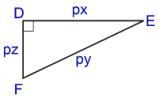
In the diagrams above, . For the enlarged triangle DEF, . Since the factor cancels out, . This proves that , meaning angle angle as they are both acute. This same logic applies to sine and cosine ratios.
Worked Example: Sine Ratios in Enlarged Triangles
Triangle DEF is an enlargement of triangle ABC with a scale factor of . The sides of triangle ABC have lengths and , where . In triangle DEF, the side lengths satisfy . What is the sine of angle DFE in terms of and ?

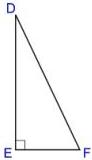
Because DEF is an enlargement of ABC, the triangles are similar and their corresponding angles are equal. Side is the smallest side in ABC, and is the smallest side in DEF. Therefore, angle A (opposite ) corresponds to angle D (opposite ). This means angle C must correspond to angle F. Since , and in triangle ABC, , it follows that .
Key takeaways
- Similar shapes have equal angles and sides that are proportional by a scale factor .
- Area ratios are the square of linear ratios (), and volume ratios are the cube of linear ratios ().
- To convert between area and volume ratios, you must first calculate the linear ratio as an intermediate step.
- Trigonometric ratios (sin, cos, tan) remain constant under enlargement because the scale factor cancels out.
- The linear scale factor is found by dividing a dimension of the larger shape by the corresponding dimension of the smaller shape.
Always check which units are being used in the question. If a question gives you a volume in cm and an area in cm, ensure you convert to the linear scale factor first before attempting to find the unknown value.
The most common error is forgetting to square or cube the linear scale factor. Students often mistakenly multiply the volume by the linear scale factor instead of the volume scale factor ().
The relationship between dimensions () is a fundamental property of Euclidean space. This is why similarity is so powerful in physics and engineering; if you double the height of a structure, you must account for the fact that its weight (volume) has actually increased eightfold, while its base support area has only increased fourfold.
Frequently asked questions
What happens if I know the ratio of areas but need the ratio of volumes?
You cannot go directly from area to volume. First, take the square root of the area ratio to find the linear ratio. Then, cube that linear ratio to find the volume ratio. For example, if the area ratio is , the linear ratio is , and the volume ratio is .
Does similarity only apply to triangles and rectangles?
No, similarity applies to any shape, including circles, spheres, and irregular polygons, as long as every dimension is scaled by the same factor and all angles remain identical.
If a shape is doubled in size, what happens to its surface area and volume?
If 'doubled in size' refers to its linear dimensions (scale factor ), its surface area increases by times, and its volume increases by times.
Why do trigonometric ratios stay the same in similar triangles?
A trigonometric ratio is the ratio of two sides. In a similar triangle, both sides are multiplied by the same scale factor . When you divide the sides to find the ratio, cancels out, leaving the original ratio unchanged.