Function Mappings and Common Functions for the ESAT
Updated July 2026
In ESAT Mathematics 2, understanding the precise definition of a function is crucial. This topic covers why functions must be one-to-one or many-to-one mappings, the convention that square roots are always positive, and how to manipulate the modulus function. One key fact is that every input must have exactly one output.
A function is a rule that assigns exactly one output value to every valid input value. If a rule produces multiple outputs for a single input, such as , it is not a function.
What defines a function?
In mathematics, a function is defined as a rule or mapping from a set of input values to a set of output values. While we often use algebraic expressions to represent these rules, not every expression qualifies as a function. To understand what makes something a function, we must look at how inputs are transformed into outputs.
We typically use the notation to represent the value of a function for a given input . For example, if we have , the rule takes an input , squares it, and adds . We often combine this with a statement about the allowed inputs, such as , which means can be any real number on the axis. While mathematicians might strictly distinguish between the function and its value , or use mapping notation like , for the ESAT you can safely treat and as ways of describing the same relationship.
The criteria for a function
For an expression to be called a function, it must satisfy three specific requirements:
- There must be a rule, usually an algebraic expression, that maps inputs to outputs.
- There must be a clear list of permitted input values, known as the Domain. In the ESAT, if a domain is not specified, you should assume it is the set of all real numbers for which the expression is defined. Some functions have inherent domains, such as logarithms, which only accept positive values. Other times, the domain is restricted manually, such as for .
- For every input value in the domain, there must be exactly one output value.
Consider the expression . If we input , we get two possible outputs: and . Because a single input leads to more than one output, this expression is not a function. The only exception is at , where there is only one output, but for the mapping to be a function, the 'single output' rule must hold for every value in the domain.
One-to-one and many-to-one mappings
While every input must have only one output, it is perfectly acceptable for different inputs to produce the same output. This leads to two classifications of functions:
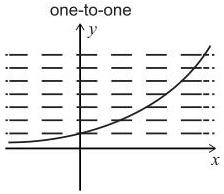
- One-to-one functions: Each input gives a unique output that is not shared by any other input. An example is , where every value of results in a distinct value of .
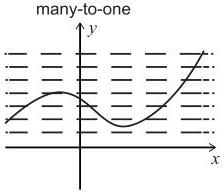
- Many-to-one functions: Different input values can result in the same output value. A classic example is . Here, and . Even though two inputs give the same output, it is still a function because each individual input only points to one specific output.
Graphical tests for functions
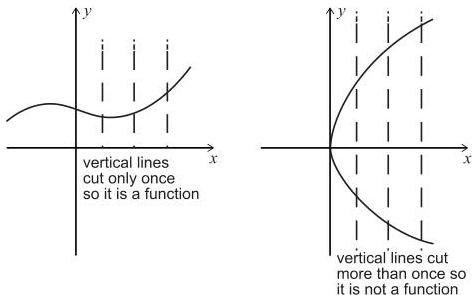
You can determine if a relationship is a function by looking at its graph. If any vertical line drawn through the domain crosses the graph more than once, it is not a function because that value has multiple values.
Once you have confirmed a relationship is a function using the vertical line test, you can determine if it is one-to-one or many-to-one using the horizontal line test. If every horizontal line crosses the graph at most once, the function is one-to-one. If you can find a horizontal line that crosses the graph more than once, the function is many-to-one.
The square root function
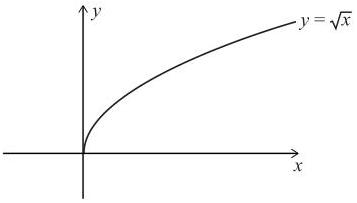
In the ESAT, the notation always refers to the positive square root. This is a standard convention. Unless otherwise stated, the domain for this function is , as the square roots of negative numbers (complex numbers) are not part of the ESAT specification.
Looking at the graph of , you can see it passes the vertical line test (it is a function) and the horizontal line test (it is one-to-one).
The modulus function
The modulus function, written as , outputs the positive value of whatever is inside the bars. For example, , , and . You should be comfortable working with the modulus both algebraically and graphically.
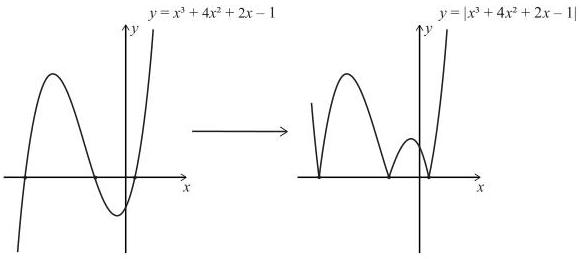
A helpful technique for sketching the graph of is to first sketch the graph of . You then reflect any part of the graph that lies below the axis in the axis itself, while leaving the parts above the axis unchanged. This ensures that all values are non-negative.
Key takeaways
- A function must provide exactly one output for every input in its domain.
- The vertical line test identifies if a mapping is a function: a vertical line must never cross the graph more than once.
- The horizontal line test distinguishes between one-to-one and many-to-one functions.
- The symbol strictly denotes the non-negative square root in the context of functions.
- To graph , reflect any parts of that are below the axis into the upper half-plane.
When you see a modulus sign in an equation, consider two cases: one where the expression inside is positive, and one where it is negative. This is often the quickest way to solve modulus problems algebraically.
Never assume means in a function context. In the ESAT, is the unique positive root. If a question requires both roots, it will explicitly use the sign.
The distinction between one-to-one and many-to-one is essential for understanding inverses. Only one-to-one functions have an inverse function because the reverse mapping must also satisfy the 'single output' rule to qualify as a function.
Frequently asked questions
Is the equation of a circle a function?
No. If you rearrange for , you get . For most values of , there are two possible values. Graphically, a vertical line would cross the circle twice, failing the vertical line test.
What is the difference between a mapping and a function?
A mapping is a general term for a rule connecting sets. A function is a specific type of mapping where each input maps to exactly one output. Therefore, all functions are mappings, but not all mappings are functions.
Why is the domain important in the ESAT?
The domain defines where the function exists. For instance, is only a function if . Restricting the domain can also turn a many-to-one function into a one-to-one function, which is necessary for defining an inverse.
Does count as a one-to-one or many-to-one function?
It is many-to-one. For example, and . Since two different inputs produce the same output, it is many-to-one.