Simultaneous Equations and Analytical Solutions
Updated July 2026
Simultaneous equations require finding values that satisfy multiple algebraic relationships at once. For the ESAT, you must master analytical methods like substitution and elimination to solve systems of linear and quadratic equations. Geometrically, these solutions represent the intersection points of lines and curves on the Cartesian plane.
A solution to a set of simultaneous equations is a set of number pairs that make every equation in the system true at the same time, representing the geometric intersection of their corresponding graphs.
Understanding Equations and Their Graphs
To understand simultaneous equations, we should first consider what a single equation like represents. This equation is a concise way of describing an uncountably infinite set of number pairs. For instance, when , , so is in the set. Similarly, , , and are members.
We can represent this set geometrically on a diagram known as the Cartesian plane. Introduced by Rene Descartes in 1637, this plane allows us to draw a line or curve where every point on the line corresponds to one number pair in the set. Understanding the connection between algebra (sets of pairs) and geometry (graphs) is a fundamental skill for advanced mathematics. When we solve equations simultaneously, we are looking for the specific number pairs that appear in the sets for both equations. Geometrically, these are the points where the graphs cross.
Solving Linear Simultaneous Equations
Consider the following two linear equations:
We can find the values of and that satisfy both using three primary techniques.
Method 1: By Substitution
In this method, we rearrange one equation to make one variable the subject and then substitute this into the second equation.
Starting with , we rearrange for :
Now we replace in the second equation () with our new expression:
Substituting back into , we find . The solution is .
Method 2: By Elimination
Elimination involves manipulating the equations so that the coefficients of one variable are the same, allowing us to subtract or add the equations to remove that variable.
Multiply the first equation by 2:
Now we have:
Subtracting the bottom equation from the top:
Substituting into gives , so .
Method 3: Graphically
We can draw the graph of each equation and identify the coordinates of the intersection point.
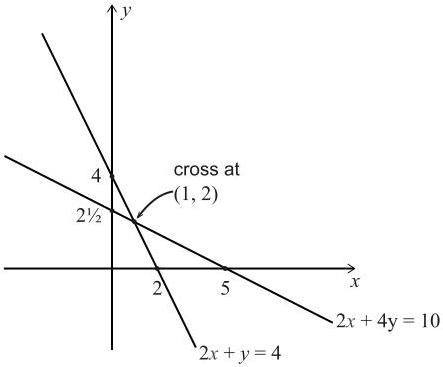
The Number of Solutions in Linear Systems
In two dimensions, two straight lines can be drawn in exactly three ways, which dictates the number of solutions:
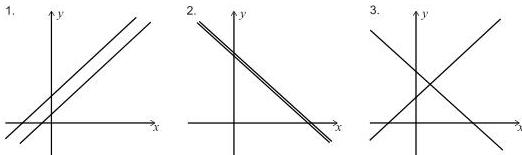
- Parallel and distinct lines: These lines have the same gradient but different intercepts, such as and . They never cross, so there are no solutions.
- Parallel and identical lines: These are the same line written differently, such as and . Every point on the line is a solution.
- Non-parallel lines: These lines have different gradients and will always intersect at exactly one point, providing one unique solution.
Linear and Quadratic Simultaneous Equations
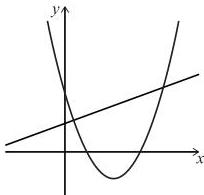
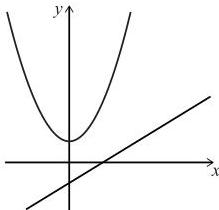
When one equation is linear and the other is quadratic, we solve them by eliminating one variable (usually ) to create a single quadratic equation in terms of . There are three possible geometric outcomes for a line and a quadratic:
- Two distinct solutions: The line crosses the quadratic at two points.
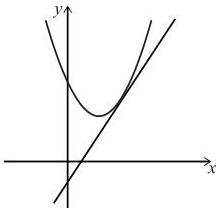
- One repeated solution: The line is a tangent to the quadratic, touching it at exactly one point.
- No real solutions: The line never crosses the quadratic.
Worked Example: Linear and Quadratic
Solve and simultaneously.
First, we equate the two expressions for :
Rearrange into a standard quadratic form :
Next, factorise the quadratic:
This yields a single repeated solution for :
To find , substitute into the linear equation:
The single solution is , which indicates that the line is tangent to the curve . If the resulting quadratic had two distinct factors, there would be two solutions. If the quadratic had no real roots (determined by a negative discriminant ), there would be no real solutions.
Key takeaways
- Simultaneous equations represent the intersection points of their respective graphs.
- Substitution is the most reliable method for systems involving one linear and one quadratic equation.
- A linear and a quadratic system can have zero, one (tangent), or two real solutions.
- The number of solutions to a linear-quadratic system is determined by the discriminant of the resulting single-variable quadratic equation.
- Parallel lines in a linear system result in either zero solutions or infinitely many solutions if the lines are identical.
When solving linear-quadratic systems, always substitute the linear expression into the quadratic one rather than the other way around to avoid dealing with square roots and plus-minus signs unnecessarily.
A common mistake is finding only the values and forgetting to calculate the corresponding values. A full solution requires the complete coordinate pair for every intersection point.
The relationship between the number of solutions and the discriminant of the combined equation is a powerful tool. In ESAT problems, you may be asked to find a constant that makes a line a tangent to a curve. This is solved by setting the discriminant of the combined equation to zero.
Frequently asked questions
How do I know whether to use substitution or elimination?
Elimination is often faster for two linear equations where coefficients can be easily matched. Substitution is usually necessary when one equation is non-linear, such as a quadratic, as it allows you to reduce the system to a single-variable equation.
What does a 'repeated solution' mean in a geometric context?
In a linear-quadratic system, a repeated solution occurs when the linear graph is tangent to the quadratic graph. It means they touch at exactly one point rather than crossing through each other.
Can a system of two linear equations have exactly two solutions?
No. Two straight lines can either intersect once, never (if parallel), or infinitely many times (if they are the same line). They cannot curve back to intersect a second time.
What if the resulting quadratic equation cannot be factorised?
If the quadratic equation resulting from substitution does not factorise easily, use the quadratic formula or check the discriminant to see if real solutions exist.