Quadratic Functions and Equations for the ESAT
Updated July 2026
This guide explores quadratic functions of the form , focusing on the relationship between algebraic manipulation and graphical properties. Understanding completing the square and the discriminant is essential for solving ESAT problems. You will learn to determine roots and locate the vertex through multiple rigorous mathematical methods.
A quadratic function (where ) represents a parabola whose graphical position is determined by its coefficients, with the discriminant indicating the number of real roots.
Quadratics are functions written in the form where . The term quadratic is often used generally to refer to the function, the expression, or its graph. Within the ESAT, quadratics serve as a fundamental tool because they possess interesting properties that illustrate complex mathematical concepts without unnecessary complications. They are the ideal model for understanding how graphs shift and how algebra dictates geometry.
Essential Skills for Quadratics
To succeed in the ESAT Mathematics 2 paper, you must be able to perform the following operations with confidence:
- Factorise quadratic expressions when appropriate.
- Solve quadratic equations using the quadratic formula.
- Complete the square for any given quadratic and understand how this relates to the quadratic formula.
- Understand the relationship between the roots of a quadratic and the x-intercepts of its graph.
- Understand the relationship between a quadratic in completed-square form and its graph.
- Sketch quadratic curves, marking the x-intercepts (roots), y-intercept, and the coordinates of the minimum or maximum.
- Use the discriminant to determine the nature of the roots.
- Find the coordinates of the vertex (min/max) by completing the square or by differentiation.
When asked to solve an equation, it is generally more efficient to attempt factorisation before using the quadratic formula or completing the square.
The Interplay Between Algebra and Graphs
Consider the quadratic . By completing the square, we can rewrite this as:
This form reveals that the graph of has the same shape as but is translated to a different position. If we start with and shift it to the left by and then move it vertically by , we arrive at our quadratic graph. This is a translation that does not involve stretching or squashing the curve. Using functional notation, if , the translated graph is .
Finding the Vertex
We can determine the coordinates of the minimum point (the vertex) of using three different methods:
- Graph Shifting: The original minimum of is . Shifting it as described above moves the minimum to the coordinates .
- Differentiation: Finding the stationary point by setting the derivative to zero: . This yields . Substituting this value back into the original equation gives the coordinate .
- Algebraic Inspection: In the form , the term is always greater than or equal to zero. To minimise , we must make this term zero, which happens when .
Roots and the Discriminant
The roots of a quadratic are the solutions to , representing where the graph crosses the x-axis (). For a U-shaped quadratic where , the graph crosses the x-axis only if the minimum point is below the x-axis. Algebraically, this means the y-coordinate of the minimum must be negative: . Rearranging this gives , which is the discriminant condition for two real roots.
The General Case and the Quadratic Formula
For the general quadratic where , we complete the square by first factoring out :
Simplifying this leads to the completed-square form:
To derive the quadratic formula, we set :
Taking the square root of both sides (considering both positive and negative results):
Symmetry and Root Distance
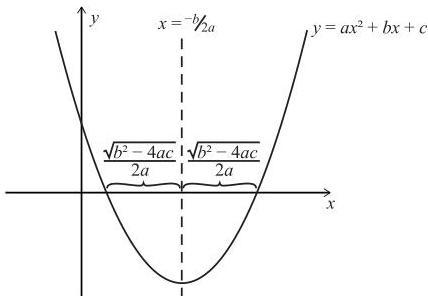
The graph of a quadratic is symmetrical about the vertical line . The horizontal distance from this line of symmetry to each root is . Consequently, the total distance between the two roots is .
The Discriminant Conditions
The value determines the number of real roots:
- If , the quadratic has two real distinct roots and the graph cuts the x-axis at two points.
- If , the quadratic has one repeated root and the graph touches the x-axis at its vertex.
- If , the quadratic has no real roots and the graph never touches or crosses the x-axis.
Exercise: An Alternative Formula
If we start with and divide the expression by , we obtain a quadratic in terms of . Using the quadratic formula, it can be shown that . Taking the reciprocal gives . While this is equivalent to the standard formula, it requires to avoid division by zero.
Key takeaways
- Completing the square reveals the vertex of the parabola as the point in the form .
- The discriminant is the definitive test for the number of real roots and the graph's relationship with the x-axis.
- The line of symmetry for any quadratic is always located at .
- Always check for factorisation as your first solving strategy to save time during the ESAT.
In the ESAT, you might encounter quadratics within other functions. Being able to complete the square quickly is vital for identifying the range of a function or the centre of a circle.
Be extremely careful with signs when completing the square, especially when the coefficient or is negative. A common error is failing to distribute the negative sign to all terms inside the brackets.
The fact that a quadratic has no real roots when the discriminant is negative is the gateway to complex numbers. In that system, every quadratic has exactly two roots, though they may be imaginary.
Frequently asked questions
What is a repeated root?
A repeated root occurs when the quadratic is a perfect square, such as . Graphically, this means the vertex of the parabola lies exactly on the x-axis, so it touches the axis at one point rather than crossing it.
Does the discriminant tell us about the y-intercept?
No. The discriminant only provides information about the x-intercepts (roots). The y-intercept is always given by the constant term in the form , because that is the value of when .
What happens to the graph if 'a' is negative?
If the coefficient is negative, the parabola is inverted (an 'n' shape). The vertex becomes a maximum point instead of a minimum point.