Solving Linear and Quadratic Inequalities for the ESAT
Updated July 2026
Master the algebraic and graphical techniques required to solve linear, quadratic, and modulus inequalities. This guide explains why multiplication by negative numbers flips signs and how to use sketches to identify correct solution regions, preparing you for the rigor of the ESAT Advanced Mathematics paper.
Inequalities define ranges of values rather than fixed points, requiring unique manipulation rules, such as reversing the inequality sign when multiplying or dividing by negative numbers, and using graphical sketches to solve non-linear forms.
Rules for Manipulating Inequalities
The most important principle to grasp when dealing with inequalities is that they do not behave exactly like equations. While you can add or subtract the same value from both sides without restriction, you cannot multiply or divide both sides, raise both sides to an even power, or apply specific functions without first verifying if the operation preserves the inequality.
Consider these cases where standard algebraic logic might fail if applied blindly:
- Multiplication by a negative: is true, but multiplying by gives , which is false.
- Squaring both sides: is true, but squaring gives , which is false.
- Cubing both sides: is true, and cubing gives , which remains true.
- Division by a negative: is true, but dividing by gives , which is false.
- Trigonometric functions: is true, but is false, whereas is true.
When solving inequalities, ensure that your manipulations do not turn a true statement into a false one or generate incorrect solutions.
Linear Inequalities
Linear inequalities involve to the power of 1 and can generally be solved by rearranging, provided you remember the negative multiplication rule.
Example 1: Solve .
- Subtract from both sides: .
- Subtract 2 from both sides: .
- Divide by 2: .
Quadratic Inequalities
Solving a quadratic inequality typically requires two steps: algebraic factorisation and graphical sketching. The sketch helps you visualise which regions of the -axis satisfy the inequality.
Example 2: Solve .
First, factorise the expression: . This tells us the quadratic crosses the -axis at and . Next, sketch the graph to see where the curve sits above the -axis (the region where ):
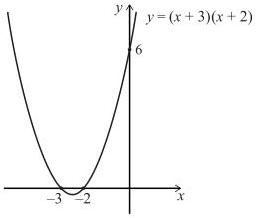
From the diagram, the solution consists of the two outer regions: or .
Rational Inequalities
When an inequality has a variable in the denominator, you must be careful. You cannot simply multiply by the denominator because its sign changes depending on the value of . To avoid this, multiply by the square of the denominator, as a squared term is always positive for real numbers.
Example 3: Solve .
- Multiply both sides by : .
- This simplifies to: .
- Rearrange to set to zero: .
- Factorise out the common term : .
- Simplify: .
As seen in Example 2, this is a U-shaped quadratic with roots at and . The solution for is or .
Correct Range Notation
Avoid common errors in writing solution ranges. A string like is mathematically impossible as cannot be simultaneously greater than 1 and less than . Similarly, using "and" incorrectly, such as and , creates an empty set. Always use "or" for separate regions: or .
Modulus Inequalities
The modulus function represents the positive distance of from on the number line. This interpretation is often the fastest way to solve modulus inequalities.
Example 4: Solve .
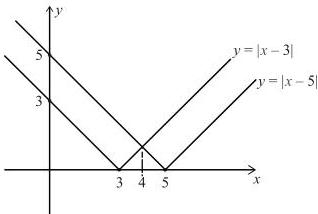
This asks: for what values of is the distance from 3 less than the distance from 5? The midpoint between 3 and 5 is 4. Any value less than 4 is closer to 3. Thus, the solution is . Graphically, this is where the V-shape of sits below :
Example 5: Solve , which is .
We solve this by finding the points where the graphs intersect:
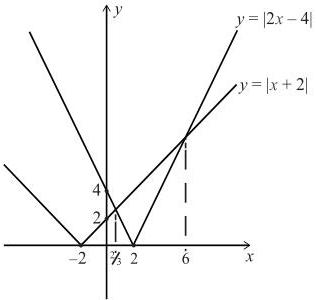
To find the intersection points, we solve the equations for the relevant branches of the modulus functions:
- For the first intersection: .
- For the second intersection: .
The graph shows is below between these points. So, the solution is .
Key takeaways
- Always reverse the inequality sign when multiplying or dividing by a negative number.
- Solve quadratic inequalities by finding roots and using a sketch to identify the correct regions.
- Multiply rational inequalities by the square of the denominator to ensure the inequality sign is preserved.
- The modulus expression is best understood as the geometric distance from to on a number line.
In the ESAT, time is limited. For modulus inequalities involving , skip the algebra and find the midpoint of and to instantly identify the boundary of the solution region.
Never multiply an inequality by a variable (like ) unless you are certain of its sign. If the variable could be negative, the inequality might flip, leading to lost or incorrect solutions.
The graphical method for inequalities is a precursor to understanding feasible regions in linear programming and the concept of 'neighbourhoods' in mathematical analysis. In the ESAT, thinking graphically often reveals symmetries that make complex algebraic problems much simpler.
Frequently asked questions
Why can I not just square both sides of an inequality to solve it?
Squaring an inequality is only valid if both sides are known to be non-negative. If one side is negative, squaring can reverse the order of the values (e.g., is true, but squaring gives , which is false).
How do I decide between 'and' and 'or' when writing solutions?
Use 'and' (often written as a single string like ) when the solution is a single continuous interval. Use 'or' when the solution consists of two separate, disconnected regions on the number line.
When solving , can I just solve ?
Yes, for a constant , the inequality is equivalent to . This is often quicker than sketching for simple linear modulus expressions.