Trapezium Rule and Area Approximation
Updated July 2026
The trapezium rule is a numerical integration method used to estimate the area under a curve or the value of a definite integral. This technique is essential for the ESAT when functions are difficult to integrate analytically. It involves dividing an area into multiple trapezia of equal width to calculate a numerical approximation.
The trapezium rule approximates a definite integral by summing the areas of equal width trapezia: , where is the strip width and are the vertical heights at each interval.
Estimating Areas and Definite Integrals
The trapezium rule is primarily used to estimate the area between a curve and the axis. In the context of the ESAT, it is important to distinguish between estimating an area and estimating a definite integral. By convention, area is always taken as a positive value. However, definite integrals treat areas located below the axis as negative. Any examination question will clearly specify whether you are calculating a geometric area or a definite integral value.
The Geometry of a Single Trapezium
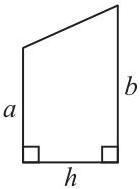
To understand the rule, we first consider a single trapezium. For a trapezium with two right angles, a width , and vertical parallel sides of heights and , the area is calculated as the width multiplied by the average height of the two sides.
Deriving the Trapezium Rule Formula
To approximate the total area under a curve , we divide the region into trapezia, each having an equal width . The height of each vertical side is determined by the value of the function at that specific point, denoted as .
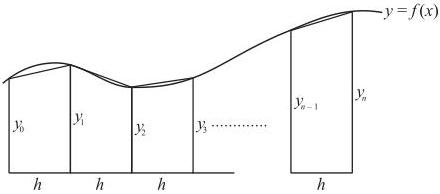
The total approximate area is the sum of the individual areas of these trapezia:
By factoring out and grouping like terms, the formula simplifies to:
This is the standard form of the Trapezium rule. You will notice that the first height and the last height are used only once, while all intermediate heights are multiplied by two. This occurs because every internal vertical side is shared by two adjacent trapezia.
Overestimates and Underestimates
Whether the trapezium rule provides an overestimate or an underestimate depends entirely on the curvature of the function. By observing the shape of the graph, you can determine how the straight top edge of the trapezium relates to the actual curve.
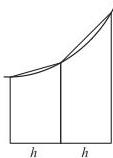
If the curve is convex, meaning it is cupped upwards, the straight line of the trapezium will lie above the curve, resulting in an overestimate.
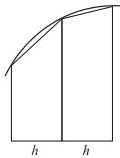
Conversely, if the curve is concave, meaning it is cupped downwards, the straight line of the trapezium will lie below the curve, resulting in an underestimate.
In some cases, such as when a curve contains an inflection point where the curvature changes from concave to convex, it is not possible to determine if the result is an overestimate or underestimate without further mathematical investigation.
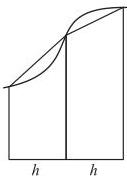
Key takeaways
- The trapezium rule uses equal width strips to approximate the area under a curve.
- The formula is , where internal ordinates are doubled because they are shared by two trapezia.
- The approximation is an overestimate for convex curves and an underestimate for concave curves.
- Definite integrals count area below the axis as negative, while geometric area is always positive.
The ESAT focuses on conceptual understanding rather than tedious arithmetic. If you are asked to determine whether a result is an overestimate, focus on the concavity of the curve rather than calculating the exact error.
A common error is using the wrong number of values. Always remember that for strips, there are vertical lines. For example, three strips require four values: and .
The accuracy of the trapezium rule increases as the number of strips increases. Mathematically, the error in the trapezium rule is related to the second derivative of the function: if throughout the interval, the rule always overestimates the area.
Frequently asked questions
What is the relationship between the number of strips and the number of y values?
If there are strips of equal width, there will always be heights (or ordinates) used in the calculation, ranging from to .
How is the strip width h calculated?
For an integral over the interval using strips, the width is calculated as .
Can the trapezium rule be used for curves that go below the x axis?
Yes. When estimating a definite integral, the values below the axis will be negative, and the trapezium rule will naturally account for this by subtracting those areas. If you are asked for the total geometric area, you must treat those regions as positive.