Atomic Structure and Relative Atomic Mass for the ESAT
Updated July 2026
Understanding atomic structure is the foundation of chemistry. This guide explains how to use atomic and mass numbers to determine subatomic particle counts, defines isotopes through their Greek roots, and details how mass spectrometry data is used to calculate the relative atomic mass of elements based on isotopic abundance.
Every atom of an element is defined by its atomic number (protons), but may exist as different isotopes with varying mass numbers (neutrons). The relative atomic mass () is the weighted average mass of these isotopes compared to of a carbon-12 atom.
Atomic Number and Mass Number
All atoms of a specific element contain the same number of protons in their nuclei. This value is known as the atomic number. While the atomic number identifies the element, the mass of atoms within that element can vary. This variation is due to the presence of different numbers of neutrons. The mass number is the sum of the protons and neutrons in an atom's nucleus.
To identify a particular atom or ion, we use a standard notation where the mass number is written as a superscript and the atomic number as a subscript to the left of the chemical symbol.
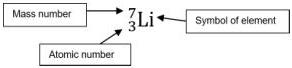
Calculating Subatomic Particles
In a neutral atom, the number of electrons is equal to the atomic number (protons). In an ion, the number of electrons changes based on the charge.
- Protons: Equal to the atomic number.
- Neutrons: Calculated as .
- Electrons: In a neutral atom, this equals the protons. For an ion, electrons = .
Worked Example: Calcium Ion For the ion :
- The atomic number is 20, so there are 20 protons.
- The mass number is 41. Neutrons = .
- The charge is . Electrons = .
Isotopes
Isotopes are defined as atoms of the same element that have the same number of protons but different numbers of neutrons. This means they have the same atomic number but different mass numbers. The term comes from the Greek roots isos (equal) and topos (place), referring to the fact that isotopes occupy the same position in the Periodic Table.
Hydrogen provides a classic example with three isotopes:
- Protium (): 1 proton, 0 neutrons.
- Deuterium (): 1 proton, 1 neutron.
- Tritium (): 1 proton, 2 neutrons.
Mass Spectrometry
The number and abundances of an element's isotopes are determined using a mass spectrometer. In this machine, atoms or molecules are ionised, accelerated, and then separated based on their mass and charge as they drift toward a detector. The resulting mass spectrum plots the number of ions detected against their mass-to-charge ratio ().
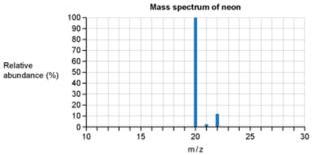
The x-axis shows the value (effectively the mass of the ion if the charge is ), while the y-axis shows the relative abundance or the number of ions detected. In some spectra, the most abundant peak is set to 100 percent, and others are scaled accordingly.
Interpreting Spectra: Neon and Boron In the neon spectrum above, there are three peaks, meaning neon has three isotopes with masses 20, 21, and 22. For boron, the spectrum shows two peaks at 10 and 11.
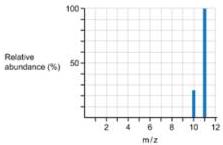
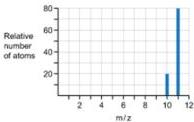
The ratio of the peaks for boron is 1:4. This indicates that for every five atoms, four have a mass of 11 and one has a mass of 10. Thus, boron-11 () has an abundance of 80 percent and boron-10 () has an abundance of 20 percent.
Diatomic Elements: Bromine Bromine exists as molecules. Its mass spectrum shows peaks for individual atoms ( and ) and for molecular ions (, , and ).
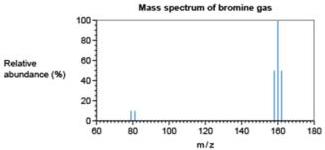
Because the and peaks are equal in height, the isotopes are 50 percent abundant each. The molecular peaks occur in a 1:2:1 ratio because there are two ways to form a mass 160 molecule ( and ).
Relative Atomic Mass ()
The relative atomic mass () is the weighted mean of the mass numbers of the isotopes of an element. The term 'relative' signifies that these masses are compared to a standard: the mass of an atom of carbon-12.
To calculate from percentage data: Where are percentages and are isotopic masses.
Worked Example: Chlorine Chlorine is 75 percent and 25 percent .
If the data is provided as relative abundances (peak heights) rather than percentages, use the following formula:
Worked Example: Copper
Using the mass spectrum for copper:
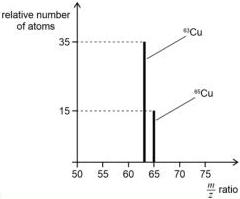
- Mass 63 has a height of 35.
- Mass 65 has a height of 15.
- Total abundance = .
Key takeaways
- The atomic number is the number of protons and defines the identity of the element.
- Isotopes are atoms of the same element with identical proton numbers but different neutron numbers.
- Mass spectrometry separates ions by their mass-to-charge ratio (m/z) to show isotopic abundance.
- Relative atomic mass is a weighted average of all isotopes, measured relative to 1/12 of carbon-12.
When calculating relative atomic mass from a spectrum, always sum the heights of all peaks to find your denominator. Do not assume the total is 100 unless the y-axis is explicitly given in percentages.
Be careful when calculating electrons for negative ions (anions). You must ADD the magnitude of the charge to the atomic number. For example, a ion has electrons.
Isotopes of the same element have identical chemical properties because they have the same number and arrangement of electrons, which determines how they react. Their physical properties, such as density or rate of diffusion, may differ slightly due to the difference in mass.
Frequently asked questions
Why is the relative atomic mass of chlorine 35.5 instead of a whole number?
The relative atomic mass is a weighted average of all naturally occurring isotopes. Since chlorine consists of approximately 75 percent Cl-35 and 25 percent Cl-37, the average mass is .
What is the difference between mass number and relative atomic mass?
The mass number is an integer representing the count of protons and neutrons in a single specific atom. The relative atomic mass is a decimal value representing the average mass of all isotopes of that element found in nature.
How do you calculate the number of neutrons in an ion?
The number of neutrons remains the same regardless of whether the atom is neutral or an ion. It is always calculated by subtracting the atomic number (protons) from the mass number.
What does a peak at m/z 160 in a bromine spectrum represent?
It represents a molecular ion of bromine () composed of one atom and one atom.