Isotopes and Relative Atomic Mass
Updated July 2026
This lesson covers the definition of isotopes, the operation of mass spectrometry, and the calculation of relative atomic mass. You will learn to identify isotopes from mass spectra and calculate weighted averages based on isotopic abundance, which are essential skills for solving stoichiometry problems in the ESAT.
Isotopes are atoms of the same element with the same number of protons but different numbers of neutrons. Relative atomic mass () is the weighted mean mass of an element's isotopes relative to one twelfth of the mass of a carbon-12 atom.
Defining Isotopes
Atoms of the same element always contain the same number of protons in their nuclei, meaning they share the same atomic number. However, the number of neutrons can vary between atoms of the same element. These variations are known as isotopes. Because the number of neutrons differs, isotopes of the same element have different mass numbers.
The term isotope comes from the Greek words isos, meaning same, and topos, meaning place. This refers to the fact that isotopes occupy the same position in the Periodic Table. A specific isotope is identified by its atomic and mass numbers using standard notation.
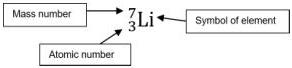
Consider the three isotopes of hydrogen as an example:
(Protium), (Deuterium), and (Tritium).
In each case, the number of protons remains 1. The number of neutrons for Protium is 0, for Deuterium is 1, and for Tritium is 2. This results in mass numbers of 1, 2, and 3 respectively.
Mass Spectrometry and Abundance
The number and relative abundances of an element's isotopes are determined using a mass spectrometer. In this device, atoms or molecules are ionised, accelerated, and then separated based on their mass to charge ratio () as they drift through the machine toward a detector.
A mass spectrum is a plot showing the number of ions detected (the abundance) against their values. The x-axis represents the value, while the y-axis indicates the relative abundance or intensity. Often, the peak for the most abundant ion is set to 100 percent, with others measured relative to it.
Interpreting Mass Spectra
By looking at a spectrum, you can identify the number of isotopes and their relative quantities. For instance, the mass spectrum of neon shows three distinct peaks.
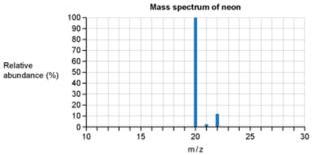
This indicates neon has three isotopes with mass numbers 20, 21, and 22. In contrast, the spectrum for boron shows two peaks.
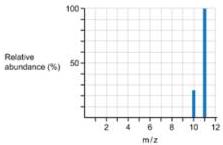
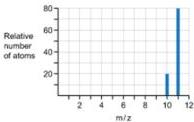
These peaks are at 10 and 11. The ratio of the heights for 10 to 11 is 1 to 4. This means that in a sample of boron, there are four times as many atoms with a mass of 11 as there are with a mass of 10. Consequently, 80 percent of the atoms are boron-11 and 20 percent are boron-10.
Calculating Relative Atomic Mass
The relative atomic mass, , is not a simple average. It is a weighted mean that takes the abundance of each isotope into account. The values obtained from mass spectra are relative to one twelfth the mass of an atom of carbon-12. Because it is a ratio, has no units.
Calculation Methods
1. Using Percentage Data
If you are given percentages, such as of isotope and of isotope , the formula is:
For chlorine, 75 percent of atoms are and 25 percent are :
2. Using Mass Spectrum Peak Heights
If the data is presented as arbitrary peak heights for mass and for mass , the formula is:
Using the chlorine mass spectrum below:
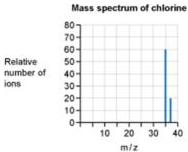
The peaks are at 50 units for 35 and 20 units for 37. The total height is .
Worked Examples from the Guide
Example: Copper Isotopes
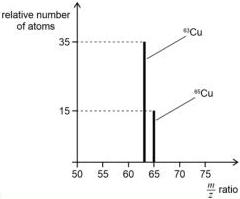
In this spectrum, there are 35 units at mass 63 and 15 units at mass 65. The total number of atoms represented is .
Example: Diatomic Bromine Gas
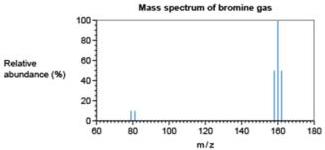
Bromine exists as molecules. The peaks at 79 and 81 are ions. Since they are equal height, the abundance of and is 50 percent each. The peaks at 158, 160, and 162 are molecular ions. These correspond to molecules made of 79 plus 79, 79 plus 81 (or 81 plus 79), and 81 plus 81. Because there are two ways to form the 160 mass ion, it is twice as abundant as the 158 or 162 peaks.
Key takeaways
- Isotopes are atoms of the same element with identical proton counts but different neutron counts.
- A mass spectrometer separates ions based on their mass to charge ratio, denoted as .
- Relative atomic mass is a weighted mean of isotopic masses compared to a carbon-12 standard.
- If isotopes have equal abundance, the will be the arithmetic mean of their mass numbers.
- Relative molecular mass can be calculated from mass spectra by looking at molecular ion peaks.
When calculating from a graph, always sum the total y-axis heights first. This sum becomes your denominator if the y-axis is not already in percentages.
Do not confuse the mass number with the atomic number during calculations. The value used in the weighted average is based on the mass number, not the number of protons.
Isotopes explain why relative atomic masses on the Periodic Table are rarely whole numbers. For example, Chlorine is 35.5 because it is a mixture of roughly three parts to one part .
Frequently asked questions
Why do isotopes have the same chemical properties?
Chemical properties are determined by the number and arrangement of electrons, which are dictated by the number of protons. Since isotopes of an element have the same number of protons and electrons, they react in the same way chemically.
What does relative to one twelfth of carbon-12 actually mean?
It means that the carbon-12 isotope is defined as having a mass of exactly 12 units. All other atomic masses are measured against this standard to create a consistent ratio scale.
How can you tell if a peak in a mass spectrum is an atom or a molecule?
For diatomic elements like Bromine, peaks at lower values usually represent single ions (), while peaks at higher values represent molecular ions (). The molecular ion peaks will reflect the various combinations of the isotopes present.