Atomic Structure Isotopes and Quantitative Chemistry
Updated July 2026
This lesson covers the fundamentals of atomic structure, isotopes, and the periodic table for the ESAT. It details the use of mass spectrometry to determine isotopic abundance and provides a comprehensive guide to stoichiometric calculations, including the mole, gas volumes, and redox reactions using oxidation states.
Atoms of the same element possess the same number of protons but can differ in their number of neutrons (isotopes), leading to non-integer relative atomic masses () calculated as weighted averages from mass spectrometry data.
Atomic Structure and Isotopes
Atoms consist of a central nucleus containing protons and neutrons, surrounded by electrons in specific shells or energy levels. Elements are defined by their atomic number, which is the number of protons in the nucleus. However, atoms of the same element can have different mass numbers because they contain different numbers of neutrons. These variations are called isotopes.
The term isotope comes from the Greek 'isos' (same) and 'topos' (place), indicating that isotopes occupy the same position in the Periodic Table. A particular isotope is identified by its mass number () and atomic number () using the notation .
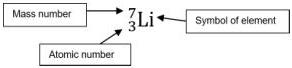
For instance, hydrogen has three isotopes: Protium (), Deuterium (), and Tritium (). They all have 1 proton but possess 0, 1, and 2 neutrons respectively.
Mass Spectrometry and Isotopic Abundance
Mass spectrometry is used to identify the number and abundance of isotopes. In a mass spectrometer, atoms or molecules are ionised, accelerated, and then separated based on their mass-to-charge ratio (). The resulting spectrum plots relative abundance against .
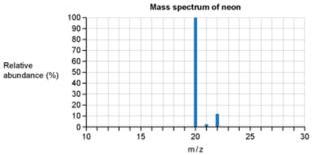
The mass spectrum of neon shows three peaks, indicating three isotopes with masses 20, 21, and 22. Similarly, the mass spectrum of boron shows two peaks at 10 and 11.
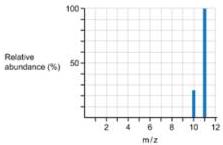
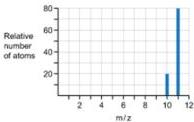
Worked Example: Boron Abundance In a sample of boron, the ratio of peaks for 10:11 is 1:4. This means 20% are and 80% are .
Worked Example: Bromine Molecules Bromine exists as diatomic molecules (). The mass spectrum of gas shows peaks at 79 and 81 (atomic ions) and peaks at 158, 160, and 162 (molecular ions). Because there are two isotopes of equal abundance ( and ), the combinations , , , and lead to a molecular peak ratio of 1:2:1 for the masses 158:160:162.
Relative Atomic Mass ()
The relative atomic mass is the weighted mean of the mass numbers of an element's isotopes, relative to of the mass of an atom of carbon-12.
To calculate from percentage data: Where and are percentages and and are isotopic masses.
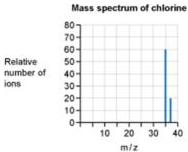
To calculate from mass spectrum heights ():
Worked Example: Chlorine A sample of chlorine contains 75% and 25% . .
The Periodic Table
Elements are arranged by increasing atomic number. Horizontal rows are Periods and vertical columns are Groups. Elements in the same Group share similar chemical properties because they have the same number of electrons in their outermost shell.
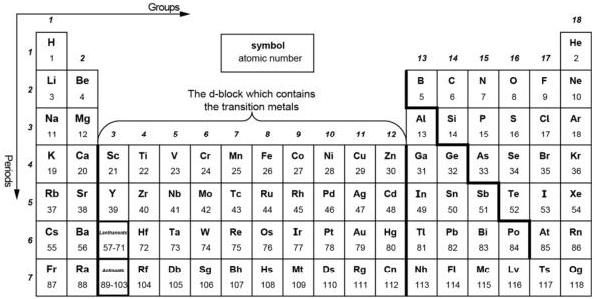
Key trends include:
- Group 1 (Alkali Metals): Reactivity increases down the group. Lithium reacts slowly with water; Potassium reacts vigorously, self-igniting with a lilac flame.
- Group 17 (Halogens): Reactivity decreases down the group.
- Group 18 (Noble Gases): Possess complete outer shells and are generally unreactive.
Chemical Reactions and Equations
In chemical reactions, atoms are rearranged; no nuclei are created or destroyed. Total mass is conserved.
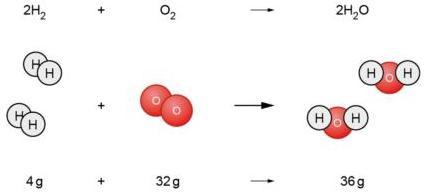
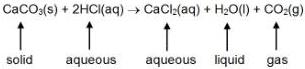
Formulae and State Symbols You must know common formulae: Water (), Methane (), Ammonia (), and the diatomic elements (). Use state symbols: (s) solid, (l) liquid, (g) gas, and (aq) aqueous solution.
Ionic Equations These show only the species that change state or charge. For example, all acid-alkali neutralisations share the same simplest ionic equation:
Half-equations Used for redox processes and electrolysis to show electron transfer. For example, in the electrolysis of molten sodium chloride: At the cathode: At the anode:
Reversible Reactions and Equilibrium
Many reactions are reversible (). In a closed system, they reach dynamic equilibrium, where the forward and reverse reactions occur at the same rate.
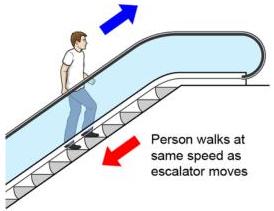
Le Chatelier's Principle states that if a system at equilibrium is changed, the position of equilibrium moves to oppose that change.
- Concentration: Adding a reactant moves the equilibrium to the right.
- Temperature: Increasing temperature favours the endothermic direction (positive ). Decreasing temperature favours the exothermic direction (negative ).
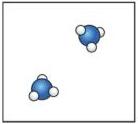
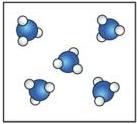
- Pressure: Increasing pressure moves the equilibrium to the side with fewer gas molecules.
Quantitative Chemistry: The Mole
The mole is the unit for the amount of a substance. One mole contains particles (Avogadro's constant, ).
Key relationship:
Empirical and Molecular Formulae The empirical formula is the simplest integer ratio of atoms. The molecular formula is the actual number of atoms and is a multiple of the empirical formula.
Worked Example: Empirical Formula A compound is 36% Beryllium () and 64% Oxygen (). Moles Be = ; Moles O = . Ratio is 1:1, so the formula is .
Reacting Masses and Yield Calculations often require identifying a limiting reactant. The percentage yield is calculated as:
Gases and Solutions At room temperature and pressure (rtp), 1 mole of any gas occupies . Concentration () is measured in or : (where is in )
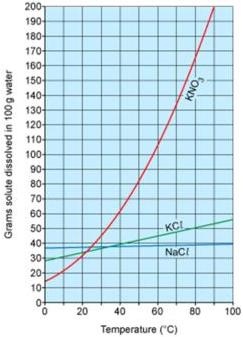
Solubility A saturated solution contains the maximum mass of solute that can dissolve at a specific temperature. Solubility curves show how this changes with temperature.
Oxidation, Reduction, and Oxidation States
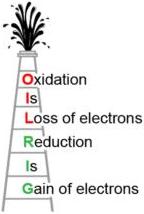
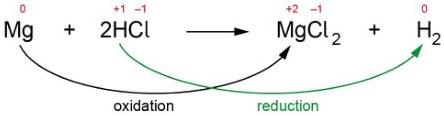
Oxidation is the gain of oxygen or the loss of electrons. Reduction is the removal of oxygen or the gain of electrons. Remember OIL RIG.
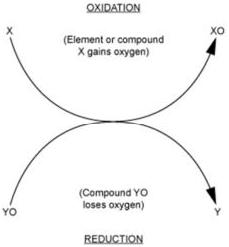
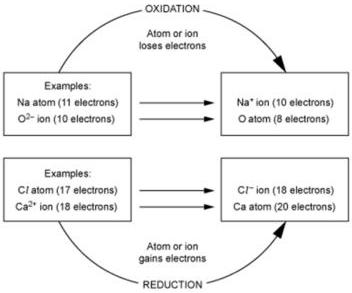
Oxidation States are used to track electron transfer in covalent molecules.
- Elements = 0.
- Monatomic ions = Charge of ion.
- Oxygen = -2 (except in peroxides or with Fluorine).
- Hydrogen = +1 (except in metal hydrides).
- Sum in a neutral compound = 0.
- Sum in a polyatomic ion = Charge of ion.
An increase in oxidation state indicates oxidation; a decrease indicates reduction.
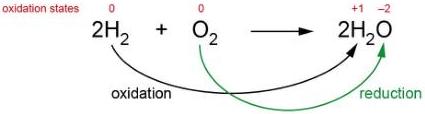
Key takeaways
- Isotopes are atoms with the same number of protons but different numbers of neutrons, identifiable via mass spectrometry.
- Relative atomic mass () is a weighted average of isotopes relative to of Carbon-12.
- The mole link between mass and particles is , and for gases at rtp, 1 mole occupies .
- Le Chatelier's Principle predicts that equilibrium shifts to oppose changes in temperature, pressure, or concentration.
- Oxidation and reduction (redox) are defined by electron transfer (OIL RIG) and changes in oxidation states.
In the ESAT, always check if a question refers to atoms or diatomic molecules. For example, if a question mentions 'one mole of chlorine', it usually means (approx 71g) rather than atoms (35.5g).
A common mistake in calculations is forgetting to divide the sum by the total abundance. If abundances are given as a ratio like 3:1, divide by 4, not 100.
Oxidation states are a formal bookkeeping tool. While ions have real charges, the 'charges' assigned via oxidation states in covalent molecules are theoretical values based on the electronegativity of the atoms, helping chemists track electron movement even where full transfer doesn't occur.
Frequently asked questions
What is the difference between relative atomic mass and mass number?
The mass number is the sum of protons and neutrons in a single specific atom (an integer). The relative atomic mass () is the weighted average of the mass numbers of all naturally occurring isotopes of that element, which is why it is often not an integer (e.g., Cl is 35.5).
How do you identify a limiting reactant?
Calculate the moles of each reactant available. Use the balanced equation to see how many moles of one would be required to react with the other. The reactant that would be completely consumed first is the limiting reactant.
Why does pressure only affect equilibria involving gases?
Pressure significantly changes the concentration of gas particles by changing the volume they occupy. In solids and liquids, the particles are already very close together, so changes in pressure have a negligible effect on their volume or concentration.