Properties of Quadrilaterals and Triangles
Updated July 2026
This lesson explores the essential geometric properties and definitions of common plane figures for ESAT Mathematics 1. You will learn to identify and describe triangles and quadrilaterals, including squares, rhombuses, and kites, by their side lengths, interior angles, and symmetries. Understanding these characteristics is vital for solving complex geometry problems.
Plane figures are defined by their unique combination of side equalities, angle measures, and symmetries. Quadrilaterals are classified by their parallel sides and diagonal properties, while triangles are categorised by their largest angle or the number of equal sides.
Labelling Conventions in Geometry
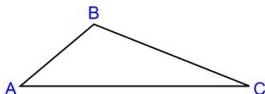
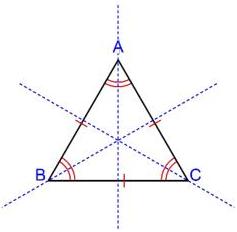
Consistent labelling is fundamental for communicating geometric ideas accurately. In the triangle , capital letters , , and denote the angles at the respective vertices. The lowercase letters , , and represent the lengths of the sides opposite those angles.
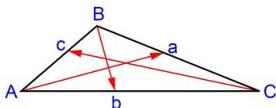
For quadrilaterals and other plane figures, vertices must be labelled in a consistent order, either clockwise or anti-clockwise around the perimeter. The choice of the starting vertex does not matter as long as the sequence is maintained.

Properties of Special Quadrilaterals
Square
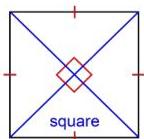
A square is defined as a regular quadrilateral. It possesses two pairs of parallel sides where all four sides are equal in length. Every interior angle in a square is exactly . A square has lines of symmetry and rotational symmetry of order .
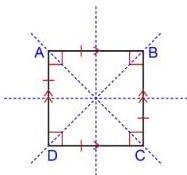
In geometric notation, single arrows indicate that sides and are parallel, while double arrows indicate that and are parallel. Single marks on each side indicate that all four sides are equal in length. Dotted lines represent the lines of symmetry.
Rectangle
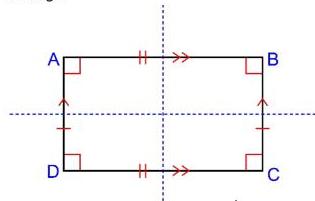
A rectangle features two pairs of parallel sides and four interior angles of . Typically, a rectangle has lines of symmetry and rotational symmetry of order . However, if the rectangle is a square, it will possess the higher symmetries of that specific type.
Parallelogram
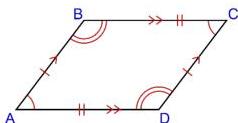
A parallelogram is a quadrilateral with two pairs of parallel sides. Its opposite sides are equal in length, and its opposite angles are equal. Adjacent angles in a parallelogram are supplementary, meaning they sum to . Unless it is a special case like a square, rhombus, or rectangle, a parallelogram generally has no lines of symmetry and rotational symmetry of order .
Trapezium
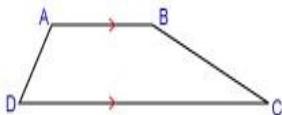
A trapezium is defined by having exactly one pair of parallel sides. In most instances, it does not have any lines of symmetry.
Kite
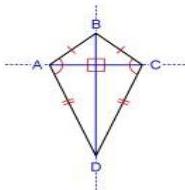
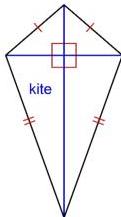
A kite has two pairs of equal sides that are adjacent to each other. It possesses exactly line of symmetry and one pair of equal opposite angles. Crucially, the diagonals of a kite always intersect at right angles ().
Rhombus
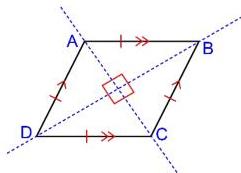
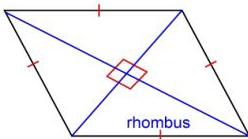
A rhombus has two pairs of parallel sides and all four sides are equal in length. Its diagonals bisect each other at right angles. It typically has lines of symmetry and rotational symmetry of order , unless it is a square.
Types of Triangle
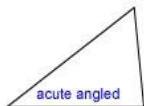
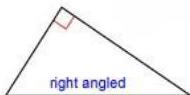
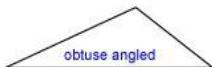
Triangles can be classified by their angles. An acute angled triangle has all interior angles less than . A right angled triangle has exactly one angle of , and an obtuse angled triangle has one angle greater than .
Scalene Triangles
A scalene triangle has no sides of equal length and contains no right angles. It has no lines of symmetry.
Isosceles Triangles
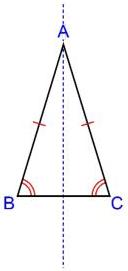
An isosceles triangle has at least equal sides. It can be acute, right angled, or obtuse. It features one line of symmetry and no rotational symmetry.
Equilateral Triangles
An equilateral triangle has equal angles (each ) and equal sides. It has lines of symmetry and rotational symmetry of order .
Worked Examples and Applications
Example 1: Diagonal Intersections
Name three types of quadrilaterals whose diagonals intersect at right angles.
As shown in the following diagrams, the diagonals of a rhombus, a square, and a kite intersect at right angles. A delta (or dart) is also a valid answer, as it is a special case of a kite.
Example 2: Combining Triangles
Two identical equilateral triangles are joined along one edge to form a quadrilateral. Name the quadrilateral and describe its symmetries.
When two identical equilateral triangles are joined, the resulting quadrilateral has four equal sides. This means it must be either a square or a rhombus. Since each triangle has angles of , the resulting quadrilateral has two opposite angles of and two opposite angles of (from ). Because the angles are not , it is a rhombus.
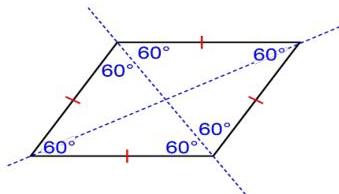
This rhombus has lines of symmetry and rotational symmetry of order , as it fits onto itself twice during a rotation.
Key takeaways
- A rhombus and a square both have four equal sides, but only a square must have angles.
- The diagonals of squares, rhombuses, and kites intersect at .
- An equilateral triangle is a regular polygon with lines of symmetry and rotational symmetry of order .
- In a parallelogram, opposite angles are equal and adjacent angles sum to .
When identifying shapes from coordinates or diagrams, always check the slopes of sides to determine if they are parallel and use the distance formula to check if sides are equal.
Do not assume a quadrilateral is a square or rectangle just because it looks like it has right angles: always verify the properties using the given information or supplementary angle rules.
The square is the most constrained quadrilateral: it satisfies the definitions of a rectangle, a rhombus, and a parallelogram simultaneously.
Frequently asked questions
What is the difference between a rhombus and a parallelogram?
While both have two pairs of parallel sides and opposite angles that are equal, a rhombus must have all four sides equal in length, whereas a general parallelogram only requires opposite sides to be equal.
Can a triangle be both isosceles and obtuse?
Yes, an isosceles triangle can have one angle greater than . For example, a triangle with angles of , , and is both isosceles and obtuse.
How do you identify a trapezium in a complex diagram?
Look for a quadrilateral that has exactly one pair of parallel sides: this is its defining characteristic.
Do the diagonals of a rectangle always intersect at right angles?
No, the diagonals of a rectangle only intersect at right angles if the rectangle is also a square. In a standard rectangle, the diagonals are equal in length but do not meet at .