Arc Lengths, Sector Areas, and Geometric Similarity
Updated July 2026
This lesson teaches how to calculate arc lengths, sector angles, and areas of circle sectors, alongside the principles of congruence and similarity. You will learn to use specific formulae for circular portions and understand how area and volume scale when shapes are enlarged by a factor of n.
A sector is a portion of a circle defined by an angle , with an area and arc length proportional to the circle's total circumference and area. Similarly, geometric figures are related through congruence (identical size and shape) or similarity (enlargement by a scale factor ).
Circle Sectors and Their Properties
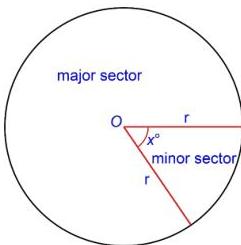
A sector of a circle with centre O is a specific region of the circle enclosed by two radii and an arc. When two radii are drawn from the centre to the edge, they divide the circle into two distinct parts: the major sector and the minor sector.
The Sector Angle
The central angle formed between the two radii that bound the sector is known as the sector angle.
Calculating Sector Area
The area of a sector is a fraction of the total area of the circle. If the sector angle is given as , the area can be calculated using the formula:
Worked Example: Sector Area
A sector of a circle, C, has a central angle of and a radius of cm. To find the area:
- Use the formula:
- Simplify the calculation:
- Final result: cm²
Calculating Arc Length and Perimeter
The length of the arc bounding the sector is also a fraction of the total circumference. If the sector angle is , the arc length is:
Worked Example: Sector Perimeter
Consider a sector of a circle, C, with an angle of and a radius of cm. What is the total perimeter of this sector?
- Calculate the arc length: cm
- The perimeter consists of the arc plus the two radii:
- Calculate: cm
Worked Example: Finding the Angle from Arc Length
A sector with a radius of cm has an arc length of cm. We can find the unknown angle as follows:
- Set up the equation:
- Simplify the left side:
- Solve for : . The sector angle is .
Congruence and Similarity
In geometry, we distinguish between figures that are exactly the same and those that are simply scaled versions of each other.
- Congruent figures: These are identical in both shape and size. All corresponding angles are equal, and all corresponding lengths are equal.
- Similar figures: These share the same shape but differ in size. One figure is an enlargement of the other. Corresponding angles remain identical, while corresponding lengths exist in a constant ratio.
All equilateral triangles, spheres, and cubes are inherently similar to others of their kind.
Investigating Congruence
Consider two right-angled triangles, ABC and PQR, both having a hypotenuse of cm. Is triangle ABC always congruent to triangle PQR?
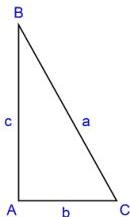
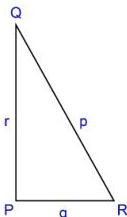
According to Pythagoras' theorem, the sum of the squares of the other two sides must equal the square of the hypotenuse: . If and , the triangles are congruent. However, we could have and for one triangle, while the other has . In this case, the triangles are not congruent. Thus, the statement is only sometimes true.
Similarity and Scale Factors
When a shape is enlarged by a scale factor of , the relationships for area and volume change as follows:
- Length: Multiplied by
- Area: Multiplied by
- Volume: Multiplied by
Worked Example: Similar Triangles
In triangle ADE, point B lies on AD and point C lies on AE, with BC parallel to DE. Given cm, cm, and cm.
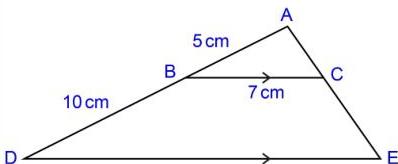
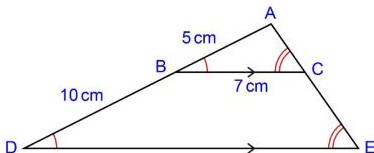
First, we show similarity. Both triangles share angle A. Angles ABC and ADE are equal (corresponding angles), and angles ACB and AED are also equal (corresponding angles). Since all angles are the same, triangle ABC is similar to triangle ADE.
To find the length of DE, we find the ratio of corresponding sides. Side cm. The ratio is , which simplifies to . Therefore, cm.
Worked Example: Area and Volume Scaling
An individual chocolate bar has ingredients weighing g and a wrapper with an area of cm². A 'family bar' is made where the length, width, and height are all twice that of the original bar.
- Area of wrapper: Since lengths are multiplied by , the area is multiplied by . The new area is cm².
- Mass of ingredients: Mass is proportional to volume. Since lengths are multiplied by , the volume is multiplied by . The new mass is g.
Key takeaways
- Sector area is calculated as and arc length as .
- The perimeter of a sector must include both the arc length and the two bounding radii ().
- If the linear scale factor between two similar shapes is , their areas scale by and their volumes scale by .
- Similarity requires equal corresponding angles and proportional sides, while congruence requires both equal angles and equal side lengths.
When calculating the perimeter of a sector, the most common oversight is forgetting to add the two radii to the arc length. Always draw a quick sketch to visualise the boundary.
Be careful with scale factors. If a question states that the area has increased by a factor of , the lengths have only increased by a factor of (the square root of ). Do not apply the area scale factor directly to linear dimensions.
The relationship between length, area, and volume scaling () is a fundamental property of Euclidean space. This is why, in physics and biology, heat loss (proportional to surface area) and heat generation (proportional to volume/mass) change at different rates as an object or animal grows larger.
Frequently asked questions
What is the difference between a major and a minor sector?
A minor sector is the smaller region created by two radii (where the angle ), while the major sector is the larger region (where the angle ).
Does the perimeter of a sector formula change if the angle is in radians?
Yes, if the angle is in radians (), the arc length is simply and the area is . However, the ESAT Mathematics 1 specification typically focuses on degrees as shown in the primary guide.
How do I identify similar triangles in diagrams with parallel lines?
Look for 'F-angles' (corresponding angles) and 'Z-angles' (alternate angles) created by a transversal crossing the parallel lines. If two triangles share these angles and a common angle, they are similar by the AAA (Angle-Angle-Angle) criterion.