Geometry of Circles and Composite Solids for the ESAT
Updated July 2026
Geometry in the ESAT Mathematics 1 section focuses on the application of formulae for circles, cylinders, and other 3D solids. Students must recall fundamental properties of and apply provided formulae to calculate the perimeters, areas, and volumes of complex composite shapes and solids.
Geometric properties of circles and solids are calculated using the radius , diameter , and height . For composite figures, total perimeter, area, or volume is determined by adding or subtracting the properties of constituent primitives such as circles, rectangles, cones, and spheres.
Core Formulae for Circles and Cylinders
To succeed in the ESAT, you must memorise the following fundamental formulae for circles and right circular cylinders. These will not be provided in the formula sheet. The radius is denoted as , the diameter as (), and the vertical height as .
- Circumference of a circle:
- Area of a circle:
- Volume of a right circular cylinder:
Formulae Provided in the Examination
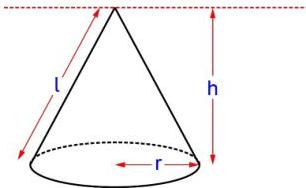
For more complex solids, such as spheres, pyramids, and cones, the following formulae will be provided in the question or an examiner guide if required for a calculation:
- Sphere of radius : Volume ; Surface Area .
- Cone of base radius , perpendicular height , and slant height : Volume ; Curved Surface Area .
- Pyramid of base area and perpendicular height : Volume .
Calculating Perimeters of Simple and Compound Shapes
The perimeter is the total distance around the outside of a 2-dimensional shape. For compound shapes involving circles, you must identify arcs (fractions of the circumference) and add them to the straight-line segments.
Worked Example: Perimeter of a Window
A window is formed by a rectangle with a semicircle drawn on the side . Side cm and side cm. The total perimeter of the window is given as . Find the length of side .
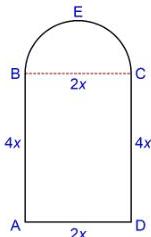
Step 1: Define the components of the perimeter. The perimeter consists of the three straight sides of the rectangle (, , and ) plus the arc length of the semicircle .
Step 2: Calculate the arc length. The diameter of the semicircle is , so the radius is . The arc length of a full circle is , so a semicircle is . Thus, arc .
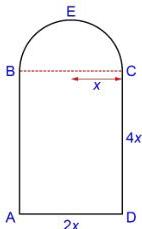
Step 3: Sum the components. . Substituting the variables: .
Step 4: Solve for . We are told , which implies .
Step 5: Find . cm.
Calculating Areas of Circles and Compound Shapes
Areas of composite shapes are found by adding the areas of individual shapes or subtracting the area of a shape cut out from another.
Worked Example: Concentric Circles
A circle of radius 4 cm is cut from a circle of radius 8 cm. What fraction of the area of the larger circle remains?

Method 1 (Calculation): The area of the larger circle is . The area of the smaller circle is . The remaining area is . The fraction remaining is .
Method 2 (Scale Factors): The ratio of the radii is or . Since area is proportional to the square of the linear scale factor, the area ratio is or . If the small circle is of the area, then the remaining part is .
Surface Area and Volume of Composite Solids
When calculating the properties of composite solids, you must be careful not to include internal faces in the total surface area.
Worked Example: Ice Cream Cone Model
A model consists of a solid cone (base radius 10 cm, height 25 cm) attached to a solid hemisphere of radius 10 cm. Find the surface area and volume of the model.
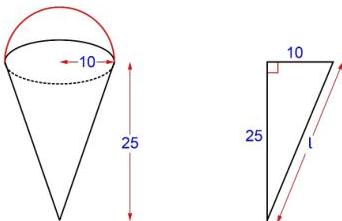
Step 1: Find the slant height of the cone. Using Pythagoras' theorem: . Therefore, cm.
Step 2: Calculate Surface Area. The total surface area is the curved surface of the cone plus the surface of the hemisphere. Note the circular base is internal and excluded. . Substituting: cm².
Step 3: Calculate Volume. The total volume is the volume of the cone plus the volume of the hemisphere. . Substituting: cm³.
Key takeaways
- Memorise the circle formulae for circumference () and area () as they are not provided in the exam.
- Volume of a right circular cylinder is the base area times height: .
- For composite solids, identify which formulae are provided (sphere, cone, pyramid) and only sum the external surface areas.
- Use Pythagoras' theorem to find unknown dimensions such as the slant height () of a cone or the height of a pyramid face.
- Check if calculations require the final answer in terms of or as a decimal.
When solving problems with composite shapes, draw a quick sketch and clearly label each dimension. Always calculate each part of the shape separately before summing or subtracting to avoid algebraic errors. Keep your working in terms of until the final step to maintain precision.
The most common mistake is confusing the formula for circumference () with the formula for area (). Another frequent error is using the diameter instead of the radius in the area formula; always double check which dimension you have been given.
The volume of a cone is exactly one third the volume of a cylinder with the same base radius and height. This relationship also exists between a pyramid and its corresponding prism (cuboid). Understanding these ratios can help you quickly verify if your calculated values are reasonable.
Frequently asked questions
Are the formulae for the area of a sector and arc length provided?
No, you must know that the area of a sector with angle is and the arc length is .
How do I find the slant height of a cone if only the vertical height is given?
The vertical height , radius , and slant height form a right-angled triangle. You can find using Pythagoras' theorem: .
Why is the surface area of a hemisphere instead of ?
A full sphere has a surface area of , so its curved half is . You only add the extra for the flat base if the hemisphere is a standalone solid; in composite solids, the base is often hidden.