Geometry for ESAT Mathematics 1
Updated July 2026
A comprehensive study of geometric principles for the ESAT, ranging from fundamental properties of polygons and angles to complex circle theorems and transformations. This section focuses on applying congruence and similarity to solve problems involving lengths, areas, and volumes, ensuring full preparation for university admissions geometry questions.
Geometric reasoning on the ESAT relies on the identification of identical figures (congruence) and scaled figures (similarity), governed by rigid rules of angles, circle theorems, and coordinate transformations.
Conventional Terms and Notation
In ESAT Mathematics 1, geometry is defined using precise terms. A point represents a singular position. A line is an infinite one dimensional figure, while a line segment is a finite portion of that line. Vertices are the corners where edges meet. In flat shapes, these are intersections of sides, while in figures like pyramids, the apex is also a vertex.
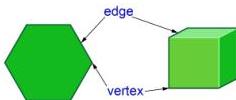
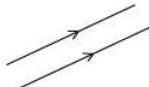
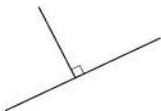
An edge is the side of a polygon or polyhedron. A plane is a flat surface. Lines that remain a constant perpendicular distance apart are parallel, indicated by arrows. Lines meeting at are perpendicular.
Polygons are closed plane shapes with three or more straight sides. A regular polygon has all sides and angles equal. Reflection symmetry occurs if a shape can be folded exactly onto itself. Rotational symmetry is the number of times a shape fits into its outline during a turn.
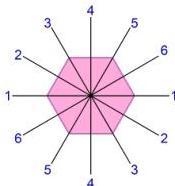
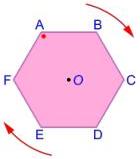
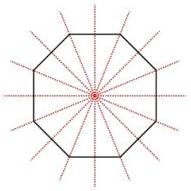
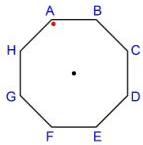
For example, a regular hexagon has 6 lines of symmetry and an order of rotational symmetry of 6. A regular octagon, similarly, has 8 lines of symmetry and an order of 8.
Angle Properties
Angle calculation is a core skill. The following rules must be mastered:
- Angles around a point sum to .
- Angles on a straight line sum to .
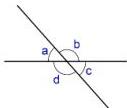
- Vertically opposite angles at a vertex are equal ().
Parallel Lines
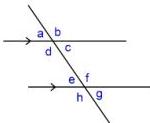
When a transversal crosses parallel lines:
- Alternate angles are equal (Z shape).
- Corresponding angles are equal (F shape).
- Allied or co-interior angles sum to (C shape).
Polygons
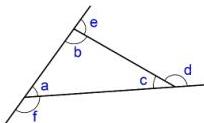
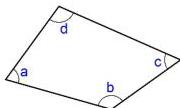
The sum of interior angles in an sided polygon is . The sum of exterior angles for any polygon is . For a triangle, the sum of interior angles is , and an exterior angle equals the sum of the two opposite interior angles. Quadrilaterals sum to .
Example: Finding an unknown angle in a pentagon. Three angles are , , and . The other two are equal. Sum = . Sum of known angles = . Remaining = . Each equal angle = .
Types of Triangles and Quadrilaterals
Shapes are identified by their side and angle properties.
- Square: 4 equal sides, 4 right angles, 2 pairs of parallel sides.
- Rectangle: 2 pairs of parallel sides, 4 right angles.
- Parallelogram: 2 pairs of parallel sides, opposite sides and angles equal.
- Trapezium: Exactly one pair of parallel sides.
- Kite: 2 pairs of equal adjacent sides, diagonals meet at right angles.
- Rhombus: 4 equal sides, opposite sides parallel, diagonals bisect at right angles.
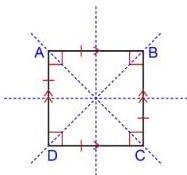
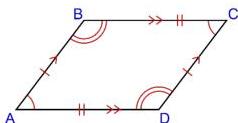
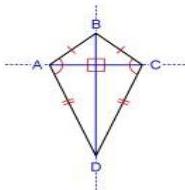
Triangles include Acute (all angles ), Right angled (one angle), and Obtuse (one angle ). Isosceles triangles have 2 equal sides and angles, while Equilateral triangles have 3 equal sides and angles ().
Congruence and Similarity
Congruence
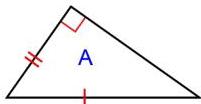
Two triangles are congruent if they are identical in size and shape. There are four criteria:
- SSS (Side, Side, Side): All three sides are equal.
- SAS (Side, Angle, Side): Two sides and the included angle are equal.
- ASA (Angle, Side, Angle): Two angles and a corresponding side are equal.
- RHS (Right angle, Hypotenuse, Side): A right angle, the hypotenuse, and one other side are equal.
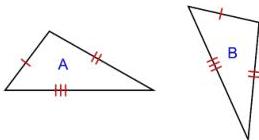
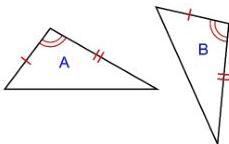
Similarity
Similar figures have the same shape but different sizes. Angles remain identical, but lengths are in a constant ratio . If the length scale factor is , then the area scale factor is and the volume scale factor is .
Example: Scaling a chocolate bar. An individual bar has a mass of g and a wrapper area of cm. A family bar has dimensions twice as large. Scale factor . Area of wrapper = cm. Mass (volume proportional) = g.
Transformations
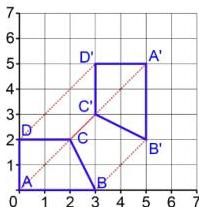
Transformations describe the movement of an object to an image.
- Rotation: Defined by a centre, angle, and direction (anticlockwise is positive).
- Reflection: Defined by a mirror line. Points on the line are invariant.
- Translation: Defined by a vector .
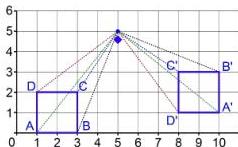
- Enlargement: Defined by a centre and scale factor. Negative factors place the image on the opposite side of the centre.
Pythagoras Theorem and Circle Geometry
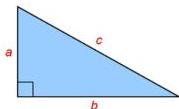
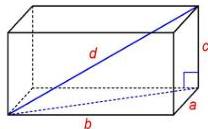
Pythagoras Theorem states for right angled triangles. In 3D, the diagonal of a cuboid is .
Circle Theorems
Key theorems for the ESAT include:
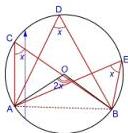
- The angle at the centre is twice the angle at the circumference.
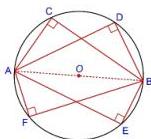
- The angle in a semicircle is .
- Angles in the same segment are equal.
- Opposite angles in a cyclic quadrilateral sum to .
- The angle between a tangent and a radius is .
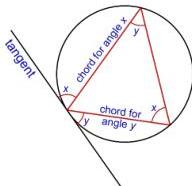
- The alternate segment theorem: the angle between a tangent and a chord equals the angle in the alternate segment.
Coordinate Geometry, Bearings, and Maps
On a coordinate grid, the distance between and is . The midpoint is .
Bearings are measured clockwise from North and written with three digits (e.g., ).
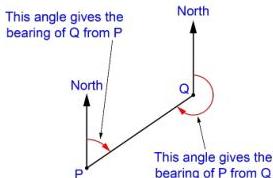
Scale Drawings use ratios. For a map scale of , cm on the map represents cm ( m) in reality.
Mensuration: Area and Volume
- Triangle Area: .
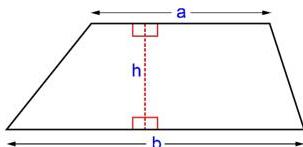
- Trapezium Area: .
- Circle Area: ; Circumference: .
- Sector Area: ; Arc Length: .
- Prism Volume: .
- Cylinder Volume: .
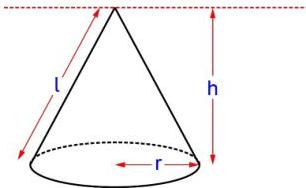
- Cone Volume: .
- Sphere Volume: .
Key takeaways
- Congruence requires identical shapes (SSS, SAS, ASA, RHS), whereas similarity allows for scaling.
- Scale factors for area and volume are the square and cube of the linear scale factor respectively.
- Circle theorems often work in combination with triangle properties to solve for unknown angles.
- Bearings must always be 3 digits and measured clockwise from a North line.
- Prism volumes are always calculated as the product of the cross-sectional area and the perpendicular length.
Always draw a clear, large diagram for geometry problems even if one is provided. Label every known length and angle immediately to help identify which theorem (like alternate segment or Pythagoras) applies.
A common mistake is using the wrong scale factor for area or volume. Remember that if length doubles, area quadruples and volume increases eightfold.
Many geometry problems on the ESAT can be simplified by identifying 'hidden' right angled triangles, allowing you to bridge between trigonometric ratios and coordinate geometry.
Frequently asked questions
What is the difference between congruent and similar triangles?
Congruent triangles are identical in every way (lengths and angles). Similar triangles have identical angles but their lengths are scaled by a constant factor .
How do you calculate the interior angle sum of any polygon?
Use the formula , where is the number of sides. For example, a hexagon () has a sum of .
What are the rules for exterior angles?
The sum of the exterior angles of any convex polygon is always . For a regular polygon, each exterior angle is .
How does a negative scale factor affect an enlargement?
A negative scale factor means the image is inverted and appears on the opposite side of the centre of enlargement. The distance from the centre to the image is times the distance to the object.