Area and Volume of Polygons and Right Prisms for the ESAT
Updated July 2026
Mastering the geometric properties of two dimensional and three dimensional shapes is vital for the ESAT. This section covers the area formulae for triangles, parallelograms, and trapezia, alongside volume calculations for cuboids and right prisms. The focus is on applying perpendicular measurements correctly to find exact spatial values.
The area of a polygon is determined by its base and its perpendicular height, while the volume of a right prism is found by multiplying its constant cross sectional area by its perpendicular length.
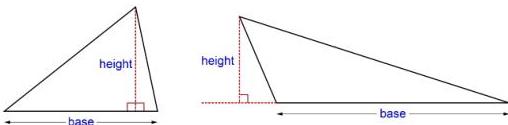
Area of a triangle
The area of a triangle is calculated using the formula . It is critical to ensure that the height used in this calculation is measured perpendicular to the base.
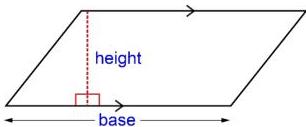
Area of a parallelogram
The area of a parallelogram is defined as . In this context, the height is defined as the perpendicular distance between the base and the side directly parallel to that base.
Area of a trapezium
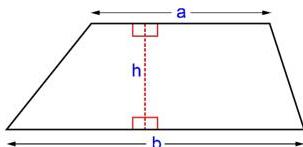
A trapezium is a quadrilateral with at least one pair of parallel sides. Its area is found by taking . As with other polygons, the height must be the perpendicular distance between the parallel sides.
Using the variables on the diagram, where and are the lengths of the parallel sides and is the perpendicular height, the formula is .
Volume of a right prism
The volume of any right prism is calculated as .
A right prism is a three dimensional polygon characterized by parallel, congruent ends. These ends are joined by rectangles. The length of a right prism is defined as the perpendicular distance between these congruent ends. A defining feature of a right prism is that it possesses a constant cross section when cut parallel to its ends, meaning any such cross section is congruent to the shape of the ends themselves.
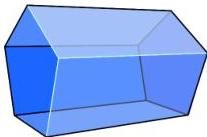
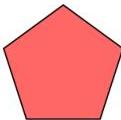
Prisms are generally named after the shape of their constant cross section, such as a triangular prism or a hexagonal prism. A right prism with a rectangular cross section is specifically called a cuboid. If every edge of a cuboid is of equal length, it is known as a cube.
Worked Example: Area of a triangle
Consider a triangle ABC where the length of side AB is 12 cm and the perpendicular distance from point C to the line AB is 8 cm. What is the area of this triangle?
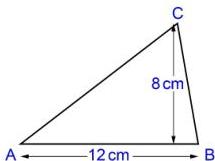
By applying the formula, the area is .
Worked Example: Area of a parallelogram
Suppose we have a parallelogram PQRS. The side SR is 15 cm and the side QR is 12 cm. The perpendicular distance between the parallel sides SR and PQ is 8 cm. We need to find the total area and the perpendicular distance between the sides QR and PS.
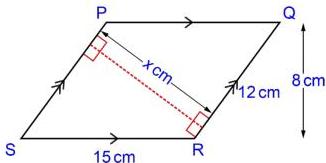
- To find the area, take SR as the base. The area is .
- To find the perpendicular distance between QR and PS, denoted as , take QR as the base. The area remains , so . By dividing both sides by 12, we find .
Worked Example: Area of a trapezium
In a trapezium WXYZ, WX is parallel to ZY. Side XY is perpendicular to WX. The given lengths are WX = 6 cm, XY = 8 cm, ZY = 12 cm, and WZ = 10 cm. Find the area.
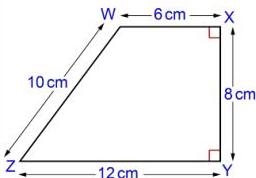
Using the formula , we substitute the known values. The height is the perpendicular side XY, which is 8 cm. The parallel sides are WX and ZY.
.
Note that the measurement of WZ (10 cm) is not used because it is a slant height and not required for the area formula.
Worked Example: Volume of a cuboid
A rectangular block is represented as a cuboid in the following diagram.
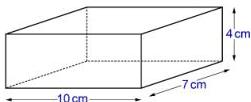
In a cuboid, any face can serve as the cross section. If we take the front face, the area of the cross section is . Given the length is 10 cm, the volume is .
Worked Example: Volume of a right triangular prism
A right triangular prism has a cross section that is a right angled triangle. The shorter sides of this triangle are 6 cm and 7 cm. The total length of the prism is 20 cm.
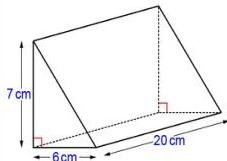
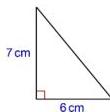
First, calculate the area of the triangular cross section: .
Then, find the volume by multiplying this area by the length: .
Key takeaways
- The height used in area and volume formulae must always be the perpendicular height, never the slant height.
- The area of a trapezium is the average of the two parallel sides multiplied by the perpendicular distance between them.
- A right prism is characterized by a constant cross section throughout its entire length.
- Volumes are measured in cubic units, while areas are measured in square units. Always verify your units are consistent before calculating.
In the ESAT, you may be given more information than you need, such as slant heights. Always identify which dimensions are perpendicular before beginning your calculation to avoid using redundant data.
A common error is forgetting the in the triangle and trapezium formulae. Always double check your formula before plugging in the numbers.
The formula for the volume of a right prism is a generalisation. Since a cuboid is a right prism with a rectangular cross section, its volume formula is just a specific instance of .
Frequently asked questions
What happens if a prism is not a right prism?
If a prism is oblique, meaning the sides are not perpendicular to the base, the volume is still calculated as , but the side length will no longer equal the height.
Can any side of a triangle be the base?
Yes, any side can be the base as long as you use the perpendicular height corresponding to that specific side.
How do I identify the parallel sides in a complex trapezium diagram?
Look for arrows on the lines or check if the angles indicate that two lines are parallel. In the standard formula, these are the sides and .