Circle Geometry Definitions and Theorems for the ESAT
Updated July 2026
Mastering circle geometry is essential for ESAT Mathematics 1. This guide covers fundamental terminology such as chords, sectors, and tangents, alongside the critical circle theorems used to calculate unknown angles. Understanding these properties allows students to solve complex geometric proofs involving subtended angles and cyclic quadrilaterals.
A circle is defined by a set of points at a constant distance from a centre. Geometrical properties arise from the relationship between the centre, radius, diameter, chords, and tangents, which are formalised through a series of circle theorems.
Basic Terminology of the Circle
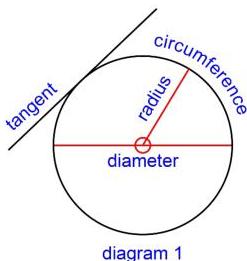
Understanding the components of a circle is the first step in geometric problem solving. The following terms are essential for any student sitting the ESAT:
-
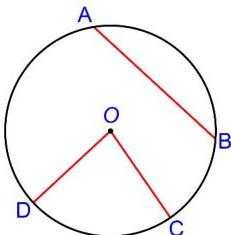
Circumference: The circumference of a circle, shown as the black outline in the diagram, represents the total distance around the outside of the shape.
-
Centre: The centre of a circle, marked as , is the point which is the exact same distance from every point on the circumference. It is also the location where the lines of symmetry of the circle meet.
-
Radius: A line segment extending from the centre to any point on the circumference is known as the radius. This term also refers to the specific length of that line.
-
Diameter: This is a line segment that passes through the centre of the circle and has both endpoints on the circumference. The diameter is exactly twice the length of the radius.
-
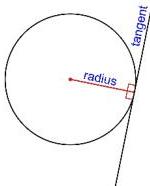
Tangent: A tangent is a straight line that touches the circumference at a single point but does not cross or cut into the circle.
Arcs, Sectors, and Segments
Circles can be divided into smaller parts using curves and straight lines. These parts are classified as arcs, sectors, or segments.
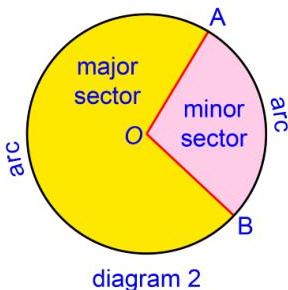
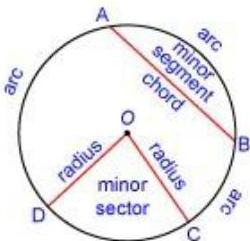
An arc is any part of the circumference. A minor arc measures less than a semicircle, while a major arc measures more than a semicircle.
A sector is a region of a circle bounded by two radii and an arc. When two radii divide a circle into two regions of different sizes, the larger region is the major sector and the smaller region is the minor sector.
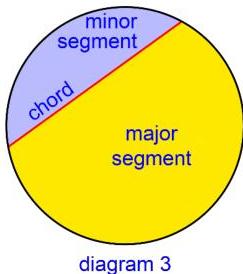
A chord is a straight line joining two points on the circumference. A chord divides the circle into two segments. If the segments are of different sizes, the larger is the major segment and the smaller is the minor segment.
The Relationship between Radius and Diameter
As shown in the diagram below, the diameter consists of two radii, and . Therefore, the length of the diameter is always twice the length of the radius.
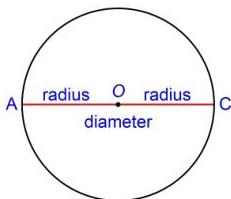
Correct identification of these parts is vital for the exam. The following diagrams illustrate the standard labeling of a circle:
Circle Theorems: Angles at the Centre and Circumference
To solve ESAT problems, you must apply standard circle theorems concerning angles, radii, tangents, and chords. A key concept here is the term subtended. An angle can be subtended at a point by two other points, a line segment, an arc, or an object.
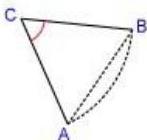
In the diagrams above, angle is the angle subtended at point by the arc or the line segment .
The angle subtended at the centre of a circle by a chord is twice the angle subtended at the circumference by the same chord.
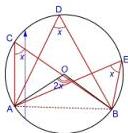
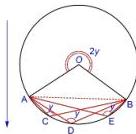
In these diagrams, the angle at the centre, , is twice the angle at the circumference, . Note that the direction is important: the theorem applies to the same chord . One diagram involves an obtuse angle while the other involves a reflex angle .
Example: Angle at the Centre
Points , , and lie on a circle with centre . The obtuse angle is .
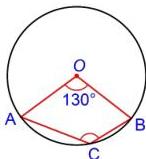
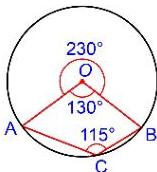
To find the marked angle , we must identify the correct angle at the centre. The angle at the centre that is twice is the reflex angle , not the obtuse angle.
- Calculate the reflex angle: .
- Use the theorem: .
- Angle .
The Angle in a Semicircle
When a diameter cuts a circle into two semicircles, the angle at the centre is . Consequently, the angle subtended at the circumference in a semicircle is always .
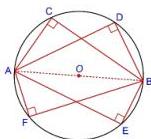
Example: Triangle in a Semicircle
is a triangle inscribed in a circle with centre . is a diameter and angle .
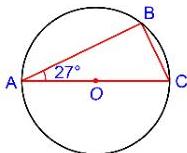
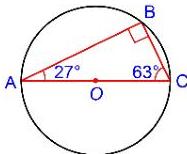
Since is a diameter, angle must be because it is the angle in a semicircle. To find angle , we use the fact that angles in a triangle total :
Angle .
Angles in the Same Segment
Angles subtended at the circumference by the same chord are equal, provided they are in the same segment.
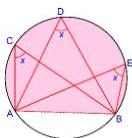
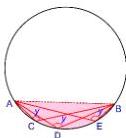
In the diagram above, all angles subtended by chord at the circumference in the same segment are identical. However, if the angles are in different segments, such as angles and in the diagram below, they are not equal.
Example: Using Multiple Theorems
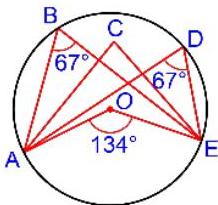
In a circle with centre , angle .
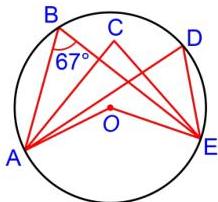
Identify which other angle must be and calculate angle .
- Angle is in the segment defined by chord . Angle is also subtended at the circumference by the same chord, so angle . Note that angle is not subtended at the circumference, so it does not equal .
- Angle is at the centre subtended by chord . Therefore, .
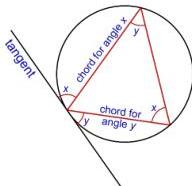
Alternate Segment Theorem
The angle between a tangent and a chord is equal to the angle subtended by that chord in the alternate segment.
Example: Alternate Segment Theorem
Triangle is inscribed in a circle with tangent . Angle and angle .
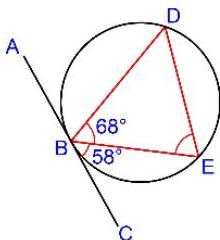
We can find angle using two methods:
Method 1: Angle because is a straight line. Angle is between the tangent and chord . The alternate segment contains angle , so angle .
Method 2: Angle is between the tangent and chord . The angle in the alternate segment is , which is . Using triangle , angle .
Angle between a Radius and a Tangent
The angle between a radius and a tangent at the point of contact is always .
Example: Tangents from a Point
and are tangents at and to a circle centre . Angle .
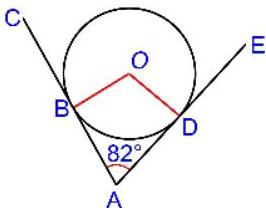
Angles and are both as they are angles between a radius and a tangent. In the quadrilateral , the sum of angles is :
Angle .
Properties of Cyclic Quadrilaterals
A cyclic quadrilateral is a four sided shape where all vertices lie on the circumference of a circle.
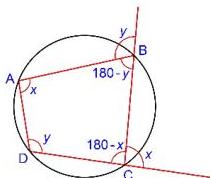
- Both pairs of interior opposite angles add up to .
- The exterior angle is equal to the interior opposite angle.
Example: Cyclic Quadrilateral with Parallel Lines
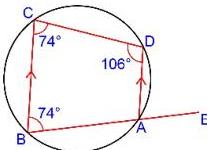
is a cyclic quadrilateral with parallel to . is a straight line.
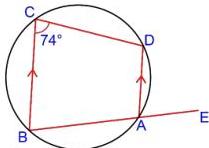
Method 1: The exterior angle is equal to the interior opposite angle , which is . Because and are parallel, angle is equal to the corresponding angle , so .
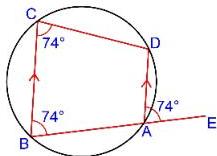
Method 2: Since is parallel to , angle (co-interior angles). In the cyclic quadrilateral, opposite angles add to , so .
Combining Circle Theorems
Most ESAT questions require multiple theorems. Consider a tangent touching a circle at , where angle .
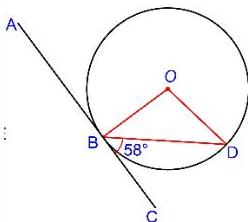
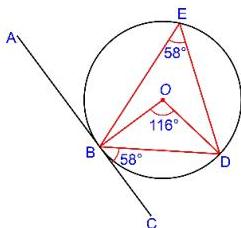
To find angle , first locate the angle in the alternate segment. Draw lines and to a point on the circumference.
- Angle (alternate segment theorem).
- Angle (angle at the centre is twice the angle at the circumference).
Key takeaways
- The angle at the centre of a circle is exactly double the angle subtended at the circumference by the same chord.
- The angle formed within a semicircle (subtended by the diameter) is always a right angle of .
- In a cyclic quadrilateral, opposite interior angles are supplementary, meaning they sum to .
- The alternate segment theorem states the angle between a tangent and a chord equals the angle in the opposite segment.
When faced with a circle geometry problem, always look for radii. Drawing in extra radii often creates isosceles triangles, which can help you find missing angles using the base angle properties.
Be careful with the centre-circumference theorem when dealing with reflex angles. Always ensure you are using the angle at the centre that opens toward the same arc as the angle at the circumference.
The theorem stating the angle in a semicircle is is actually a specific case of the theorem where the angle at the centre is twice the angle at the circumference: a diameter creates a angle at the centre, resulting in at the edge.
Frequently asked questions
What is the difference between a sector and a segment?
A sector is a portion of a circle shaped like a pizza slice, bounded by two radii and an arc. A segment is the region created when a chord cuts across a circle, bounded by the chord and an arc.
How can I tell if an arc is major or minor?
An arc is minor if it covers less than half of the circumference (less than ). It is major if it covers more than half (more than ).
Are the angles subtended by a chord in different segments equal?
No, angles in the same segment are equal. If they are in opposite segments, they will actually sum to because they form opposite angles of a cyclic quadrilateral.
Is the diameter considered a chord?
Yes, the diameter is a special type of chord that passes through the centre: it is the longest possible chord in any circle.