Pythagoras' Theorem in Two and Three Dimensions
Updated July 2026
Pythagoras' theorem is a fundamental geometric principle for right-angled triangles and 3D shapes. For ESAT Mathematics 1, students must apply the formula to calculate distances, verify right angles, and solve complex problems in three dimensions, such as finding the diagonal of a cuboid.
In a right-angled triangle, the square of the hypotenuse is equal to the sum of the squares of the other two sides: .
Pythagoras' theorem in 2 dimensions
Pythagoras' theorem is a rule that applies specifically to right-angled triangles. It describes the relationship between the lengths of the three sides. The longest side of a right-angled triangle is called the hypotenuse, and it is always located directly opposite the right angle.
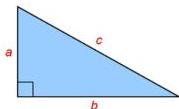
The theorem states that:
In the context of the ESAT, you must be able to perform several tasks using this theorem:
- Find a missing side length when the other two sides are known.
- Calculate the distance between two points on a coordinate grid.
- Determine if a triangle is right-angled by checking if the side lengths satisfy the theorem.
- Find missing lengths in composite shapes that contain right angles.
Pythagoras' theorem in 3 dimensions
Pythagoras' theorem can be extended to find lengths in three-dimensional shapes. A common application is finding the internal diagonal of a cuboid, which is the line segment connecting two opposite corners through the centre of the shape.
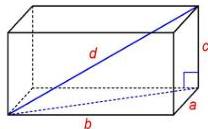
The extended formula for the diagonal of a cuboid with dimensions , , and is:
You should be prepared to find missing lengths in various 3D shapes and solve multi-step problems that may involve keeping values in surd form for accuracy.
Finding a missing side
When calculating a missing side, the method depends on whether you are looking for the hypotenuse or one of the shorter sides.
Case 1: Finding the hypotenuse In triangle ABC below, we need to find the length of the hypotenuse, AC.
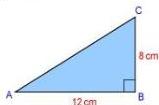
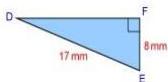
Case 2: Finding a shorter side In triangle DEF, we know the hypotenuse is 17 and one side is 8. We need to find DF.
Distance between two points given as coordinates
To find the distance between two points M and N , you should treat the line segment MN as the hypotenuse of a right-angled triangle.
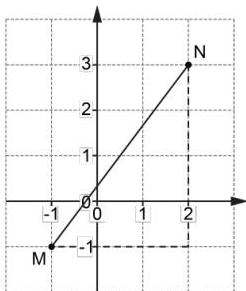
By sketching the points, you can find the horizontal and vertical distances. The horizontal distance is . The vertical distance is .
Identifying whether or not a triangle is right-angled
We can use the converse of Pythagoras' theorem to check if a triangle contains a right angle. If holds true for the three sides, the triangle is right-angled.
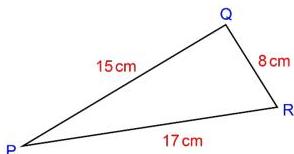
In triangle PQR, the longest side is 17. We check if the square of 17 equals the sum of the squares of 15 and 8:
Because , the theorem applies and triangle PQR is right-angled.
Missing lengths in other shapes containing right angles
Complex shapes can often be broken down into simpler right-angled triangles. Consider finding the perimeter of the trapezium ABCD.
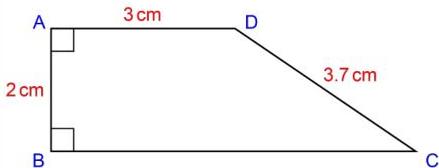
To find the unknown side , we drop a vertical line to form a right-angled triangle. This reveals a triangle with a hypotenuse of 7 and a base of 2 (since ).
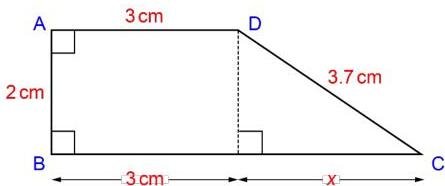
The total perimeter is the sum of all outer sides: .
Missing lengths in 3-dimensional shapes
To find the internal diagonal of a cuboid with sides 3 cm, 4 cm, and 12 cm, you can use two methods.
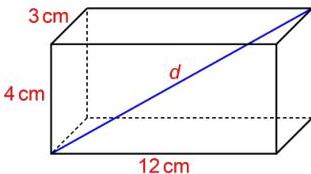
Method 1: The 3D Formula
Method 2: Using 2D Pythagoras twice First, find the diagonal of the base (let's call it ): Then, use this base diagonal and the height to find :
Complex problems in 3 dimensions
Pythagoras' theorem is also vital for finding heights in pyramids. Consider a square-based pyramid where F is the centre of the base and E is the apex directly above F.
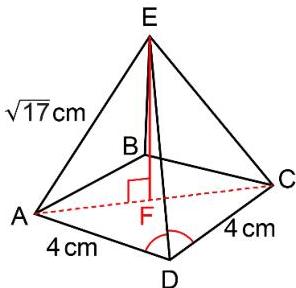
To find the vertical height FE:
- Find the diagonal of the square base ACD: . Therefore, .
- The distance from a corner to the centre (AF) is half of AC: .
- Use triangle AFE to find FE, where AE is given as :
Key takeaways
- Pythagoras' theorem only applies to right-angled triangles.
- The 3D diagonal of a cuboid is found using .
- To find the distance between coordinates, calculate the horizontal and vertical differences and treat them as the shorter sides of a triangle.
- If the sum of the squares of the two shorter sides equals the square of the longest side, the triangle must be right-angled.
When solving 3D problems, always identify the right-angled triangles within the shape. It often helps to sketch these triangles separately in 2D to avoid confusion with the perspective of the 3D diagram.
A frequent error is forgetting to subtract when finding a shorter side. Always check if you are finding the hypotenuse (add the squares) or a shorter side (subtract the square of the known side from the square of the hypotenuse).
Pythagoras' theorem is the foundation for the distance formula in coordinate geometry and the standard equation of a circle, , where is the radius (hypotenuse) and the terms on the left represent the squares of the horizontal and vertical distances from the centre.
Frequently asked questions
Can Pythagoras' theorem be used on non-right-angled triangles?
No, it specifically defines the relationship between sides in a triangle with a 90-degree angle. For other triangles, the Cosine Rule must be used.
How do I decide which side is ?
Side is always the hypotenuse, which is the longest side and is always opposite the 90-degree angle.
Is it better to use the 3D formula or two-step 2D Pythagoras for cuboids?
Both yield the same result. The 3D formula is faster, but the two-step method is useful if you are asked to find the base diagonal as part of the question.
What should I do if a calculation results in a non-perfect square?
In the ESAT, you should usually leave the answer in exact surd form, such as or , unless the question asks for a decimal approximation.