Circle Theorems and Geometric Proofs for ESAT Mathematics
Updated July 2026
Circle theorems establish fundamental relationships between angles, arcs, tangents, and chords within a circle. These theorems are crucial for the ESAT Mathematics 1 paper, enabling students to solve complex geometric problems, calculate missing angles, and prove properties of cyclic quadrilaterals and inscribed triangles using consistent logical deductions.
Circle theorems are a set of geometric rules that define how angles relate to one another when subtended by the same chord or arc, or when interacting with tangents and radii. Specifically, they describe the doubling of angles at the centre compared to the circumference, the consistency of angles in the same segment, and the specific properties of cyclic quadrilaterals.
Understanding Subtended Angles
In circle geometry, the term subtended is used to describe an angle formed when two rays pass through the endpoints of an arc, line segment, or chord. An angle can be subtended at the centre of the circle or at any point on the circumference.
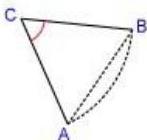
Angle at the Centre and Circumference
The fundamental circle theorem states that the angle subtended at the centre of a circle by a chord is exactly twice the size of the angle subtended at the circumference by the same chord.
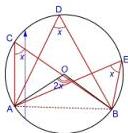
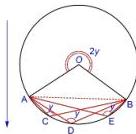
When applying this theorem, the direction of the angles is important. As shown in the diagrams, the theorem applies to the angle at the centre and the angle at the circumference based on the same chord . If the chord subtends a reflex angle at the centre, the angle at the circumference is still half of that reflex angle.
Worked Example: Finding the Angle Subtended at the Circumference
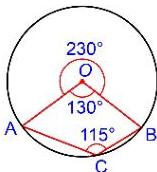
Points , , and lie on the circumference of a circle with centre . The obtuse angle is . What is the size of the marked angle ?
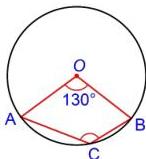
To solve this, we must identify the correct angle at the centre. The angle at the centre that is twice angle is the reflex angle , not the obtuse angle. First, calculate the reflex angle: . Since the angle at the centre is twice the angle at the circumference, angle .
Angle in a Semicircle
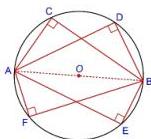
If a chord is also the diameter of the circle, it passes through the centre, making the angle at the centre . Consequently, any angle subtended at the circumference by the diameter is . This is often referred to as the angle in a semicircle theorem.
Worked Example: Angle in a Semicircle
In triangle inscribed in a circle with centre , is the diameter. If angle , find angle .
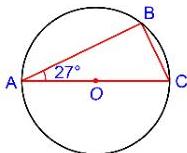
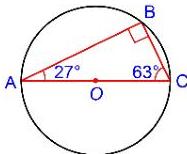
Because is the diameter, angle is the angle in a semicircle and must be . Using the fact that the sum of angles in a triangle is , we calculate angle .
Angles in the Same Segment
Angles subtended at the circumference by the same chord or arc are equal, provided they are in the same segment. This is known as the angles in the same segment theorem.
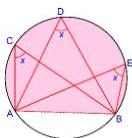
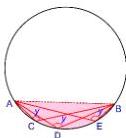
If the angles are in different segments, they are not equal. As shown below, angles and are not equal because they are on opposite sides of the chord .
Worked Example: Using Multiple Theorems
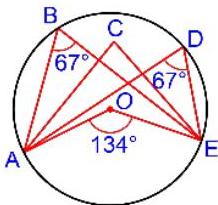
Given angle in the circle below, which other angle must be , and what is the size of angle ?
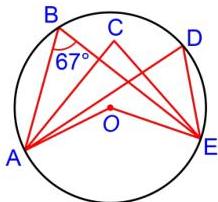
Angle is in the segment defined by chord . Another angle subtended at the circumference by the same chord is angle , so . Note that angle is not equal to because its vertex is not on the circumference. Angle is at the centre subtended by , so it is twice angle . Therefore, angle .
Alternate Segment Theorem
The alternate segment theorem states that the angle between a tangent and a chord through the point of contact is equal to the angle subtended by that chord in the alternate segment.
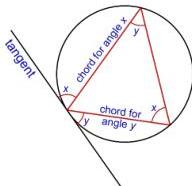
Worked Example: Alternate Segment Theorem
is a triangle inscribed in a circle with tangent touching at . Angle and angle . Find angle .
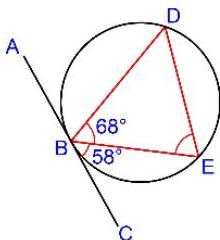
Method 1: Since is a straight line, angle . According to the alternate segment theorem, angle is between the tangent and chord , so it equals the angle in the alternate segment, which is angle . Thus, angle .
Method 2: Angle is between the tangent and chord . The alternate segment angle is . In triangle , angle .
Radius and Tangent
The angle between a radius and a tangent at the point of contact is always .
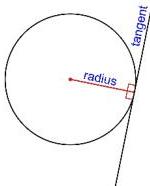
Worked Example: Radius and Tangent
and are tangents at points and to a circle with centre . Angle . What is the size of angle ?
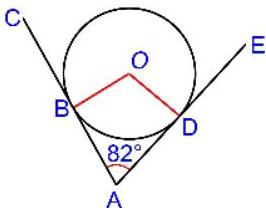
Angles and are both formed by a radius meeting a tangent, so they are both . is a quadrilateral, and its angles must sum to . Therefore, angle .
Properties of Cyclic Quadrilaterals
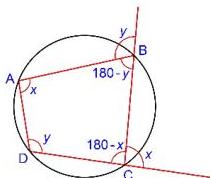
A cyclic quadrilateral is a four sided shape where all four vertices lie on the circumference of a circle. The following properties apply:
- Opposite interior angles sum to .
- The exterior angle of a cyclic quadrilateral is equal to the interior opposite angle.
Worked Example: Cyclic Quadrilateral
is a cyclic quadrilateral and is a straight line. is parallel to . If the exterior angle is , find angle .
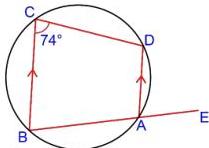
Method 1: The exterior angle of a cyclic quadrilateral equals the interior opposite angle, so angle . Since is parallel to , angles and are corresponding, making angle .
Method 2: Because and are parallel, co-interior angles sum to . Thus, angle . In a cyclic quadrilateral, opposite angles sum to , so angle .
Combining Circle Theorems
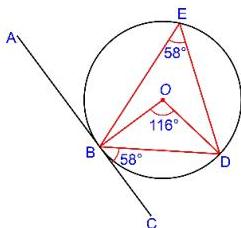
Exam questions often require using multiple theorems simultaneously. For example, to find angle when given angle between a tangent and chord :
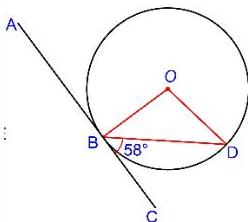
First, identify the angle in the alternate segment. If we pick any point on the major arc, angle (Alternate Segment Theorem). Then, angle (Angle at centre is twice angle at circumference).
Key takeaways
- The angle at the centre is twice the size of the angle at the circumference subtended by the same arc.
- The angle subtended by the diameter (angle in a semicircle) is always .
- Opposite angles in a cyclic quadrilateral are supplementary, meaning they add to .
- The alternate segment theorem states that the angle between a tangent and a chord is equal to the angle in the alternate segment.
- A radius always meets a tangent at a angle at the point of contact.
Always look for radii in circle theorem problems. Because all radii are equal in length, they often form isosceles triangles. Drawing extra radii from the centre to the vertices on the circumference can reveal hidden angles and help you split complex shapes into manageable triangles.
Be careful when applying the 'angle at the centre' theorem. Ensure the angles you are comparing are subtended by the same chord and are pointing in the same relative direction. Using the obtuse angle when you should use the reflex angle is a very common error.
Circle theorems are essentially specific cases of the properties of isosceles triangles and symmetry. For instance, the 'angle at the centre' theorem can be proven by dividing the inscribed triangle into two isosceles triangles using a radius, showing how the central angle is built from the base angles.
Frequently asked questions
Can the angle at the centre be reflex?
Yes. If the chord subtends a reflex angle at the centre, the theorem still holds: the angle at the circumference subtended by the same chord (in the major segment) will be half of that reflex angle.
How do I determine if two angles in a circle are equal using the same segment theorem?
Check if both angles are subtended by the same chord or arc and if their vertices both lie on the circumference within the same segment of the circle.
Does the alternate segment theorem apply to any triangle?
It applies to any triangle inscribed in a circle where one of the vertices is the point of contact for a tangent line. The angle between the tangent and a triangle side (chord) equals the interior angle opposite that side.
What is the exterior angle property of a cyclic quadrilateral?
The exterior angle formed by extending one side of a cyclic quadrilateral is exactly equal to the interior angle located at the opposite vertex.