Solving Geometry Problems on Coordinate Axes
Updated July 2026
This guide covers essential techniques for coordinate geometry in the ESAT Mathematics 1 section. You will learn to calculate the distance between points using Pythagoras theorem, determine midpoints, and solve complex geometric problems by applying coordinate logic to shapes such as trapezia. Mastery of these fundamentals allows for the algebraic analysis of spatial relationships.
Geometric problems on a plane are solved by relating the spatial positions of points to their numerical x and y coordinates, specifically using the distance formula and the midpoint formula.
Calculating the Distance Between Two Points
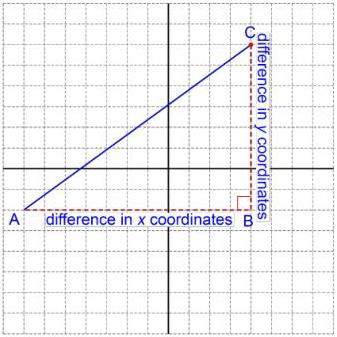
The distance between two points on a two dimensional coordinate plane can be determined by applying Pythagoras theorem. If we consider two points, and , we can visualize a right-angled triangle by drawing a vertical line through and a horizontal line through . These lines meet at a point .
In this triangle, the horizontal distance is the difference between the x-coordinates, while the vertical distance is the difference between the y-coordinates. According to Pythagoras theorem, the square of the hypotenuse is equal to the sum of the squares of the other two sides:
Substituting the coordinate differences into this formula gives:
This can also be written as:
(distance between two points) = (difference in y-coordinates) + (difference in x-coordinates)
Worked Example: Finding Distance
Point is and point is . To find the distance :
- Calculate the squared difference in y-coordinates: .
- Calculate the squared difference in x-coordinates: .
- Sum these values: .
- Take the square root: .
Finding Midpoints
The midpoint of a line segment is the point that lies exactly halfway between two given coordinates. It represents the average of the positions. For points and , the midpoint is calculated as:
Worked Example: Finding a Midpoint
Point is and point is . If is the midpoint of :
- The x-coordinate of is .
- The y-coordinate of is .
- The coordinates of are .
Problem Solving with Coordinates
More complex geometric problems can be solved by translating shape properties into coordinate relationships. Success in these problems often depends on a structured approach.
- Always draw a diagram. It does not need to be perfectly accurate, but it must show the relative positions of the points correctly.
- Ensure the vertex labels (such as ) follow a consistent order, either clockwise or anticlockwise, around the shape.
- Identify geometric traits like parallel lines (which share a gradient) or perpendicular lines.
Worked Example: Trapezium Problem
is a trapezium where is parallel to . Point is , is , and is . We are given that angle is an acute angle and the length of is . We must find the length of .
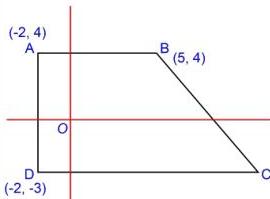
When sketching the diagram, several key observations appear:
- is on the same vertical line as (both have x-coordinate ).
- is on the same horizontal line as (both have y-coordinate ).
- This means the angle at is 90 degrees. Because is parallel to , the angle at is also 90 degrees.
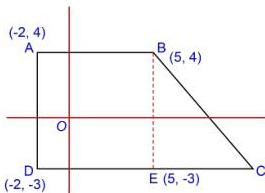
- By drawing a vertical line parallel to , we create a rectangle and a right-angled triangle .
From these observations, we can calculate lengths:
- .
- .
- Since angle is acute, must be further right than , meaning is longer than .
Now, apply Pythagoras theorem to the right-angled triangle :
. .
Finally, the total length of is the sum of and :
.
Key takeaways
- The distance between and is found using .
- The midpoint of two points is the average of their x-coordinates and the average of their y-coordinates.
- A diagram is essential for identifying hidden properties like right angles and parallel lines in coordinate geometry problems.
When dealing with negative coordinates, always use brackets in your calculations to avoid sign errors, especially when subtracting a negative number, such as .
The most common error is forgetting to take the square root at the final step of a distance calculation. Always check if your calculated length seems physically reasonable for the coordinates given.
Coordinate geometry bridges algebra and geometry. The distance formula is actually the foundation for the equation of a circle, which is defined as all points at a fixed distance from a centre , resulting in .
Frequently asked questions
Does it matter which point I label as or in the distance formula?
No. Because the differences are squared, will always yield the same result as .
How can I tell if two points form a vertical or horizontal line?
If two points have the same x-coordinate, the line connecting them is vertical. If they have the same y-coordinate, the line is horizontal.
What should I do if a geometric shape is not aligned with the axes?
You can still use the distance formula between any two points and use gradients to determine if lines are perpendicular or parallel.