Congruence Criteria for Triangles for the ESAT
Updated July 2026
This section covers the geometric principles used to determine if two triangles are identical in shape and size. Understanding the four congruence criteria (SSS, SAS, ASA, and RHS) is essential for solving proof-based problems and identifying equal lengths or angles in complex ESAT Mathematics 1 questions.
Two triangles are congruent if all their corresponding sides and angles are equal. Congruence can be established using one of four minimal sets of conditions: SSS, SAS, ASA, or RHS.
What defines congruent shapes?
In geometry, two shapes are described as congruent if they are identical in both shape and size. When two triangles are congruent, every side length and every internal angle in one triangle matches exactly with a corresponding side length and internal angle in the second triangle. However, you do not need to measure all six components to prove congruence: specific criteria allow you to prove it with just three.
The SSS Criterion (Side, Side, Side)
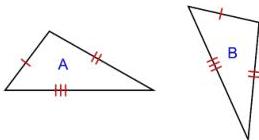
The SSS criterion states that two triangles, and , are congruent if the three sides of triangle are equal in length to the three sides of triangle .
The SAS Criterion (Two sides and the included angle)
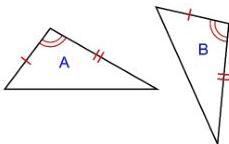
The SAS criterion states that two triangles, and , are congruent if two sides and the angle between those two sides (the included angle) in shape are the same as the two corresponding sides and the included angle in shape .
The ASA Criterion (Two angles and a corresponding side)
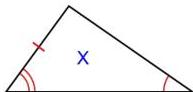
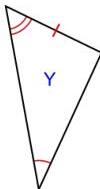
The ASA criterion states that two triangles, and , are congruent if two angles of are the same size as two angles of , and a corresponding side of each triangle is equal.
In this context, the term 'corresponding' means that the sides are located in the same position relative to the angles. For example, if the side is opposite a specific angle in the first triangle, it must be opposite the same angle in the second triangle to count as corresponding.
In the diagrams below for triangles and , the equal sides correspond because they are both situated opposite the angle marked with a single arc.
The RHS Criterion (Right angle, hypotenuse, and side)
The RHS criterion is a special case for right-angled triangles. Two triangles, and , are congruent if:
- Both triangles contain a right angle ().
- They have the same length hypotenuse (the longest side, located opposite the right angle).
- They have one other side of the same length.
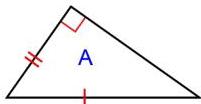
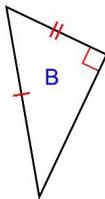
Worked Example: Proving congruence with SSS
Consider triangle , which is an isosceles triangle where . Let be the midpoint of the base . Show that triangle is congruent to triangle .
First, always draw a diagram to visualise the problem.
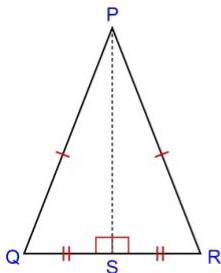
We can establish congruence by looking at the three sides of triangles and :
- : This is given because the triangle is isosceles.
- is common: Both triangles share this side.
- : This is given by the fact that is the midpoint of .
Since all three pairs of corresponding sides are equal, triangle is congruent to triangle by the SSS criterion.
Worked Example: Identifying SAS congruence
Look at the three triangles below. Which two must be congruent? Note that these diagrams are not drawn to scale, so you must rely on the given notation rather than visual estimation.
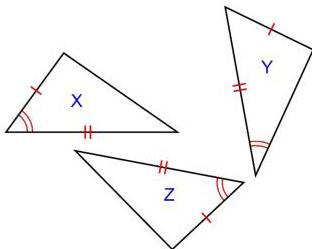
All three triangles possess two sides of the same length. However, for the SAS criterion to apply, the angle must be 'included' (located between the two known sides).
In triangles and , the equal angles are included between the marked sides. In triangle , the marked angle is not between the two sides. Therefore, triangles and are congruent.
Worked Example: Identifying ASA congruence
Examine the following three triangles to determine which two are congruent.
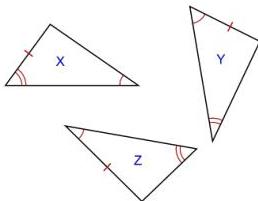
All three triangles have two equal angles. To prove congruence via ASA, we must ensure the equal side is in a corresponding position.
In triangle , the side with the single bar is opposite the angle with one arc. In triangles and , the side with the single bar is opposite the angle with two arcs. Because the sides in and are in the same position relative to the angles, triangles and are congruent.
Worked Example: Proving RHS congruence in a circle
is the diameter of a circle . Points and lie on the circumference on opposite sides of the diameter. If , show that triangle is congruent to triangle .
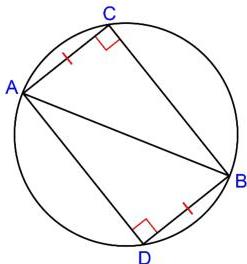
To prove this, we can use the RHS criterion:
- Angle and angle : This is a known geometric property where the angle subtended by a diameter at the circumference is always a right angle.
- The hypotenuse of triangle is and the hypotenuse of triangle is : They share the same hypotenuse, which is the diameter.
- : This is given in the problem description.
Since they have a right angle, an identical hypotenuse, and one other equal side, triangle is congruent to triangle by the RHS criterion.
Key takeaways
- Congruent shapes are identical in size and shape, meaning all corresponding sides and angles match.
- The four standard tests for triangle congruence are SSS, SAS, ASA, and RHS.
- In the SAS test, the angle must be the 'included angle' between the two known sides.
- In the ASA test, the side must be 'corresponding', meaning it is in the same position relative to the angles in both triangles.
- The RHS test is exclusive to right-angled triangles and requires the hypotenuse and one other side to be equal.
When solving congruence problems, always start by sketching the triangles and marking all given information. Look for 'common' sides that are shared by two triangles, as these are often the key to proving SSS or SAS.
The most common error is assuming SAS applies when the given angle is not between the two sides. Always check the position of the angle carefully; if it is not the included angle, you cannot assume congruence unless it is a right angle satisfying RHS.
Congruence is a specific case of similarity where the scale factor between the two shapes is exactly . Proving congruence is often the first step in more complex geometric proofs, such as showing that a quadrilateral is a parallelogram or that a line bisects an angle.
Frequently asked questions
Can triangles be congruent if they have the same three angles (AAA)?
No. The AAA (Angle, Angle, Angle) condition only proves that triangles are similar, meaning they are the same shape but potentially different sizes. To be congruent, at least one side length must be known to be equal.
Does the order of the letters in the criteria matter?
The order reminds you of the arrangement. In SAS, the 'A' is between the 'S's to indicate the angle must be between the sides. In ASA, the 'S' is between the 'A's, though as long as the side is 'corresponding' (in the same relative position), congruence is maintained.
What is the difference between congruence and similarity?
Congruent shapes are exactly the same size and shape. Similar shapes are the same shape (all angles are equal and sides are in the same ratio) but can be different sizes.
Is SSA a valid congruence criterion?
No, SSA (two sides and a non-included angle) is not a valid congruence criterion. It is possible to draw two different triangles with the same two sides and the same non-included angle, unless the angle is a right angle (which falls under RHS).