Geometry of Triangles and Quadrilaterals for the ESAT
Updated July 2026
This lesson synthesises geometric principles to solve problems involving triangles and quadrilaterals. By integrating angle sum rules, congruence criteria, and the specific symmetry of shapes like kites and parallelograms, students can determine unknown sides and angles. Success on the ESAT requires a systematic approach to identifying and marking equal geometric properties.
Advanced geometric problem solving involves combining fundamental angle facts with the formal properties of polygons, such as the side equalities of isosceles triangles and the symmetry of special quadrilaterals, to prove congruence or calculate dimensions.
Understanding Geometric Properties
To solve complex geometry problems in the ESAT, you must be able to apply the fundamental properties of triangles and quadrilaterals simultaneously. This often involves looking for hidden relationships, such as shared sides that create new isosceles triangles or provide enough information to prove congruence between two shapes. You should be familiar with the properties of isosceles and equilateral triangles, as well as the defining characteristics of rectangles, parallelograms, and kites.
Properties of Isosceles Triangles
Isosceles triangles are a frequent component of geometric diagrams. When two isosceles triangles share a side, it often allows you to equate lengths across the entire figure.
Consider the following example. In the isosceles triangle , and angle . Another isosceles triangle is drawn in the same plane as triangle , with angle .
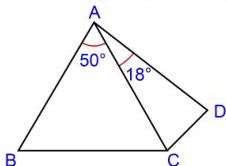
To find the size of angle , we first mark all equal lengths onto the diagram: . This shows that triangle is also isosceles, as it has two sides of equal length ().
Next, we join and to form the triangle , which contains our target angle.
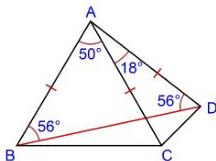
- Calculate the base angles of : because base angles of an isosceles triangle are equal.
- Determine the total angle at : .
- Calculate the base angles of the new isosceles : .
- Find the final difference: .
Combining Triangles and Special Quadrilaterals
Often, quadrilaterals and triangles are combined to test your knowledge of symmetry and congruence. In the following diagram, is a rectangle while and are equilateral triangles.
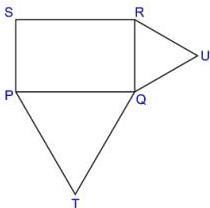
If the length of is 10 cm, what is the length of ? To solve this, we must identify congruent triangles by marking equal sides:
- (opposite sides of a rectangle are equal).
- (sides of equilateral triangle are equal).
- (opposite sides of a rectangle and sides of equilateral triangle ).
In triangles and :
- (since both equal ).
- (since both are sides of equilateral ).
Now we check the included angle between these sides:
- .
- (using the angles around the point ).
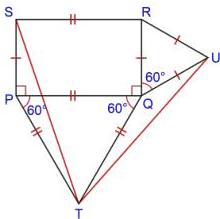
Because they share two sides and an identical included angle, triangle is congruent to triangle (SAS). This means the triangles are identical in every way, so cm.
Applying Parallelogram and Kite Properties
Parallelograms and kites provide useful angle facts based on symmetry. Opposite angles of a parallelogram are equal, and kites have one pair of equal opposite angles along their axis of symmetry.
Example: Parallelogram and Isosceles Triangles
is a parallelogram. is an isosceles triangle with , and is a straight line. Angle . Triangle is isosceles with and angle .
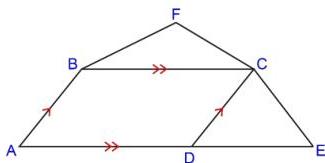
To find the size of angle :
- Find angles in : (base angles of an isosceles triangle).
- Use the straight line property: .
- Use parallelogram properties: (opposite angles are equal).
- In , the base angles are .
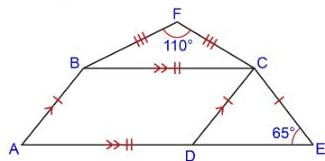
Finally, .
Example: Kite and Isosceles Triangles
is a kite. is an isosceles triangle with . Angle . Angle and angle .
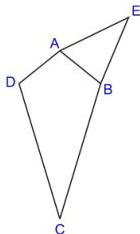
To find angle :
- Identify symmetry: .
- Find total internal angles: .
- Use isosceles ( for a kite): .
- Use isosceles : .
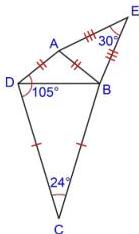
Finally, .
Key takeaways
- Always mark all given equal lengths and angles on your diagram to reveal hidden isosceles triangles.
- Recall that the internal angles of any quadrilateral sum to while those of a triangle sum to .
- Look for Side-Angle-Side (SAS) congruence when shapes share common vertices or sides within a larger figure.
- Use the specific symmetry properties of kites and parallelograms to equate opposite or alternate angles.
When you find a new length or angle, immediately update every part of the diagram that it affects. A single deduction in one triangle often unlocks a whole chain of reasoning in an adjacent quadrilateral.
Be careful when subtracting angles that overlap. Ensure you are looking at the 'included' angle between two known sides before applying congruence rules like SAS.
Many advanced ESAT geometry problems can be reduced to finding 'bridge' components: a side or an angle that belongs to two different shapes, allowing you to transfer known values from one part of the diagram to another.
Frequently asked questions
How do I identify which pair of angles in a kite are equal?
In a kite, the pair of equal angles is always between the two unequal sides. These angles are found at the vertices that the axis of symmetry (the diagonal between the vertices of equal sides) does not pass through.
What is the SAS criterion used in these examples?
Side-Angle-Side (SAS) is a congruence rule stating that if two triangles have two sides and the included angle (the angle between those two sides) equal, then the triangles are identical.
Can I assume a triangle is isosceles if it looks like one in the diagram?
No, you must never assume geometric properties based on the appearance of the diagram. You must prove a triangle is isosceles using given lengths, angle facts, or symmetry properties stated in the text.
Why did we use when calculating angle ?
The sum of angles at a point is . In that example, the point was a shared vertex for a rectangle angle (), two equilateral triangle angles ( each), and the unknown angle .