Trigonometric Ratios and Exact Values
Updated July 2026
This guide covers the fundamental trigonometric ratios of sine, cosine, and tangent in right angled triangles. You will learn to calculate lengths and angles in two and three dimensions, as well as how to derive exact values for standard angles, a critical skill for the non calculator ESAT Mathematics paper.
Trigonometric ratios describe the relationship between the angles and side lengths of a right angled triangle through the ratios , , and .
Definition of Sine, Cosine, and Tangent
In any right angled triangle, we define the sides relative to a specific internal angle. Consider the triangle below, where the angle at is .
- The side is the opposite side because it is directly across from the angle .
- The side is the hypotenuse, which is the longest side of the triangle and sits opposite the right angle.
- The side is the adjacent side, as it is next to the angle and the right angle.
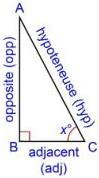
The three primary trigonometric ratios are defined as follows:
Exact Values for 30 and 60 Degrees
You must be able to recall or derive the trigonometric ratios for and . These are derived from an equilateral triangle with side lengths of 2 units. By splitting this triangle in half with a perpendicular line, we create a right angled triangle with a base of 1 unit and a hypotenuse of 2 units. Using Pythagoras' theorem, the height is .
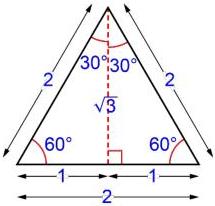
The values are:
Exact Values for 45 Degrees
The ratios for are derived from an isosceles right angled triangle where the two equal sides are 1 unit long. By Pythagoras' theorem, the hypotenuse is .
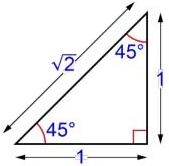
The values are:
Exact Values for 0 and 90 Degrees
Candidates must also know the limiting values of these ratios as the angle approaches or :
Relationship Between Sine and Cosine
In a right angled triangle where the angle at is and the angle at is , we can find an expression for .
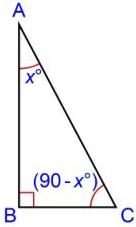
It is important to note that this is identical to calculating the sine of the other non right angle in the triangle. Since the sum of angles is , the angle at is . Therefore:
This shows that .
Worked Example: Deriving Ratios for 30 and 60 Degrees
Problem: Show that .
Solution: Imagine an equilateral triangle with side lengths of 2. Let be a point on such that . The line is a line of symmetry, meaning the angle is , the angle is , and the angle is .
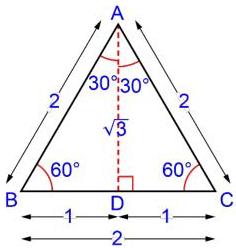
Apply Pythagoras' theorem to triangle to find the length : . So, .
Now, calculate the sine of : .
Worked Example: Deriving Ratios for 45 Degrees
Problem: Show that .
Solution: Let be an isosceles triangle where the angle and .
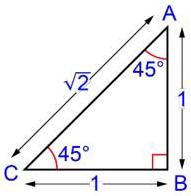
Because the triangle is isosceles, the other two angles are equal: . By Pythagoras' theorem, the hypotenuse is: . So, .
Thus, .
Problems in Two Dimensions
Problem: A circle has a centre and a radius of 6 cm. is the diameter, and is a point on the circumference. is 8 cm. Find the value of .
Solution: First, draw a diagram.
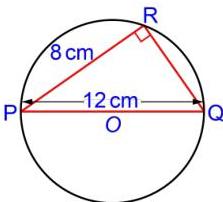
Since is the diameter, the angle must be because it is the angle in a semicircle. The diameter is cm. We need .
Using Pythagoras' theorem to find : . .
Therefore, .
Problems in Three Dimensions
Problem: is a square based pyramid with a base of side 10 cm and a vertical height of 8 cm. What is the sine of the angle that the side makes with the base ?
Solution: Draw a diagram and identify the relevant triangle. Let be the centre of the square base and be the midpoint of the side . The angle we need is the angle between the face and the base, which is angle .
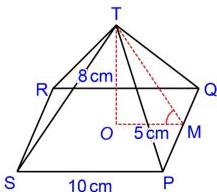
The distance is half the side of the square: cm. The vertical height is 8 cm. To find , we need the hypotenuse of the triangle .
Using Pythagoras' theorem: . So, .
Thus, .
Key takeaways
- The trigonometric ratios are defined as , , and .
- Essential exact values include , , , and .
- The identity is helpful for converting between ratios of complementary angles.
- For 3D problems, always drop a perpendicular to create a right angled triangle and identify the specific angle requested.
If you forget the exact values during the exam, quickly sketch the equilateral triangle (side 2) and the isosceles right triangle (sides 1, 1, ) to re derive them.
Always ensure the angle you are calculating is actually part of a right angled triangle. A common error is applying these ratios to oblique triangles without first creating a right angle.
The values for and can be understood by imagining the triangle collapsing. As the angle approaches , the opposite side length effectively becomes zero, making and .
Frequently asked questions
How can I remember which sides correspond to which ratio?
The mnemonic SOH CAH TOA is commonly used: Sine = Opposite/Hypotenuse, Cosine = Adjacent/Hypotenuse, and Tangent = Opposite/Adjacent.
What should I do if a triangle is not right angled?
The ESAT does not expect you to use the sine or cosine rules. Instead, look for ways to divide the triangle into two right angled triangles by drawing a perpendicular height.
Do I need to rationalise the denominator for exact values like ?
While is often written as , both forms are mathematically correct and frequently appear in ESAT multiple choice options.
How do I find the angle between a face and a base in a 3D shape?
Identify a line on the face and a line on the base that both meet the same edge at a right angle. Usually, this involves using the midpoint of a base edge and the apex of the shape.