Geometric Terminology for three dimensional Solids
Updated July 2026
Understanding the geometric properties of three dimensional solids is essential for the ESAT. This guide covers the terminology of faces, surfaces, edges, and vertices for polyhedra and curved shapes. Learning these definitions ensures you can accurately identify and count the features of cubes, prisms, pyramids, and curved solids like cones.
A face is a flat polygonal surface, an edge is a straight line where two faces meet, and a vertex is a point where edges intersect or the apex of a cone.
Understanding Geometric Terminology
In geometry, definitions are ideas established by convention. Because different textbooks may define terms slightly differently, it is important to understand the specific criteria used in the context of the ESAT. For instance, some definitions may classify a cylinder as a prism, while others do not. Similarly, some sources require a face to have straight line edges, whereas others allow for circular faces. If there is any ambiguity in an examination question, the intended meaning will be specified, and you will not be asked for definitions that are not universally agreed upon.
Faces and Surfaces
A face of a three dimensional figure is typically defined as a flat surface of a polyhedron. Under this definition, a cube has faces, but a sphere has none. Most standard definitions require a face to be a polygon, which means that cylinders and hemispheres are considered to have no faces.
The term surface is more general. It can refer to the entire exterior of a three dimensional shape, as seen when calculating surface area. For example, the surface area of a cube is times the area of one face. Surface also refers to curved areas: a cone consists of one curved surface and one circular area, while a cylinder consists of one curved surface and two circular areas.
Edges and Vertices
An edge is usually defined as a straight line joining two faces. Based on this, spheres, cylinders, cones, and hemispheres have no edges because they lack straight lines and flat polygonal faces. A cube, by contrast, has edges. It is worth noting that some alternative definitions allow an edge to join any two surfaces, but the standard polyhedron definition is most common.
A vertex is either a point where two or more edges of a polyhedron meet or the apex point of a cone. The plural of vertex is vertices. A cube has vertices, whereas a cylinder has no vertices.
Worked Example: Features of a Square Based Pyramid
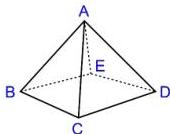
To identify the properties of a solid, it is helpful to label its points and surfaces. Consider a square based pyramid:
-
Faces: There are faces in total. These include the four triangles , , , and , plus the square base .
-
Vertices: There are vertices. These are the points labeled , , , , and .
-
Edges: There are edges. These are the straight lines , , , , , , , and .
Worked Example: Solids with Six Vertices
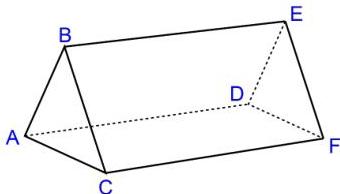
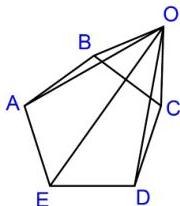
In some cases, different solids may share the same number of vertices but have a different number of faces. For example, both a triangular prism and a pentagonal pyramid have exactly vertices.
The Triangular Prism
A triangular prism has vertices: , , , , , and . It also has faces.
The Pentagonal Pyramid
A pentagonal pyramid also has vertices: , , , , , and .
Key takeaways
- A face is specifically a flat polygonal surface, meaning curved solids like spheres and cylinders have zero faces.
- Edges are defined as straight lines where two faces meet, so curved shapes do not have edges in the standard sense.
- A vertex can be a meeting point of straight edges or the singular point at the top of a cone.
- Surface area refers to the total outside area, which may include both flat faces and curved surfaces.
- A cube has faces, edges, and vertices, while a cylinder has faces, edges, and vertices.
When counting faces or edges on a diagram, mark off each one as you count it to avoid missing the base or the hidden lines at the back of the solid.
Be careful with terminology: do not assume every flat part is a face. Only flat polygons are faces in polyhedra. Likewise, do not confuse the circular boundaries of a cylinder with edges, as edges must be straight.
The relationship between the number of faces (), vertices (), and edges () for any convex polyhedron is described by Euler's formula: . For a cube, , and for the square based pyramid, .
Frequently asked questions
Is the circular base of a cone considered a face?
In most strict geometric definitions used for polyhedra, a face must be a polygon. Since a circle is not a polygon, the base of a cone is usually referred to as a circular area or surface rather than a face.
How many vertices does a cone have?
A cone has vertex, which is the point at the top of the curved surface, often called the apex.
Why do cylinders and spheres have no edges?
By the standard definition, an edge is a straight line where two flat faces meet. Because cylinders and spheres have curved surfaces and no flat polygonal faces, they contain no straight line edges.
What is the difference between a triangular prism and a triangular based pyramid in terms of vertices?
A triangular prism has vertices, whereas a triangular based pyramid (a tetrahedron) has vertices.