Transformations and Similarity in Geometry
Updated July 2026
Master the geometric transformations of rotation, reflection, translation, and enlargement for the ESAT. This guide covers how to identify congruent and similar shapes on coordinate axes, use 2-dimensional vectors for translations, and determine invariant points. Understanding these principles is essential for solving complex coordinate geometry problems in Mathematics 1.
A transformation maps an object to an image using specific rules. Rotation, reflection, and translation produce congruent images, while enlargement produces similar images where the scale factor determines the change in size and distance from a fixed centre.
In coordinate geometry, we distinguish between the original shape, called the object, and the transformed shape, known as the image. When certain points do not change their position following a transformation, they are referred to as invariant points. This page details the four primary 2-dimensional transformations and how they affect the properties of shapes.
Rotation
A 2-dimensional rotation turns an object about a fixed point in the plane. To define a rotation completely, three pieces of information are required:
- The centre of rotation: the fixed point about which the shape turns.
- The angle of rotation: the degree of turning between the object and image.
- The direction of rotation: by convention, anticlockwise is the positive direction.
Under rotation, the object and image are exactly the same size and shape, meaning they are congruent. The only invariant point is the centre of rotation, unless the rotation is or a multiple of , in which case every point on the plane is invariant.
Reflection
A 2-dimensional reflection involves flipping an object across a fixed line, known as the reflection line or mirror line. The object and image remain congruent, but because the shape must be 'turned over' to match the image, they are said to have opposite congruence. The set of invariant points for a reflection is the mirror line itself: every point on the line remains exactly where it is.
Translation and Translation Vectors
A translation moves an object a specified distance in a specified direction without any rotation or reflection. This movement is described by the number of units the object shifts parallel to the and axes. We express this using a 2-dimensional vector form:
In this vector, represents the horizontal displacement (the -direction). A positive indicates a move to the right, while a negative indicates a move to the left. The value represents the vertical displacement (the -direction). A positive indicates a move upwards, and a negative indicates a move downwards.
Translations preserve both the size and orientation of the shape, so the object and image are congruent. There are no invariant points in a translation, unless the vector is the zero vector , in which case all points are invariant.
Enlargement
An enlargement transforms an object based on a centre of enlargement and a scale factor . The image is times the size of the object and is located times as far from the centre of enlargement as the object. Properties of the scale factor include:
- Negative scale factors: These indicate that the object and image are on opposite sides of the centre of enlargement.
- Fractional scale factors: If the scale factor is between and , the image is smaller than the object and located closer to the centre.
- Congruence vs Similarity: Enlargement preserves shape but changes size. Therefore, the object and image are similar rather than congruent. They are only congruent if the scale factor is or .
The centre of enlargement is the only invariant point, unless the scale factor is , which leaves all points invariant.
Combinations of Transformations
Multiple transformations can be applied in sequence. It is vital to perform them in the specific order given, as changing the order often leads to a different final image. Any combination consisting only of rotations, reflections, and translations will always result in an image congruent to the original object.
Worked Example: Rotation
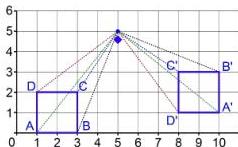
A square has vertices , , , and . It is rotated anticlockwise about the centre . What are the image coordinates , , , and ?
Method 1: Counting Squares Always draw a diagram. You can determine the position of by looking at the displacement from the centre . Since is squares down and squares left from the centre, a anticlockwise rotation means will be squares down and squares right from the centre. This places at . Repeating this logic for the other vertices gives , , and .
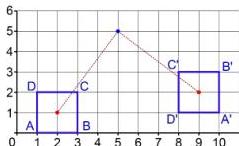
Method 2: Using the Centre of the Shape For symmetrical shapes like squares or circles, you can rotate the centre of the shape itself and then reconstruct the shape around that new point.
Worked Example: Reflection
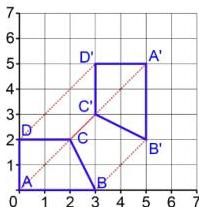
A trapezium with vertices , , , and is reflected in the line . To find the images , , , and , draw the mirror line and the object. For each vertex, draw a line at right angles to the mirror line and extend it the same distance on the other side. This results in , , , and .
Worked Example: Translation
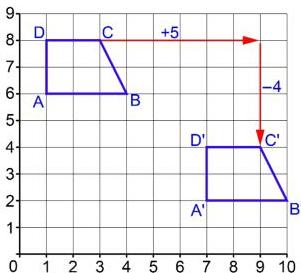
A trapezium with vertices , , , and is moved squares right and squares down. We can express this as the translation vector . Applying this shift to each vertex gives , , , and .
Worked Example: Enlargement
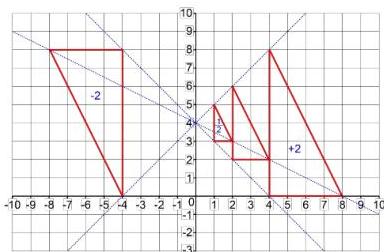
Consider a triangle with vertices , , and and centre of enlargement .
- Scale factor 2: Join to each vertex and double the distance. For , the vector . The image is found via , so is .
- Scale factor : The distance from is halved, keeping the image on the same side of .
- Scale factor -2: The distance is doubled, but the image is projected through to the opposite side. This results in an inverted triangle.
Combined Transformations and Invariance
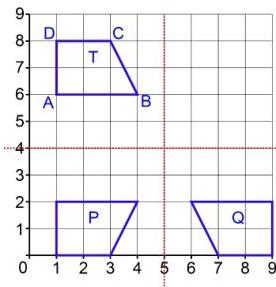
Example 1: Trapezium (vertices as in the translation example) is reflected in to form , then is reflected in to form . By inspection, the single transformation mapping to is a rotation of about the centre . The point is the only invariant point.
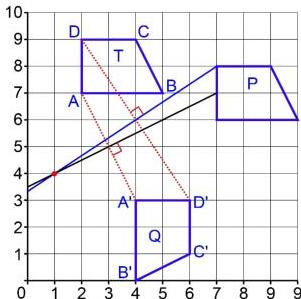
Example 2: Trapezium with vertices , , , and is translated by to form , and is then rotated clockwise about to form . To find the single transformation from to , we observe it is a clockwise rotation. The centre of this rotation is found by constructing the perpendicular bisectors of the lines connecting to and to . The intersection is , which is the invariant point.
Key takeaways
- Rotation, reflection, and translation result in congruent images, whereas enlargement results in similar images.
- A translation vector represents a shift of units horizontally and units vertically.
- The positive direction for rotation is anticlockwise; negative enlargement scale factors invert the object and place the image on the opposite side of the centre.
- Invariant points are locations that remain fixed under a transformation, such as the mirror line in a reflection or the centre in a rotation.
When performing rotations of on coordinate axes, you can use the 'step' method: if a vertex is units across and units up from the centre, its image after a anticlockwise rotation will be units left and units up from the centre.
A common mistake is incorrectly identifying the direction of rotation. Remember that 'clockwise' is negative and 'anticlockwise' is positive. Also, ensure you apply negative scale factors by drawing lines through the centre of enlargement to the opposite side.
A rotation of about a point is mathematically equivalent to an enlargement with a scale factor of centred at . This connection explains why negative scale factors 'flip' the orientation of a shape.
Frequently asked questions
How can I find the centre of rotation for a combined transformation?
Identify two pairs of corresponding points between the original object and the final image. Construct the perpendicular bisectors for the segments connecting these pairs. The point where the perpendicular bisectors intersect is the centre of rotation.
Is it possible for an enlargement to produce a congruent image?
Yes. If the scale factor is , the image is identical to the object. If the scale factor is , the image is the same size but rotated about the centre, making it both similar and congruent.
What is 'opposite congruence' in reflections?
Opposite congruence means the object and image are the same size and shape, but their orientation is reversed. You cannot simply slide or rotate the object onto the image; you would have to flip it over for them to coincide.
Does the order of transformations always matter?
In most cases, yes. Applying a translation then a rotation will usually result in a different final position than applying the rotation first then the translation. Always follow the sequence specified in the problem.