Vector Arithmetic and Geometric Proofs for the ESAT
Updated July 2026
Vectors are essential mathematical tools representing magnitude and direction. This guide for the ESAT Mathematics 1 section explains how to perform vector addition, subtraction, and scalar multiplication using both column and diagrammatic representations. It also demonstrates how to apply these operations to construct rigorous geometric proofs.
A vector describes the movement from one point to another, defined by both direction and size. Two vectors are parallel if one can be expressed as a scalar multiple of the other, such that for a constant .
A vector is a method for describing the displacement required to move from one point to another. Unlike scalars, vectors describe both a specific size and a specific direction. In printed text, vectors are usually denoted by bold letters, such as . In handwriting, vectors are indicated by underlining the letter, for example , because underlining is the standard printing proof symbol for bold text. Vectors are typically represented either as column vectors or diagrammatically using line segments.
Operations with Column Vectors
Column vectors allow for precise algebraic manipulation. To add or subtract column vectors, you simply perform the operation across the corresponding rows of the vectors.
Multiplying by a Scalar
A scalar is a physical quantity that possesses magnitude only and no direction. For example, velocity is a vector because it has a direction, whereas speed is a scalar. When a column vector is multiplied by a scalar, every component within the vector is multiplied by that value.
If then and
Parallel Vectors
Identifying parallel vectors is a common requirement in geometric problems. If two vectors and are parallel, then where is a constant scalar. This means one vector is simply a scaled version of the other, pointing in either the same or the exact opposite direction.
Diagrammatic Representation
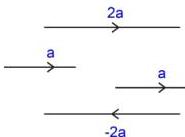
When a vector is shown diagrammatically by a line segment going from point to point , any other line segment that is parallel to , has the same length, and points in the same direction also represents the vector .
If a line segment is parallel to and points in the same direction but is twice as long, it represents the vector . If it is parallel but points in the opposite direction and is twice as long, it represents .
Triangular Addition and Subtraction
Vectors can be combined geometrically using the triangle or parallelogram rules. Consider a parallelogram where and .
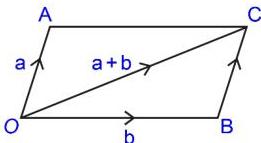
The vector represents the journey from to . An alternative route is to travel from to (vector ) and then from to . Since is parallel to , equal in length, and in the same direction, . Therefore, the total journey is:
Similarly, we can find vectors between other points:
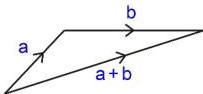
To add vectors and , you can either use the parallelogram construction or draw a triangle where the start of is placed at the end of . The resultant vector is the line joining the start of the first vector to the end of the second.
Worked Examples: Vector Calculations
Example 1: Column Vector Arithmetic
Given , , and , find .
Example 2: Scalar Multiples
Using the same vectors, find .
First, calculate the individual multiples:
Then subtract them:
Example 3: Identifying Parallel Vectors
If and , which of the following are parallel to ?
First, find :
Now compare: , so this is parallel. , so this is parallel. is not a multiple of , so it is not parallel.
Worked Examples: Diagrammatic Representation
Example 4: Labelling Vectors
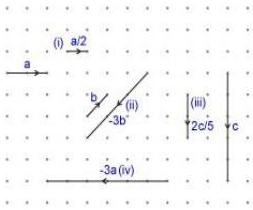
Label the lines in the following diagram using , , and .
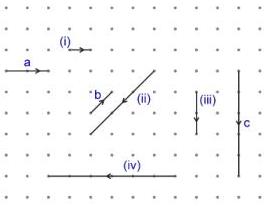
- Line (i) is parallel to and in the same direction but half the length, so it is .
- Line (ii) is parallel to in the opposite direction and 3 times as long, so it is .
- Line (iii) is parallel to and in the same direction but of the length, so it is .
- Line (iv) is parallel to in the opposite direction and 3 times as long, so it is .
Example 5: Constructing Resultants
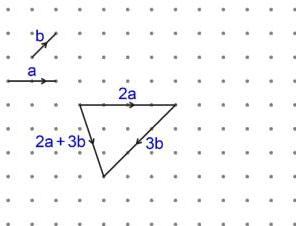
Draw a vector equal to based on the following diagram.
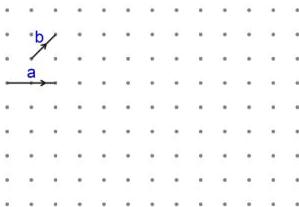
Draw the vector (twice the length of , same direction). Then draw starting from the end of . The resulting path represents the vector sum.
Geometric Proofs Using Vectors
Vectors are powerful tools for proving geometric theorems. Consider the following problem: in triangle , is the midpoint of and is the midpoint of . Prove that is parallel to and half its length.
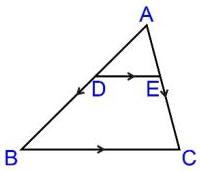
Let and .
-
Express in terms of and :
-
Express and as fractions of the full sides: and
-
Express in terms of the known vectors:
-
Conclusion: Since , the vector is a scalar multiple of . Therefore, must be parallel to and exactly half its length.
Key takeaways
- A vector represents displacement with both magnitude and direction, whereas a scalar has magnitude only.
- Column vectors are added, subtracted, or multiplied by scalars by applying the operation to each individual row.
- Vectors are parallel if and only if one vector is a scalar multiple of the other ().
- Vector subtraction geometrically represents the vector from the tip of to the tip of .
- Geometric properties like midpoints and parallel lines can be proven by expressing segments as vector sums and comparing the results.
When solving geometric proofs, always start by defining two non-parallel vectors as your 'base' (like and for two sides of a triangle). Express all other lines as combinations of these two vectors to make comparisons easy.
Be extremely careful with the direction of vectors when subtracting. The vector is the journey from to , which is equal to . Reversing the direction of a vector always requires a sign change.
The concept of parallel vectors is a specific case of linear dependence. In two dimensions, if any vector can be written as , it lies on the same line as . If it cannot, the two vectors can be used as a basis to reach any point in the 2D plane.
Frequently asked questions
How do I represent a vector when writing by hand for the ESAT?
Since you cannot easily write in bold, you should underline the letter, such as or , to indicate it is a vector.
Does the order of vector addition matter?
No, vector addition is commutative. For example, results in the same vector as , as demonstrated by the parallelogram rule.
What is the difference between a vector and a scalar in practical terms?
A scalar represents a quantity like mass or speed. A vector represents a quantity like displacement or velocity, which requires a specified direction (e.g., 5 metres North).
How can I tell if two column vectors point in opposite directions?
If the scalar constant in the relationship is negative, the vectors are parallel but point in opposite directions.