Coordinate Geometry of the Circle for the ESAT
Updated July 2026
This lesson covers the coordinate geometry of circles, focusing on deriving and using circle equations in both standard and expanded forms. You will learn how to identify centres and radii, determine if an equation represents a valid circle, and solve problems involving tangents and shortest distances.
A circle is the locus of points at a constant distance from a fixed centre , described by the equation .
The Fundamental Equation of a Circle
Consider a circle of radius 1 on the plane with its centre at the origin . Every point sitting on this circle is exactly a distance of 1 from the origin. By applying Pythagoras' theorem to the coordinates of any point on this perimeter, we can establish the relationship between and . This gives us the equation for a unit circle: .
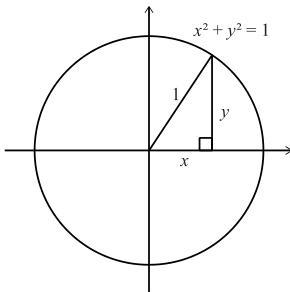
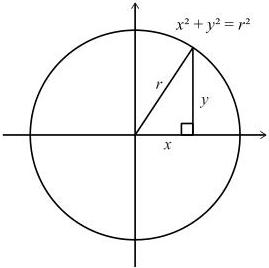
Points that satisfy the equation lie on the circle. Points satisfying the inequality lie inside the circle, while those satisfying lie outside the circle. If we increase the radius to , the distance from the origin to any point on the circle must be . Again, using Pythagoras' theorem, the equation becomes .
Shifting the Centre of the Circle
To find the equation of a circle with radius centred at any point , we can use two different perspectives: geometric derivation or graph transformations.
- Using Pythagoras' theorem: Any point on the circle is a distance from . The horizontal distance between the points is and the vertical distance is . Squaring these and summing them gives the squared radius:
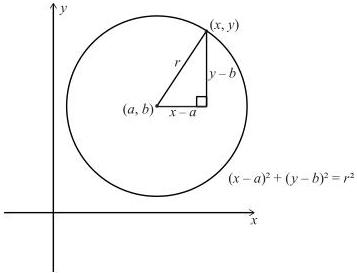
- Using graph shifting: Starting with the circle centred at the origin, we can shift it horizontally by units and vertically by units. Using standard transformation rules, we replace with and with , resulting in the same general form: .
You must be able to quickly identify the centre and radius from this form. For example, in , the centre is and the radius is . In , the centre is and the radius is . Always remember that the value on the right hand side is , not .
Expanded Form and Completing the Square
Circles are often presented in the expanded form . To find the centre and radius from this form, we use the method of completing the square for both the and terms.
Example 1
Find the centre and radius of .
First, group the terms:
Complete the square for and :
Rearrange into the standard form:
The centre is and the radius is .
Example 2: Non-existent Circles
Find the centre and radius of .
Completing the square gives:
Because the sum of squares on the left hand side cannot be negative, there are no real coordinates that satisfy this equation. Thus, it does not represent a circle. An equation of the form only represents a circle if, after completing the square, the constant on the right hand side is positive.
Example 3: Different Coefficients
Find the centre and radius of .
Divide the entire equation by 2 first:
Now complete the square:
The centre is and the radius is .
Note that for an equation to represent a circle, the coefficients of and must be identical. If they differ, such as in , or if the term is negative, such as in , the equation describes a different geometric shape.
Tangents to Circles
A line is tangent to a circle if it intersects the circle at exactly one point. To find when a line is tangent to a circle, substitute the line equation into the circle equation to create a quadratic in . Since a tangent has only one point of contact, this quadratic must have a single repeated root, meaning its discriminant must be zero.
Tangent Example
Find the values of for which is tangent to .
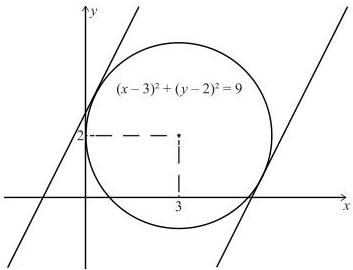
Substitute into the circle equation:
For tangency, set the discriminant :
Solving for gives two values, corresponding to the two possible tangent lines with gradient 2 shown in the diagram.
Closest Distance Between a Line and a Circle
To find the closest distance between a line and a circle, it is often helpful to translate the system so the circle is centred at the origin.
Distance Example
Find the closest distance between the line and the circle .
Translate the centre to by replacing with and with . The circle becomes (radius 3). The line becomes:
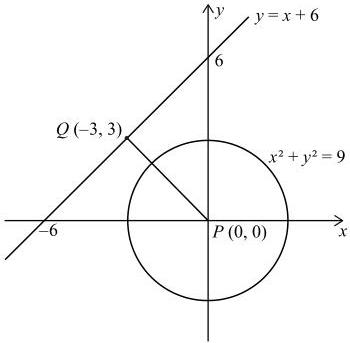
From the origin , the point on the line closest to the origin is . The distance from the origin to is . Since the circle has a radius of 3, the shortest distance from the line to the circle is the distance to the origin minus the radius: .
Key takeaways
- The standard equation of a circle is , where is the centre and is the radius.
- To convert an expanded equation to standard form, complete the square for both and terms.
- A quadratic equation only represents a circle if the coefficients of and are equal and the radius squared () is positive.
- A line is tangent to a circle if the discriminant of their combined simultaneous equation is zero, indicating exactly one point of intersection.
- The shortest distance from a line to a circle is the distance from the circle's centre to the line minus the radius.
Always check if the equation is given in a form where the and coefficients are 1 before completing the square. If the equation is , you must divide by 2 first to avoid errors in your radius calculation.
A very common mistake is forgetting that the constant on the right hand side of the standard equation is . If the equation ends in , the radius is 5, not 25. Similarly, if the centre is at , the equation uses and ; a plus sign indicates a negative coordinate.
The process of translating the circle and line to the origin to solve for distance is an application of invariance. Since distance is preserved under translation, we can choose the most convenient coordinate system to simplify the algebra without changing the geometric result.
Frequently asked questions
What happens if after completing the square?
If , the equation represents a single point rather than a circle, as only that specific point satisfies the equation.
How do I find the points where a line intersects a circle?
Substitute the equation of the line into the equation of the circle to form a quadratic equation. Solve this quadratic for , then substitute these values back into the line equation to find the corresponding coordinates.
Why must the coefficients of and be equal for a circle?
A circle represents points at a constant distance from a centre. If the coefficients were different, the 'stretching' in the and directions would be unequal, resulting in an ellipse rather than a circle.
Can I use the perpendicular distance formula for lines and circles?
Yes. The shortest distance from the centre to a line is given by . The distance to the circle's edge is then .