Coordinate Geometry of Straight Lines
Updated July 2026
This guide covers the fundamental properties of straight lines in the Cartesian plane for the ESAT. It explores various forms of line equations, the geometric interpretation of gradients, and the specific conditions required for lines to be parallel or perpendicular. Understanding these relationships is vital for solving complex coordinate geometry problems.
A straight line is defined by a constant gradient , representing the rate of change of relative to , which can be expressed through the equations or .
The Gradient of a Straight Line
The standard form of a straight line equation is , where represents the gradient and represents the -intercept. The gradient is a measure of the steepness of the line. If is positive, the line slopes upwards from bottom left to top right. If is negative, the line slopes downwards from top left to bottom right. The greater the absolute value of , the steeper the line.
We can define steepness more precisely as the vertical distance moved for every 1 unit moved horizontally. For instance, if the gradient is 2, moving 1 unit to the right requires moving 2 units up to stay on the line. If the gradient is -3, moving 1 unit to the right requires moving 3 units down.
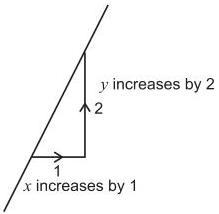
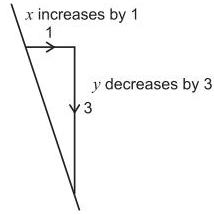
Another interpretation is that the gradient represents a rate of change. A gradient of 2 means changes twice as fast as . If increases by 5, must increase by 10. A negative gradient indicates that as increases, decreases.
Gradient as a Trigonometric Tangent
If the scales on the and axes are identical, the gradient is equal to the tangent of the angle that the line makes with the positive -axis, such that .
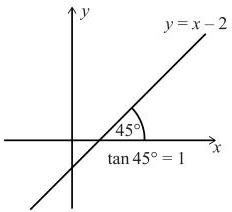
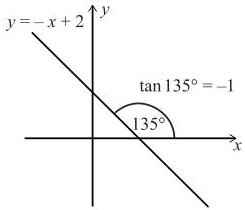
For a line at 45 degrees, the gradient is , as seen in the line . For an angle of 135 degrees, the gradient is , as seen in .
Special Cases: Horizontal and Vertical Lines
Horizontal lines have a gradient of zero and take the form , where is a constant. Vertical lines do not have a defined gradient, though they are sometimes described as having an infinite gradient. They take the form . Note specifically that the -axis has the equation , and the -axis has the equation .
Parallel and Perpendicular Lines
Two lines are parallel if and only if they have the same gradient. Thus, and are parallel if .
Two lines are perpendicular if and only if the product of their gradients is , expressed as . This relationship can be understood by looking at similar triangles formed by the lines.
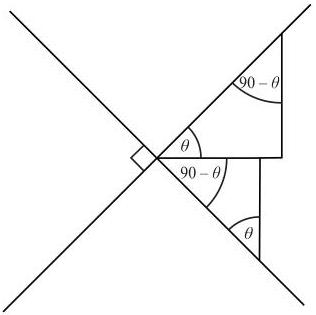
You can also justify this using trigonometry. Since the angles made with the -axis differ by 90 degrees for perpendicular lines, the gradients and satisfy .
Graph Transformations of y = x
The equations of straight lines can be viewed as transformations of the parent function . Consider how the following changes affect the graph:
- : A vertical stretch or reflection depending on the value of .
- : A vertical translation by .
- : A horizontal translation by .
- : A combination of stretching and both horizontal and vertical translations.
Finding the Equation of a Line
You can uniquely determine a line's equation given two pieces of information.
Case 1: A point and the gradient
Since the gradient between any point on the line and the given point must be , we have: Rearranging gives the point-slope form: . Alternatively, substitute the point into to solve for .
Examples:
- For and point : .
- For and point : .
- For and point : .
Case 2: Two distinct points and
You can set the gradient between a general point and equal to the gradient between the two known points:
Alternatively, calculate first, then use the method from Case 1. Ensure the order of subtraction is consistent for and to avoid sign errors.
Examples:
- Points and : . Since it passes through the origin, .
- Points and : . Using , .
- Points and : The -values are identical, so it is a horizontal line with gradient 0.
The General Form ax + by + c = 0
Lines are frequently written as . It is vital to note that the in this form is not the -intercept. To find the gradient and intercept, rearrange the equation into the form .
Key takeaways
- The gradient is the rate of change of with respect to and is also given by .
- Two lines are parallel if and perpendicular if .
- Horizontal lines have the equation , while vertical lines have the equation .
- The equation is highly efficient for constructing line equations from a point and a gradient.
- In the general form , the -intercept is not : you must rearrange to find it.
Always perform a quick sanity check on your gradient sign. If the line goes up from left to right, your calculated must be positive. If you are given two points, a quick sketch can help prevent sign errors during the subtraction process.
Be extremely careful with double negatives when using the formula . For example, if , the equation becomes , which is . This is one of the most common sources of errors in coordinate geometry questions.
The concept of gradient as a 'rate of change' bridges coordinate geometry and calculus. The gradient of a straight line is the derivative of the linear function, showing that the rate of change for a straight line is constant at every point.
Frequently asked questions
How do I calculate the gradient if I only have two points?
Use the formula . It is essential to subtract the coordinates in the same order for both the numerator and the denominator.
What is the gradient of a vertical line?
A vertical line does not have a defined numerical gradient because the change in is zero, and division by zero is undefined. Its equation is always in the form .
Does work for horizontal and vertical lines?
No, this specific rule excludes cases involving vertical lines because their gradient is undefined. However, a horizontal line () and a vertical line are geometrically perpendicular.
How can I quickly find the y-intercept of ?
The -intercept occurs where . Substitute into the equation to get , which solves to .