Solving Exponential and Logarithmic Equations for the ESAT
Updated July 2026
This lesson covers the techniques required to solve equations involving indices and logarithms, specifically focusng on the form . You will learn to use the laws of logarithms to manipulate expressions, handle quadratic forms using substitution, and provide exact solutions to complex algebraic problems.
A logarithm is the inverse of an index, defined by the relationship . Equations of the form are solved by taking logarithms of both sides and applying log laws to isolate the unknown power.
Foundations of Logarithms
Logarithms are closely related to indices: they are the inverse of indices. Instead of raising a base to a power to find a result, a logarithm tells you what power a base must be raised to in order to reach a specific number. Before the invention of calculators, logarithms were essential for simplifying complex calculations with large numbers.
Consider base 10 examples:
- because .
- because .
- because .
- because .
We can use other bases, such as base 2:
- because .
- because .
General definition: is equivalent to . There are three critical conditions for this relationship in standard mathematics:
- The base must be positive: and .
- You can only take the log of a positive number: .
- The result of a log can be any number: can be positive, negative, or zero.
Logarithms and Graphs
The relationship between exponentials and logarithms is clearly visible when graphed. Using base 2 as an example, we can see the exponential growth of .
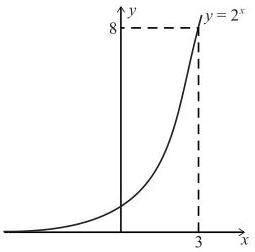
The function maps a value from the axis to the axis. If we start on the axis and trace back to find the corresponding value, we are performing the log operation: . By swapping the and axes, we produce the graph of .
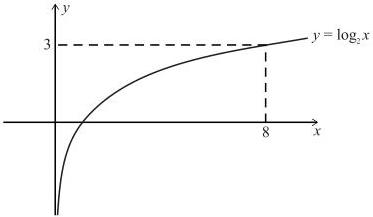
Note that the graph is only defined for . It crosses the axis at 1 because , which means .
Laws of Logarithms
You must be able to use the following laws to manipulate equations:
- The Product Law: . This is derived from . Note that by definition.
- The Quotient Law: . This is derived from .
- The Power Law: . This is derived from .
- Reciprocal Case: .
- Identity Case: because .
Solving
To solve equations where the variable is in the index, we take logs of both sides. Most log values are irrational, so we often leave answers in exact form rather than rounding to decimals.
Example: Solve
Approach 1 (Base 5): Take of both sides: . Since , we have . Using the power law: . Dividing by 2: .
Approach 2 (Base 3): Take of both sides: . Using the power law: (since ). Dividing: .
Equations Reducible to Linear or Quadratic Form
Some equations require algebraic manipulation before they can be solved. A common type is the hidden quadratic, such as .
Recognise that . If we let , the equation becomes . Factoring gives , so or . Substituting back: (so ) or (so ).
The Change of Base Formula
While questions requiring the change of base formula specifically will not be set, it is useful for your mathematical toolkit. It allows you to convert from base to base :
Derivation: Let , so . Take of both sides: . This gives , so . A special case occurs when , leading to: .
Key takeaways
- The definition is identical to and is only defined for .
- Use the Power Law to move variables out of the exponent.
- Exact solutions involve keeping logs in the final expression rather than calculating decimal approximations.
- Complex exponential equations can often be solved by identifying a hidden quadratic through substitution.
When solving hidden quadratics, always check if your solutions for the substituted variable (e.g., ) are positive. If you find , then has no real solution, and you must discard it.
A very common error is to assume . This is false. The correct law is . Always double check that you are applying laws to products or quotients, not sums.
Logarithms grow extremely slowly compared to linear or polynomial functions. This is the opposite of exponential growth, which is why logarithmic scales are used to represent data that spans many orders of magnitude, such as the Richter scale for earthquakes or pH in chemistry.
Frequently asked questions
Can the base of a logarithm be negative?
No. In the context of the ESAT and standard school mathematics, we only use a positive base where . Using a negative base would lead to undefined values for many inputs.
What should I do if an equation has different bases, like ?
Take the logarithm of both sides using a common base, such as . This allows you to use the power law to bring the and down, resulting in a linear equation: .
Why is the logarithm of 0 undefined?
If we look at the graph of , the curve has a vertical asymptote at . In terms of indices, there is no power such that , as long as is positive.