Laws of Logarithms for ESAT Mathematics
Updated July 2026
This page explains the fundamental laws of logarithms required for the ESAT. You will learn the relationship between indices and logarithms, how to manipulate logarithmic expressions using addition and subtraction rules, and the graphical properties of logarithmic functions, which are the inverse of exponential growth.
A logarithm is the inverse of an index, defined by the relationship , where the logarithm represents the power to which a base must be raised to produce the value .
The Definition of a Logarithm
Logarithms are closely related to indices. They function as the inverse of indices: rather than raising a number to a power to find a result, a logarithm identifies what power a base number must be raised to in order to reach a specific value. This can be expressed by the following general relationship:
is equivalent to
To understand this concept, consider some examples using base 10. The expression determines what power 10 must be raised to for a given number:
- because
- because
- because
- because
Logarithms can use other bases as well. For base 2, we find:
- because
- because
Important Constraints
There are three critical rules regarding the values used in logarithms that you must remember for the ESAT:
- The base number must be positive () and cannot be equal to 1 ().
- We can only take the logarithm of positive numbers, meaning . The log function is not defined for zero or negative numbers.
- The result of a logarithm, , can be any number, including negative values or zero.
Exercises in Definition
You should be able to evaluate simple logarithmic expressions by inspection:
Graphical Representation of Logarithms
We can understand logarithms graphically by comparing them to exponential functions. Consider . This function maps values from the -axis to the -axis.
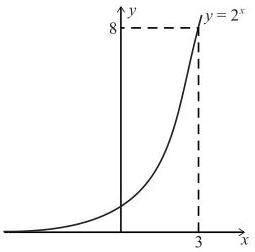
If we start on the -axis (for example at 8) and trace back to the corresponding value on the -axis (which is 3), we are performing a logarithmic operation: . The graph of is simply the graph of with the and axes swapped.
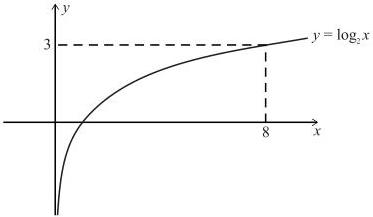
Note that the graph is only defined for . It crosses the -axis at 1 because , which means .
The Laws of Logarithms
You must be able to use the following rules to manipulate and simplify expressions. These laws are direct equivalents of index laws.
The Addition Law
This is the logarithmic equivalent of . We can derive it by noting that . This relies on the identity , which follows from the definition of a logarithm.
The Subtraction Law
Derivation: .
The Power Law
Derivation: .
Special Cases
- : This is a specific case of the power law where .
- : This is true because .
The Change of Base Formula
Although questions requiring this formula will not be set in the ESAT, it is a valuable tool for your mathematical toolkit. It allows you to convert a logarithm from one base to another:
For example, to find in terms of , we set , which means . Taking of both sides gives , then . Thus, .
A useful extension of this occurs when , leading to .
Solving Exponential Equations
You can use logarithms to solve equations of the form . Often, you will be required to give an exact answer rather than a decimal approximation.
Example: Solve exactly.
Approach 1: Use base 5 Take of both sides: . Since and , we have . Using the power law: . Therefore, .
Approach 2: Use base 3 Take of both sides: . Using the power law: . Since , we have . Therefore, .
Key takeaways
- A logarithm asks the question: What power must the base be raised to in order to get ?
- Logarithms are only defined for positive inputs () and positive bases () where the base is not 1.
- The three main laws are , , and .
- The graph of is the reflection of in the line , meaning they are inverse functions.
- To solve , take logarithms of both sides and use the power law to isolate .
When solving equations like , look for quadratic patterns. By letting , you can rewrite the equation as , solve for , and then use logarithms to find .
Always check your final answers to logarithmic equations against the initial constraints. If a solution for would result in taking the logarithm of a negative number or zero in the original equation, that solution must be discarded.
The relationship and demonstrates that exponential and logarithmic functions are identities of one another when composed. This symmetry is the reason why their graphs are reflections across .
Frequently asked questions
Why can we not take the logarithm of a negative number?
Since and the base is defined as positive, any positive number raised to any power will always result in a positive value for . Therefore, there is no real power that can produce a negative .
Is the same as ?
No. This is a common error. The law states that the sum of two logarithms is the logarithm of their product: . There is no simple log law for the logarithm of a sum, .
What happens if the base of a logarithm is not written?
In many contexts, if a base is not specified (e.g., ), it is assumed to be base 10. However, in advanced mathematics, it may also refer to the natural logarithm (base ). In the ESAT, the base will usually be clearly indicated.