Intersections and Transformations of Graphs
Updated July 2026
Understand how to find coordinate axis intercepts and apply function transformations. This guide covers vertical and horizontal translations, stretches, and squashes, alongside techniques for determining the number of real roots in a polynomial. Mastering these transformations is essential for identifying key features of complex functions in the ESAT.
A graph transformation alters the algebraic form of to shift, stretch, or reflect the curve, which directly determines the position of roots and axis intersections.
Intersecting the Coordinate Axes
To determine where the graph of a function intersects the coordinate axes, we use specific algebraic substitutions. For the axis, the coordinate must be zero. By calculating , we find the coordinate of the intersection. For the axis, the coordinate must be zero. We solve the equation to find the coordinates. These solutions are known as the real roots of the function. A general polynomial of degree can possess a maximum of real roots, though it may have fewer.
The Notation
Before exploring transformations, it is vital to understand the notation. The expression indicates that for any value of , the corresponding value on the curve is calculated using the function . For example, if , then at , . At , . This relationship allows us to deduce how changes to the algebra of the function affect the physical graph.
Vertical Stretches:
When we multiply the entire function by a constant , every value is multiplied by that constant. If we compare with , each value on the second graph is four times as large as on the first. This results in a vertical stretch away from the axis by a factor of 4.
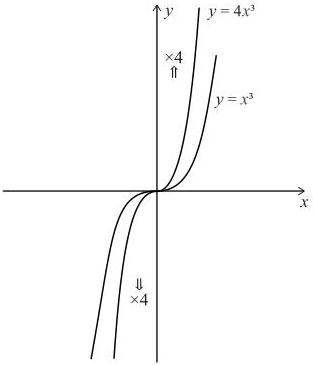
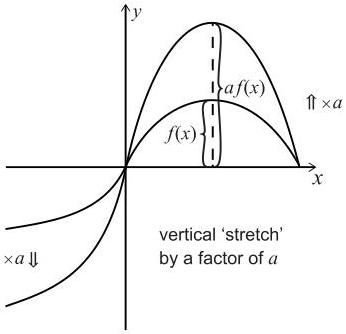
In general, stretches the graph vertically by factor . If , the graph becomes less tall (a vertical squash). If is negative, the graph is reflected in the axis in addition to the stretch.
Vertical Translations:
Adding a constant to the function result moves the entire graph vertically. For , every point on the graph is shifted up by 3 units. Formally, we describe this as a translation by the vector . If is negative, the graph moves downwards parallel to the axis.
Note that in trigonometry, we often write instead of to avoid confusion with .
Horizontal Translations:
This transformation is frequently misunderstood. While it may seem intuitive that adding to should shift the graph to the right, it actually shifts the graph to the left. To find from a given , we replace every instance of in the expression with .
Example: Given , then .
Example: Given , then . It is a common error to forget to multiply the entire replacement by the coefficient of .
To understand why shifts the graph of to the left, consider the values. On , the value above is . On , the value above is . The value that used to occur at now occurs earlier at . Thus, the graph has moved 3 units to the left.
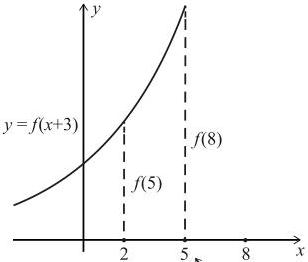
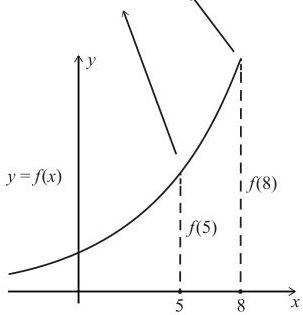
In general, is a translation of by the vector .
Horizontal Stretches:
Multiplying the input by a factor squashes the graph towards the axis by a factor of . To find , we replace every with . For example, if , then .
Consider . If we look at , the value above is . In the original graph, the value for was . Now, that same value occurs at . This causes the graph to squash horizontally.
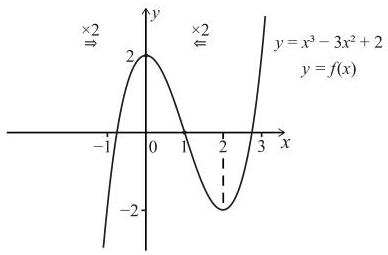
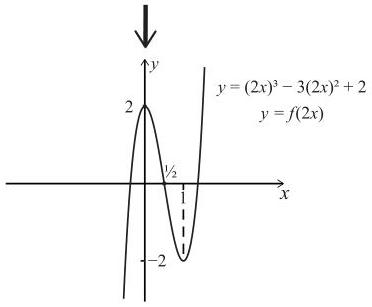
In general, is a horizontal stretch by a factor of towards the axis. If , the graph is also reflected in the axis.
Combining Transformations
The order in which transformations are applied is critical. Consider . There are two ways to interpret this starting from :
-
Translate by to get , then apply a horizontal squash by factor 2 to get . This is correct.
-
Squash by factor 2 to get , then translate by . This results in . This is also correct.
If you squash by 2 first and then translate by , you would get , which is incorrect.
The Notation
Composite functions involve taking the output of one function as the input for another. To find , replace every in with the entire expression for . For example, if and , then . Generally, is not equal to .
Linear and Quadratic Graphs
We can view standard equations through the lens of transformations:
-
Linear: can be seen as stretched vertically by factor then translated by .
-
Quadratic: is the graph stretched vertically by , translated horizontally by , and translated vertically by . The vertex of this parabola is located at .
Key takeaways
- is a horizontal translation by units to the left (negative direction) if is positive.
- is a vertical stretch of factor , while is a horizontal stretch of factor .
- To find intersections with the axis, calculate ; to find roots ( intercepts), solve .
- A polynomial of degree can have at most real roots.
- When combining transformations like , the order is vital: translating before squashing uses the value , but squashing before translating requires adjusting the shift to .
When finding the roots of transformed functions in the ESAT, it is often easier to find the roots of the parent function first and then apply the horizontal transformations to those specific values.
Be careful with inverse notation. The expression refers to the inverse function (arccos), not . Reciprocals are written using specific terms like .
The relationship between the degree of a polynomial and its roots is a fundamental theorem of algebra. While a degree polynomial has exactly complex roots, the ESAT focuses on real roots, which correspond to the physical intersections seen on a coordinate grid.
Frequently asked questions
Why does move the graph to the left instead of the right?
This happens because a specific value now requires a smaller input to achieve the same total value inside the function. If , then in , we only need to reach that same state. Consequently, all points occur 2 units earlier on the axis.
What is the maximum number of times a cubic graph can cross the axis?
A cubic is a polynomial of degree 3, so it can have at most 3 real roots, meaning it can cross the axis a maximum of 3 times.
Does the transformation change the roots of the function?
No, a vertical stretch does not change the intercepts. If , then will also be 0, provided is not zero. However, it will change the intercept unless the intercept is at the origin.
Is the same as ?
No. is a composite function where the expression for is substituted into . is the product of the two function outputs. These are fundamentally different operations.