Function Transformations and Geometric Solutions
Updated July 2026
Mastering function transformations is vital for the ESAT as it allows you to visualise complex algebraic equations. This topic explores how translations and stretches affect function behavior and provides a geometric framework for solving simultaneous equations. A key fact is that adding a constant within the function argument shifts the graph in the negative direction.
Geometric transformations provide a visual way to manipulate functions: and affect the horizontal position and scale, while and affect the vertical, with graph intersections representing solutions to simultaneous equations.
Understanding Function Notation
To master transformations, we must first be clear on what the notation represents. This notation indicates that for any given value on the horizontal axis (the value), the corresponding vertical value (the value) on the curve is calculated using the rule defined by . For example, if we have the function , the value located above is , and the value above is . We use this understanding of inputs and outputs to deduce how modifications to the algebra affect the geometry of the graph.
Vertical Stretches:
Consider the specific case where we compare with . In this transformation, every value in the new function is exactly four times as large as the original value for the same coordinate. Geometrically, this is a vertical stretch of the graph by a factor of 4. The stretch occurs away from the axis: points move upwards if is positive and downwards if is negative.
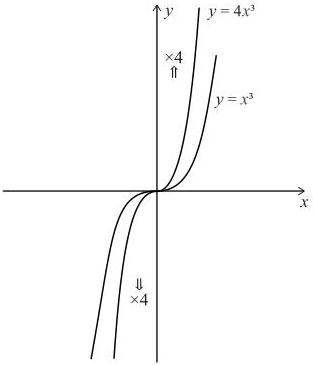
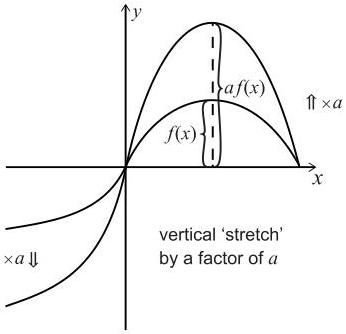
If the constant is between 0 and 1, such as , the graph becomes half its original height. If is negative, the graph is stretched by the magnitude of and then reflected in the axis due to the change in sign.
Vertical Translations:
When we compare with , we find that every value increases by 3 units. This translates the entire graph upwards parallel to the axis. Formally, we describe this as a translation by the vector . In general, the transformation results in a translation by .
In trigonometry, notation requires care. Writing can be ambiguous, as it might be confused with . Mathematicians typically write to clarify that the constant is added to the result of the cosine function, not to the angle itself. Similarly, refers to the inverse function (arccos) and not , which is written as .
Horizontal Translations:
This transformation is often counter-intuitive. Adding a positive constant to the input actually shifts the graph to the left, in the negative direction. To understand this, let and compare it with . On the original graph, the value at is . On the new graph , the value above is . Thus, the value that used to be at has moved to . This requires shifting the graph 3 units to the left.
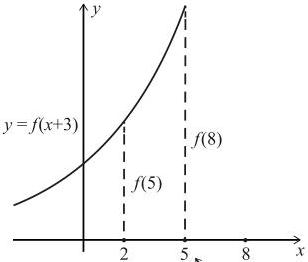
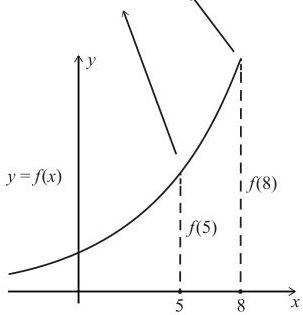
In general, is a translation of by the vector . If is negative, such as , the graph translates 4 units to the right.
To find the expression for , replace every in the original formula with .
- If , then .
- If , then . Note that the coefficient 2 must multiply the entire bracketed replacement.
Horizontal Squash:
Multiplying the input by a factor squashes the graph towards the axis by a factor of . Consider and . At , the function takes the value of , which is . This value originally occurred at , but now occurs at , effectively compressing the graph horizontally.
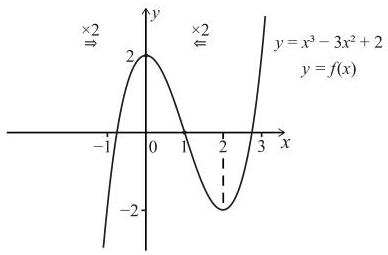
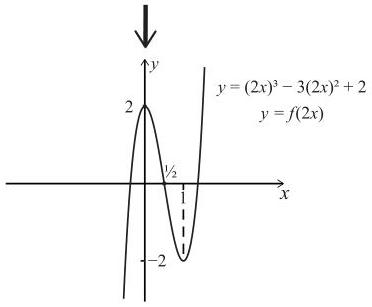
If , the graph is stretched horizontally away from the axis. If is negative, the graph is reflected in the axis in addition to the horizontal scaling.
Summary of Transformations
| Notation | Transformation Type |
|---|---|
| Vertical stretch factor away from axis. Reflection in axis if . | |
| Translation by vector . | |
| Translation by vector . | |
| Horizontal squash factor towards axis. Reflection in axis if . |
Combining Transformations
The order of operations is critical when multiple transformations are applied. Consider . We could reach this via two different sequences:
- Translate by first: , then squash by factor 2: . This is correct.
- Squash by factor 2 first: , then translate by : . This is incorrect. Alternatively, if you squash by 2 first, you would need to translate by only to reach .
Notation for Composite Functions:
The notation means that the function is the input for function . If and , we find by replacing every in with : . Note that is generally not equal to .
Linear and Quadratic Graphs as Transformations
Any linear graph can be viewed as a series of transformations of . One sequence is a vertical stretch of by factor , followed by a translation of to the left: .
Similarly, a quadratic in the form is a transformation of :
- Vertical stretch factor : .
- Translation by horizontally: .
- Translation by vertically: .
Geometric Interpretation of Equations
The solutions to the equation correspond to the coordinates of the points where the graphs of and intersect. If the equations are solved simultaneously, the resulting pairs represent the geometric locations where the two curves meet. If the graphs do not intersect, there are no real solutions to the simultaneous equations.
Key takeaways
- A horizontal translation shifts the graph by units in the negative direction.
- A horizontal squash compresses the graph towards the axis by factor , which is the inverse of the vertical stretch factor.
- The order of transformations matters, especially for horizontal changes: a squash applied after a translation affects the translation distance.
- Graph intersections provide a visual solution to simultaneous equations where the values represent the real roots.
When combining horizontal transformations, always check your work by substituting a specific value, such as the intercept, to ensure the final graph's position matches your algebraic expression.
A common mistake is applying as a single horizontal shift. Remember that terms outside the function brackets affect the vertical position, while only terms inside affect the horizontal position.
The relationship between algebraic solutions and graph intersections is the foundation of coordinate geometry. For example, the number of real roots of a polynomial is visually represented by how many times its graph crosses the axis, which is the intersection with the line .
Frequently asked questions
Why does move the graph to the left if is positive?
To obtain the same output value , the new input must satisfy , meaning . Every point is therefore shifted units in the negative direction.
How do I correctly apply a horizontal squash and translation together?
It is safest to factorise the input. For , write it as . This shows a squash by factor followed by a translation of to the left.
What is the difference between and geometrically?
is a vertical stretch that changes the coordinates, while is a horizontal squash that changes the coordinates.
Can every quadratic be sketched using transformations?
Yes, by completing the square to reach the form , you can identify the vertical stretch, horizontal translation, and vertical translation required to transform .