Graph Transformations and Composite Functions for the ESAT
Updated July 2026
This topic explores how algebraic modifications to functions, such as adding constants or multiplying by factors, result in geometric translations and stretches. Mastering these transformations is essential for sketching complex functions on the ESAT. A key fact is that adding a constant to the input variable shifts the graph horizontally in the opposite direction.
Transformations of alter the position, shape, or orientation of a curve by modifying either the output values (vertical changes) or the input values (horizontal changes). Function composition applies one function's output as the input for another, representing a sequence of operations.
Understanding the notation is the foundation for mastering graph transformations. This notation states that the value above any given value is calculated using the rule . For example, if , the value for is . By applying modifications to this rule, we can deduce how the resulting graph relates to the original function.
Vertical Stretches:
Consider the transformation . If we take and , we compare with . Every value in the new function is exactly four times as large as the corresponding value in the original. Geometrically, this is a vertical stretch away from the axis by a factor of 4. If is positive, the point moves further up: if is negative, the point moves further down.
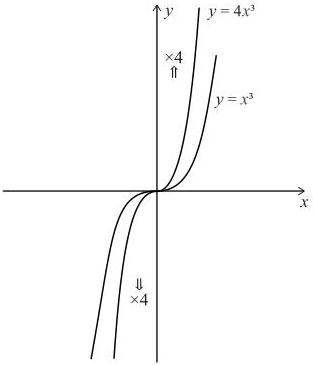
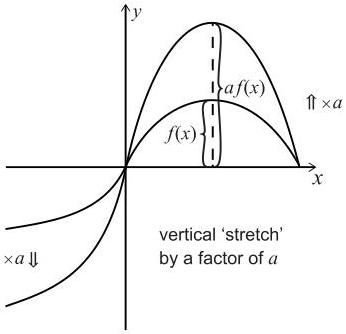
In general, the graph of is a vertical stretch of parallel to the axis by scale factor . If , the graph becomes less tall (it squashes towards the axis). If is negative, the graph is reflected in the axis and stretched by a factor of .
Vertical Translations:
If we take and , we compare with . In this case, every value increases by 3 units. The entire graph shifts upwards parallel to the axis. Formally, we describe this as a translation by the vector .
In general, represents a translation of by the vector . If is negative, the graph shifts downwards. In trigonometry, note that is often written instead of to avoid ambiguity with .
Horizontal Translations:
This transformation is often misunderstood. Students frequently assume that adding to shifts the graph to the right, but the opposite is true: shifts the graph to the left when is positive. To find the expression for , every in the original expression must be replaced by .
Example 1: Given , find . We replace every with : .
Example 2: Given , find . We replace with : . Note that the factor of 2 multiplies the entire replacement term.
To understand the shift, consider . At on , the value is . On the graph , we get this same value of 32 when because . Thus, the point that was at has moved to , which is 3 units to the left.
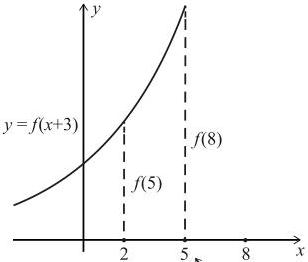
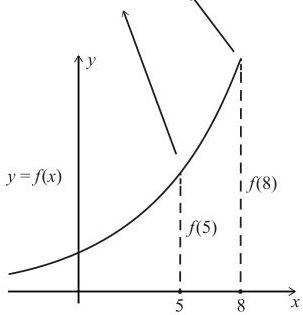
In general, is a translation of by the vector .
Horizontal Stretches:
To find the expression for , we replace every with . For example, if , then . If , then .
Geometrically, squashes the graph towards the axis by a factor of . Consider . On , the value occurs at . On , the value at is , which is the value that originally occurred at . The graph has been squashed horizontally by a factor of 2.
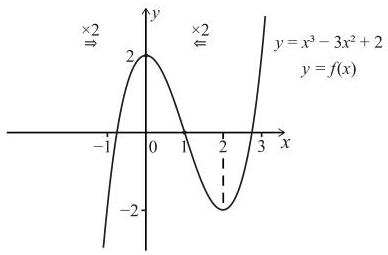
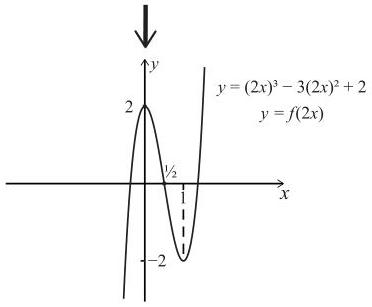
In general, is a horizontal stretch parallel to the axis by a scale factor of . If , the graph is also reflected in the axis.
Composing Transformations
When multiple transformations are applied, the order of operations is critical. Consider transforming into . There are two ways to achieve this correctly:
-
Translate by first, then squash horizontally by factor 2: .
-
Squash horizontally by factor 2 first, then translate by : .
Note that squashing by factor 2 first and then translating by would result in , which is incorrect.
Composite Function Notation:
The notation means that the output of becomes the input for .
Example: If and , then to find , we replace every in with : .
It is generally not true that . For instance, if and , then while .
Key takeaways
- Transformations outside the function brackets, like and , affect the coordinates vertically as expected.
- Transformations inside the function brackets, like and , affect the coordinates horizontally and often behave counter-intuitively.
- A translation of by results in the new function .
- The order of transformations matters: when combining horizontal shifts and stretches, it is often safest to factorise the inner expression, such as , to identify the correct translation.
When dealing with combined horizontal transformations like , always substitute the value to see where the original intercept has moved, or find the new value that makes the bracket zero to identify the shift of the original origin point.
The most common error is applying horizontal translations in the wrong direction. Remember that is a shift of 3 units in the negative direction (left).
Graph transformations are essentially a way of re-labelling the coordinate axes. can be viewed as the original graph but with the origin of the coordinate system moved 2 units to the left.
Frequently asked questions
Why does move the graph to the left if is positive?
Because we are adding to the input before the function calculates the value, we reach the same 'output' earlier on the axis. If you want the same value that used to be at , and you are using , you only need to get . Thus, every point moves 2 units to the left.
What is the difference between and ?
is a vertical stretch by factor (the values change). is a horizontal squash by factor , which is a horizontal stretch by factor (the values change).
How do I handle a negative factor in ?
A negative factor inside the function, , results in a reflection in the axis. Similarly, results in a reflection in the axis.