Transformations of Functions for the ESAT
Updated July 2026
This lesson covers how to transform the graphs of functions through stretching and translation. Understanding the relationship between algebraic changes to and their geometric effects is vital for ESAT success, particularly when dealing with horizontal shifts and combined transformations.
Transformations alter the graph of by modifying inputs or outputs: and affect the vertical position and scale, while and affect the horizontal position and scale.
Understanding the Notation
Before exploring transformations, it is vital to be clear on what represents. This notation tells us that the value directly above any given value is calculated using the rule . For example, if we have , then for , we calculate . Similarly, for , we find . We use this principle to deduce how transformed graphs relate to the original.
Vertical Stretches:
Let us compare with . In this case, every value for the second function is four times as large as the value for the first function at the same coordinate. Geometrically, this represents a vertical stretch by a factor of 4. The stretching occurs away from the axis: points with positive values move up, and points with negative values move down.
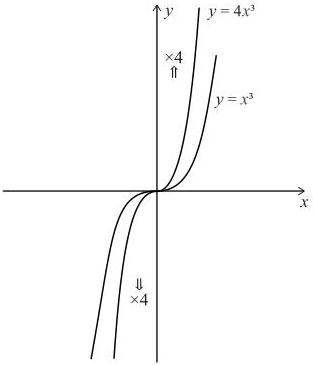
In general, is a vertical stretch parallel to the axis by a scale factor of . Here is the general effect:
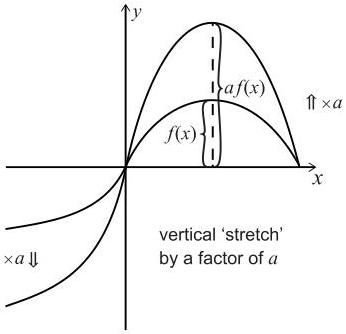
If , the graph becomes less tall (it is effectively compressed vertically). If is negative, the graph is stretched by a factor of and reflected in the axis.
Vertical Translations:
Consider and . In this transformation, every value increases by 3 units. This shifts the entire graph upwards parallel to the axis. Formally, we say the graph of is translated by the vector .
Note that in trigonometry, we often write instead of to avoid ambiguity, as might be confused with . It is also important to remember that refers to the inverse function (sometimes called ) and not , which is actually .
Horizontal Translations:
This transformation is frequently misunderstood. Intuition might suggest that adding to should shift the graph to the right, but the opposite is true: for positive , the graph shifts to the left. To understand why, we must look at how we calculate the expression and how the values align.
Working out the expression
To find , replace every in the original function with .
Example 1: Given , find . We replace with :
Example 2: Given , find . We replace with : Note that the factor of 2 multiplies the entire replacement for .
Why the shift is reversed
Consider . On the original graph, when , . On the graph of , the value above is calculated as . This means the value that used to be at has moved to . Consequently, the graph must shift 3 units to the left.
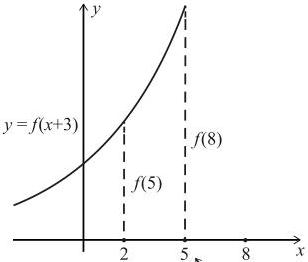
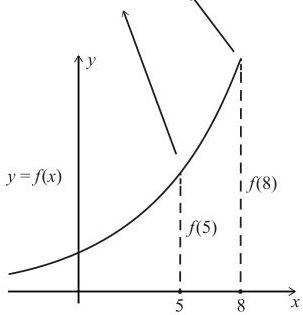
In general, is a translation by .
Horizontal Squashes:
To find the expression for , replace every in with . For example, if , then . Note that this is not .
Geometrically, squashes the graph towards the axis by a factor of . If , then the value found at in the original function will now be found at in , because .
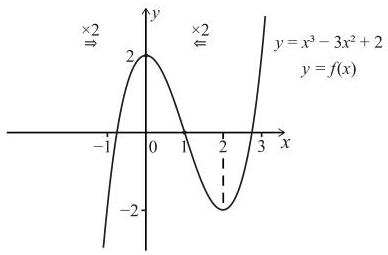
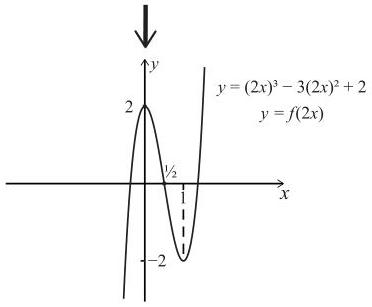
If , the graph is stretched horizontally away from the axis. If , there is a reflection in the axis.
Summary Table of Transformations
| Transformation | Geometric Effect |
|---|---|
| Vertical stretch parallel to axis by factor . Reflection in axis if . | |
| Translation by . | |
| Translation by . | |
| Horizontal squash parallel to axis by factor . Reflection in axis if . |
Combining Transformations and Order
When combining transformations, the order in which you apply them matters significantly. Consider transforming into . There are two ways to achieve this correctly:
- Translate then Squash: Translate by to get , then squash horizontally by factor 2 to get .
- Squash then Translate: Squash horizontally by factor 2 to get , then translate by . This works because replacing with in gives .
Applying a squash by 2 followed by a translation of would result in , which is incorrect.
Composite Functions:
The notation means that is used as the input for function . If and , then . In general, is not equal to .
Applications to Lines and Quadratics
We can interpret as a sequence of transformations of . One way is to stretch by (to get ) and then translate by (to get ).
Similarly, is a transformation of . We can apply a vertical stretch by , then a horizontal translation by , and finally a vertical translation by .
Key takeaways
- Vertical transformations and affect the coordinates directly and logically.
- Horizontal transformations and affect the coordinates and are counter-intuitive: moves the graph left for positive .
- Order is critical when combining transformations: always check by substituting the transformation into the function algebraically.
- The composite function involves replacing every in with the entire expression for .
- Horizontal squashes have a scale factor of relative to the axis.
When faced with a complex transformation like , factorise the inside to . This makes it easier to see that you can squash by and then translate by .
The most common error is shifting the graph of to the right instead of the left. Always test a single point (like the vertex of a parabola or a peak of a trig curve) to verify the direction of your shift.
Thinking of transformations in terms of 'input replacement' helps unify these ideas with composite functions . A transformation is simply a specific case of composition where is a linear function.
Frequently asked questions
Why does move the graph to the left if is positive?
This happens because a specific value that used to occur at now occurs when equals that original value. This requires the new to be smaller by , thus shifting the point to the left.
Does it matter if I apply a vertical stretch before a vertical translation?
Yes. If you stretch by then add , you get . If you add then stretch by , you get . These are different functions.
How do I handle negative values of in ?
The negative sign causes a reflection in the axis, while the magnitude determine the horizontal squash factor. For example, is a squash by factor 2 followed by a reflection in the axis.