Integration and Areas for ESAT Mathematics 2
Updated July 2026
This guide covers the principles of integration required for the ESAT, including the power rule for rational exponents, the distinction between definite integrals and geometric areas, and the use of symmetry. It also explains the Fundamental Theorem of Calculus, the trapezium rule for approximation, and methods for solving basic differential equations.
Integration is the reverse process of differentiation, where the definite integral calculates the signed area between a curve and the -axis, summing regions above the axis and subtracting regions below it.
Definite Integration and the Area Between a Curve and an Axis
In the context of the ESAT, you must understand the distinction between a definite integral and the geometric area between a curve and an axis. While area is typically a positive value, a definite integral is a calculation that treats regions below the -axis as negative. Specifically, a definite integral sums all areas above the -axis and subtracts all areas below the -axis in a single operation.
This occurs because integration can be viewed as the sum of infinitely many thin rectangles. The contribution of each rectangle is its height, given by the -value, multiplied by its width, . When a curve is below the -axis, the -values are negative, leading to a negative contribution to the total integral.
Example 1
Calculate and interpret the result.
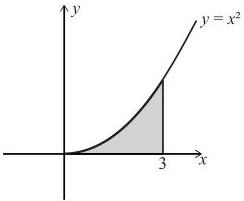
Example 2
Calculate and interpret the result.
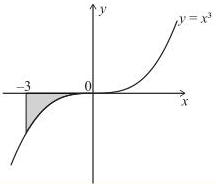
Example 3
Calculate and interpret the result.
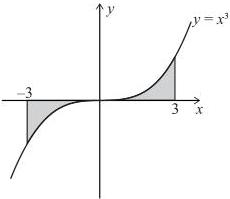
The result is zero because is an odd function: the negative area between and exactly cancels out the positive area between and .
Finding Total Area Between a Curve and the x-Axis
To find the total geometric area (where all parts are positive), you cannot simply compute the integral across the whole range if the curve crosses the -axis. Instead, you must:
- Identify where the curve crosses the -axis.
- Calculate the definite integral for each section separately.
- Take the absolute (positive) value of each result and add them together.
Worked Example
Find the area between the -axis, the lines and , and the curve .
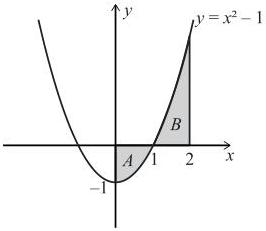
The curve crosses the -axis at . We split the calculation:
For the region from to :
For the region from to :
The total area is . Note that the single definite integral would only give .
Integrating with respect to y
While less common, you may encounter integrals with respect to , written as . These are calculated using the same rules as . For example:
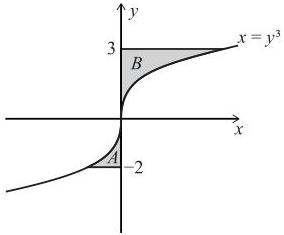
Using Symmetry to Simplify Integrals
Graphs with specific symmetries allow for faster integration:
- Symmetric about the y-axis (Even functions): If , then .
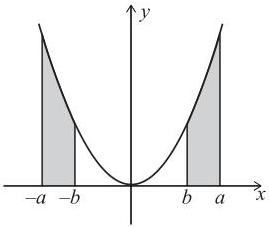
- Antisymmetric (Odd functions): If , then . This implies .
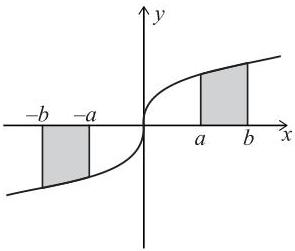
Even though trigonometric integration is not explicitly in the ESAT specification, you should be able to deduce that or based on these symmetry properties.
Rules for Integrating Powers of x
In the ESAT, you are expected to integrate sums of terms in powers of using the rule:
for
If an expression does not look like a simple power of , you must simplify it first. For example, to integrate , expand the brackets first: . Integration can be performed term by term.
Caution: You cannot integrate a fraction by integrating the numerator and denominator separately. You must simplify the expression into a sum of powers first, such as , which requires expanding and dividing each term by .
The Fundamental Theorem of Calculus
The theorem links differentiation and integration in two main ways:
-
Evaluation: , where . This justifies why swapping limits introduces a negative sign: .
-
Differentiation of an Integral: . This shows that differentiating an integral returns the original function.
You can also split integrals over contiguous ranges: . This holds even if is not between and , provided the function is defined across the entire relevant interval.
Approximating Areas with the Trapezium Rule
The Trapezium Rule estimates the area under a curve using trapezia of equal width . The width is calculated as .
The formula for a single trapezium is . For multiple strips, the heights (y-values) at each interval are used:
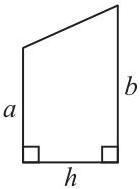
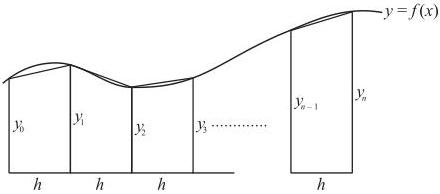
Overestimates and Underestimates
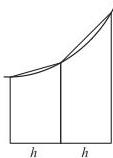
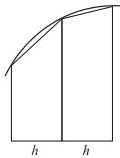
You can determine if an estimate is an overestimate or underestimate by looking at the curve's shape:
- If the curve bends away from the -axis (convex/concave up), the trapezium rule gives an overestimate.
- If the curve bends toward the -axis (concave/concave down), it gives an underestimate.
Solving Differential Equations of the Form dy/dx = f(x)
To solve , you must find the function that differentiates to by integrating both sides.
Method 1: Using the Constant of Integration
Find the general solution . If a boundary condition is given (e.g., when ), substitute these values to solve for .
Method 2: Definite Integration
Set up a definite integral with corresponding limits: This leads directly to the specific solution without needing to solve for separately.
Key takeaways
- The definite integral calculates signed area: regions below the x-axis are subtracted from regions above it.
- Always simplify algebraic expressions into a sum of terms before attempting to integrate.
- The trapezium rule uses equal-width strips and its accuracy (over or underestimate) depends on the concavity of the curve.
- The Fundamental Theorem of Calculus allows for splitting integrals and swapping limits by changing the sign.
- Boundary conditions in differential equations allow you to determine the specific value of the constant of integration .
When a question asks for the 'area' between a curve and an axis, always sketch the graph first to check for roots within your limits. If the curve crosses the axis, you must integrate the sections separately.
Do not distribute integration over multiplication or division. For example, the integral of a product is not the product of the integrals. Always expand brackets and simplify fractions into separate terms before integrating.
The Fundamental Theorem of Calculus bridges the gap between the algebraic process of finding anti-derivatives and the geometric process of finding areas. This explains why the rate of change of the area under a curve is exactly the height of the curve at that point.
Frequently asked questions
What happens if I try to integrate x raised to the power of negative one?
The rule for where you add one to the power and divide by the new power does not work for because it would involve division by zero. While you may know this integrates to , logarithmic integration is outside the scope of the ESAT specification.
How do I know if the trapezium rule is an overestimate if the curve is increasing?
The direction of the curve (increasing or decreasing) does not determine the overestimate. It is the curvature (concavity) that matters. If the curve is concave up, the trapezium sits above the curve, leading to an overestimate.
Can I use integration by parts or substitution in the ESAT?
No, the ESAT focuses on basic integration techniques. Any problem provided can be solved by simplifying the expression into a sum of powers of or by using symmetry and the Fundamental Theorem of Calculus.
Why is the constant of integration omitted in definite integrals?
When calculating , the constant would appear in both and . Since they are subtracted, , meaning the constant always cancels out.