Definite Integration and Area Under Curves
Updated July 2026
Learn the critical distinction between a definite integral and the geometric area between a curve and an axis for the ESAT. While integration sums signed values, area must always be positive. This page covers calculation methods, splitting integrals, and using symmetry to simplify complex problems.
A definite integral calculates the signed sum of regions between a curve and the axis, subtracting areas below the axis from those above. In contrast, geometric area is the sum of the absolute values of these regions.
The Relationship Between Integrals and Area
When calculating the region between a curve and an axis, we must distinguish between the numerical value of a definite integral and the physical area. In definite integration, the calculation behaves like a sum of areas where regions below the axis are subtracted rather than added. Specifically, it sums the areas of all regions above the axis and subtracts all regions that lie below it. This calculation is performed as a single operation.
This occurs because of how integration is constructed. You may have seen diagrams where integration is represented as a sum of many extremely thin rectangles between a curve and the axis. Each rectangle contributes a value equal to its height () multiplied by its infinitesimal width (). Since the width is always positive, the sign of the contribution depends entirely on . If a rectangle is beneath the axis, its value is negative, making its contribution to the integral negative. This is why definite integration treats these sections as negative areas.
Examples of Signed Integration
To understand this mechanism, consider the following examples where we calculate integrals and observe their geometric interpretations.
Example 1
Calculate and illustrate the result.
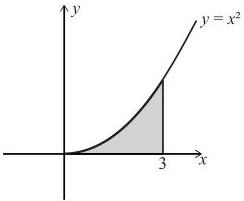
In this case, the entire region is above the axis, so the definite integral and the geometric area are identical.
Example 2
Calculate and illustrate the result.
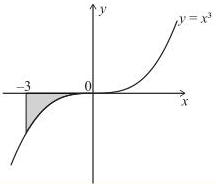
Here, the region is entirely below the axis, resulting in a negative definite integral. However, the geometric area of this region would be reported as the positive value .
Example 3
Calculate and illustrate the result.
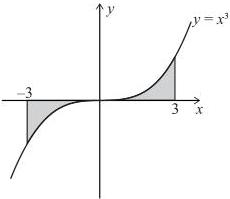
The answer is zero because the function is antisymmetric about the origin. The negative area from to exactly cancels out the positive area from to .
Finding Geometric Area by Splitting Integrals
If an ESAT question asks for the total area between a curve and an axis between two values, simply calculating the definite integral over the whole range might produce an incorrect answer if the curve crosses the axis. To find the true geometric area, you must identify where the curve crosses the axis, calculate the area of each section separately using definite integrals, and then sum the absolute values (the positive versions) of these results.
Worked Example: Splitting the Region
Find the area between the axis, the lines and , and the curve .
First, we sketch the curve to identify where it lies relative to the axis:
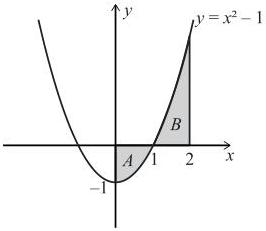
The diagram shows the curve crosses the axis at . This splits our region into two parts: Area A (from 0 to 1) and Area B (from 1 to 2). Area A is below the axis and Area B is above it.
- Calculate the integral for Area A:
- Calculate the integral for Area B:
Since Area A is , its geometric area is . Adding this to the geometric area of B (), we get a total area of . Note that the single definite integral from 0 to 2 would have given , which is incorrect for the total area.
Integration with Respect to y
While not explicitly required by the specification, it is helpful to understand integrals with respect to , such as . These follow the same principles as integrals, but they represent areas between the curve and the axis. Ensure the function is expressed in terms of before integrating.
Example: .
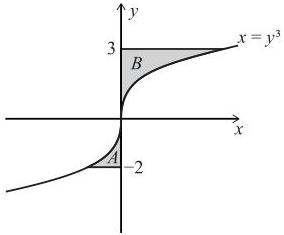
In the diagram above, the integral for section A would be negative while the integral for section B would be positive.
Using Symmetry and Antisymmetry
Symmetry can significantly simplify definite integrals.
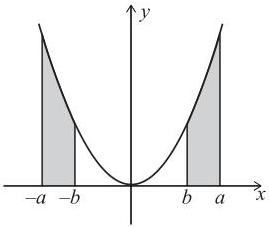
- Symmetry about the y axis (Even Functions): If is symmetric about the axis, then .
- Antisymmetry (Odd Functions): If is antisymmetric (reflecting across the axis and then the axis returns the same shape), then .
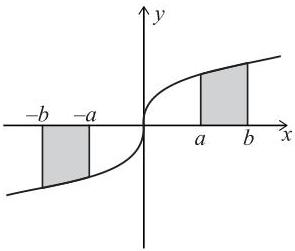
Using these properties, you can deduce that many integrals evaluate to zero or can be doubled. For instance, because is antisymmetric. Similarly, because is symmetric. Although trigonometric integration is not on the syllabus, you may be expected to deduce through symmetry that or that .
Key takeaways
- A definite integral calculates signed area, meaning regions below the x axis are subtracted from the total.
- To find the geometric area between a curve and an axis, you must split the integral at every x intercept.
- Integrals of antisymmetric functions over symmetric limits (from to ) always equal zero.
- Integrals of symmetric functions over symmetric limits can be calculated as twice the integral from to .
Always sketch the graph before starting an integration problem. A quick sketch helps you identify roots and symmetry, which can prevent you from accidentally subtracting areas or performing unnecessary calculations.
Be careful with terminology. If a question asks for a 'definite integral', keep the signs as they are. If it asks for the 'area', ensure all sub-sections are treated as positive.
The fact that for all odd functions is a powerful tool in competitive maths. It allows you to ignore highly complex terms in an integrand if you can prove they are odd and the limits are symmetric.
Frequently asked questions
What happens if I forget to split the integral when finding the area?
If you integrate across a root without splitting, the negative regions will cancel out some of the positive regions. This results in the net signed area, which is smaller than the total geometric area.
How do I know where to split the integral?
You must find the roots of the function by solving within the given interval. These roots are the points where the curve crosses the axis and the sign of the integral changes.
Are integrals with respect to y calculated differently?
No, the power rule and limit substitution work exactly the same way. The only difference is that you integrate with respect to the vertical axis, finding the area between the curve and the axis.
Can an area ever be negative?
In geometry, area is always a positive magnitude. In calculus, we use the term 'signed area' to describe integrals, but if a question specifically asks for the 'area between a curve and an axis', the final answer must be positive.