Binomial Expansion for Advanced Mathematics
Updated July 2026
Mastering the expansion of and for positive integers is a core requirement for the ESAT. This page explains how to use the binomial theorem to find specific coefficients, understand the notation for combinations and factorials, and apply efficient shortcuts instead of manual expansion.
The binomial theorem states that for a positive integer , the expansion of is given by , where the coefficients are defined by .
The binomial theorem is a powerful mathematical tool. For the ESAT, you must be able to calculate values of and determine any specific term in expressions of the form or . For example, you might be asked to find the constant term in the expansion of . While Pascal's triangle is useful for small values of , it becomes inefficient for larger powers such as . In such cases, using the binomial expansion formula directly is far more effective.
The Binomial Expansion Formula
The expansion can be written in full as:
Note that an alternative form is . Both versions are identical in result because of the symmetry of the coefficients. When using this formula, focus on the following patterns:
- The powers of the two terms in any given part of the expansion always add up to the total power .
- The value at the top of the notation is always the power to which the bracket is raised.
- The value at the bottom can be either of the powers appearing in that specific term.
Example 1: Finding a Specific Term
Find the term with in the expansion of .
To build this term, we follow three steps:
First, since we need , we identify the part of the expression involving . This is , which must be raised to the power of 7. It is vital to remember the brackets: . This ensures both the coefficient 2 and the variable are raised to the power.
Second, we determine the power for the other term, 3. Since the sum of the powers must be 8, and we already have a power of 7, the power of 3 must be . Thus, we have .
Third, we apply the combination coefficient . Here . For , we can use either the power of the first term (1) or the power of the second term (7). Both and give the same value. The final expression for the term is:
Example 2: Handling Negative Terms
Find the coefficient of in .
A common mistake is to ignore the negative sign. We must treat the second term as . Following our rules, for , we need . The power for the term 2 must be . The coefficient is .
The correct term is . Expanding this gives . The coefficient is the numerical part of this result.
How the Binomial Expansion Works
To understand why these coefficients appear, consider the logic of combinations. If you have five letters A, B, C, D, and E, and you want to choose a collection of 3 without regard for order, you are calculating '5 choose 3'.
Initially, you have 5 choices for the first box, 4 for the second, and 3 for the third, giving ways. However, this counts different orders of the same letters (like ABC and CBA) as distinct. Since there are ways to order any 3 letters, we divide 60 by 6 to get 10 unique collections. This is .
In the general case, to choose objects from , we fill boxes and leave empty.
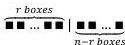
The number of ways to arrange the objects is . This explains the symmetry : choosing objects to keep is the same as choosing objects to discard.
When expanding , we are effectively multiplying five brackets: . To get the term, we must choose the term from 2 brackets and the 2 from the remaining 3 brackets. The number of ways to choose which 2 brackets provide the is , leading to the term .
Key takeaways
- The sum of the powers of the terms in any part of a binomial expansion must equal the total power .
- Always use brackets when raising terms like or to a power to ensure the coefficient is also raised to that power.
- The combination formula is , which exhibits symmetry such that .
- Factorial notation represents the product of all integers from 1 up to , with defined as 1.
When faced with an expression like , always write out the general term first. This helps you identify exactly which value of you need to satisfy the power of requested in the question.
The most common mistake is forgetting to raise the constant part of to the required power. In , the coefficient is , not 2. Similarly, always include the negative sign within the bracket, as is negative while is positive.
The link between the binomial theorem and combinations is a fundamental part of discrete mathematics. Every term in the expansion represents a specific way of 'picking' components from a set of brackets, which is why binomial coefficients are also called 'combinatorial coefficients'.
Frequently asked questions
Why can I use either or for the same term?
This is due to the symmetry of the binomial coefficients. Choosing instances of from brackets automatically means you are choosing instances of from the remaining brackets. Mathematically, is identical to .
What does the term 'coefficient' refer to in these questions?
The coefficient is the numerical value that multiplies the variable part of the term. For example, in the term , the coefficient is 240. If a question asks for the coefficient, do not include the power in your final answer.
How do I find the constant term in an expansion like ?
The constant term is the term where the power of is zero. You can find this by writing the general term and solving for such that the total exponent .
Is Pascal's triangle ever better than the formula?
Pascal's triangle is often faster for very small powers, such as or , where you can quickly write out the rows. However, for any greater than 6 or 7, or for questions asking for a specific term deep in an expansion, the binomial formula is much more reliable and less prone to addition errors.