Trigonometry and Triangle Geometry for the ESAT
Updated July 2026
This guide explains how to use the sine and cosine rules alongside the trigonometric area formula for triangles. These techniques are vital for solving complex geometry problems in two and three dimensions. You will learn to calculate triangle areas, identify missing sides and angles, and navigate the ambiguous case of the sine rule.
The sine and cosine rules relate the internal angles and side lengths of any triangle, while the formula provides a method to find the area using two sides and the angle between them.
Triangle Notation and Basic Area
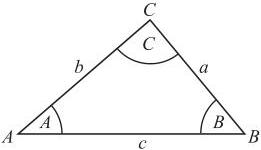
To solve trigonometric problems effectively, we must use a consistent system for labelling triangles. Generally, we label the vertices with capital letters and the sides opposite those vertices with the corresponding lower case letters . While diagrams often label corners anticlockwise, this is not a universal rule, so you must always verify the relative positions of sides and angles.
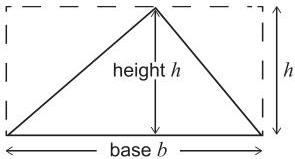
The most fundamental formula for the area of a triangle is derived from the area of a rectangle. As shown below, a triangle with a horizontal base and a vertical height is exactly half the area of the rectangle enclosing it.
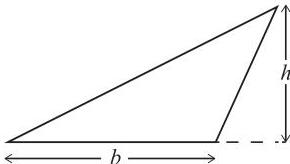
This formula remains valid even if the top corner is not directly above the base. In such cases, you must use the perpendicular vertical height above the line of the horizontal base, rather than the slanted height of the side of the triangle.
The Trigonometric Formula for Area
We can refine our area calculation using trigonometry. Consider a triangle where we know two sides and the angle between them.
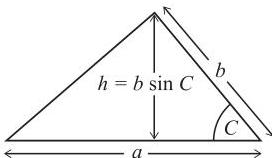
In this diagram, the base is . The vertical height can be found using the right-angled triangle formed by the slant height and the angle . The height is . Substituting this into our basic area formula gives:
This formula is powerful because it allows us to calculate the area of any triangle provided we have two sides and the included angle. By rotating the triangle, we can see that the area is also equal to and .
The Sine Rule
Because the area of a triangle is constant regardless of which sides and angles we use to calculate it, we can equate the different forms of the area formula:
By multiplying this entire equation by 2 and then dividing by , we derive the sine rule:
Alternatively, we can use the reciprocal form, which is often easier when solving for a side length:
When to use the Sine Rule
- Given two angles and one side: You can find any other side. Note that once you have two angles, you can find the third by subtracting from 180 degrees.
- Given two sides and one angle (not the angle between the sides): You can find another angle.
The Ambiguous Case of the Sine Rule
When we use the sine rule to find an angle (the side, side, angle case), we may encounter an ambiguous result. This happens because for any value of , there are two possible angles between 0 and 180 degrees: and .
Worked Example: Ambiguity
In triangle , let angle , side , and side . Find angle .
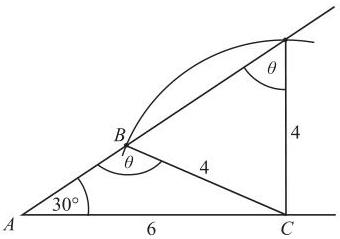
Using the sine rule:
This gives two possible values for : or . Since both and are less than 180, both triangles are theoretically possible. This ambiguity typically occurs when the side opposite the given angle is shorter than the other given side.
Sine Rule and Circle Geometry
Every triangle can be inscribed in a circle, known as the circumcircle. The radius of this circle, , is related to the sine rule.
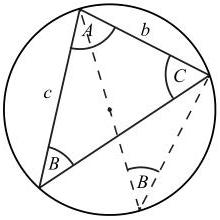
By using circle theorems, specifically that the angle at the centre is twice the angle at the circumference, it can be proven that:
This shows that the ratio of any side to the sine of its opposite angle is always equal to the diameter of the circumcircle.
The Cosine Rule
The cosine rule generalizes Pythagoras' theorem for triangles that do not have a right angle. In a right-angled triangle, .
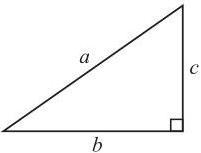
If we distort the triangle, we must add a correction term to keep the equation balanced.
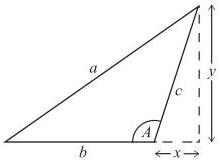
Using Pythagoras on the sub-triangles in the diagram above:
Substituting equation 2 into equation 1 yields . Since , we arrive at the standard cosine rule:
This can be written for any side by permuting the letters:
If you need to find an angle when three sides are known, rearrange the formula:
When to use the Cosine Rule
- Given three sides: You can find any angle.
- Given two sides and the included angle: You can find the third side.
Three Dimensional Problems
In the ESAT, you may encounter these rules in 3D contexts, such as finding the angle between a line and a plane or distance between vertices of a pyramid. The strategy is to identify 2D triangles within the 3D shape and apply the sine or cosine rules to those specific planes.
Key takeaways
- The area of any triangle can be calculated using where is the angle between sides and .
- The sine rule is used when given an angle, side, and side (SSA) or an angle, angle, and side (AAS).
- The ambiguous case of the sine rule occurs in SSA scenarios when two different triangles can be formed with the same given dimensions.
- The cosine rule is used when given all three sides (SSS) or two sides and the included angle (SAS).
- The cosine rule is safer for finding angles because is unique for angles between 0 and 180 degrees, whereas is not.
In 3D problems, always draw out the specific 2D triangle you are working on. This helps prevent confusion between slant heights and vertical heights. When using the sine rule to find an angle, always check if the supplementary angle () could also be a valid solution.
A common mistake is using the sine rule for an SSA triangle and forgetting to check for the obtuse second solution. Another error is applying the area formula using an angle that is not between the two sides; always ensure the angle is 'included'.
The sine rule can be linked to the circumradius of the triangle, meaning . This connects the geometry of any triangle to the properties of the unique circle that passes through all three of its vertices, a concept often tested in advanced coordinate geometry.
Frequently asked questions
How do I know if the ambiguous case applies to my sine rule calculation?
Ambiguity occurs when you are given two sides and a non-included angle (SSA). If the side opposite the given angle is shorter than the other given side, you must check both and . If both added to the original angle are less than 180, two triangles exist.
Does the cosine rule work for right-angled triangles?
Yes. If angle , then . The formula simplifies to , which is Pythagoras' theorem.
Why is there a minus sign in the cosine rule derivation?
The minus sign in arises from the geometry of the projection of side onto the base. If is acute, the projection reduces the distance used in the calculation, and the algebra ensures the formula works for both acute and obtuse angles.
Which rule should I use first if I have multiple options?
If the triangle is right-angled, use basic SOHCAHTOA or Pythagoras. If it is not, use the cosine rule if you have SAS or SSS. Use the sine rule for AAS or SSA. The cosine rule is generally preferred for finding angles as it avoids ambiguity.