Radian Measure and Circular Geometry
Updated July 2026
Radian measure is a natural way of measuring angles based on circle radius and arc length. It is fundamental to advanced trigonometry and calculus in the ESAT. This guide covers how to define radians, convert between degrees and radians, and calculate arc lengths, sector areas, and segment areas.
One radian is the angle subtended at the centre of a circle by an arc equal in length to the radius. For any circle, radians is equivalent to .
The Concept of Radians
While degrees are commonly used to measure angles, the choice of units for a full revolution is somewhat arbitrary. It may have been chosen based on the approximate number of days in a year, but other systems exist, such as Gradians where a right angle is units and a full revolution is units.
Radians are considered the most natural measure for angles because they are based on the intrinsic geometry of the circle. This measure is likely what any advanced civilisation would use, and it is the only system that makes the rules of calculus for trigonometric functions, such as , work correctly. If were in degrees, these derivatives would require much more complex constants.
Defining One Radian
To define one radian, we consider a sector of a circle where the radius is and the arc length is also . The angle subtended by this arc at the centre is defined as exactly radian.
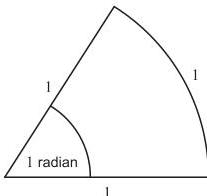
Since the circumference of a circle with radius is , a full revolution must be equal to radians. Consequently, radian is approximately . The mathematical symbol for radians is a superscript c, such as , although it is frequently written simply as rad or left with no unit symbol at all in advanced mathematics.
Converting Between Degrees and Radians
Conversion is simple if you recall that radians.
Converting θ degrees to radians An angle of degrees represents the fraction of a full revolution. Since one revolution is radians, the conversion is:
Converting α radians to degrees Similarly, an angle of radians represents the fraction of a full revolution. The conversion to degrees is:
You should memorise these standard conversions:
Arc Length and Sector Area
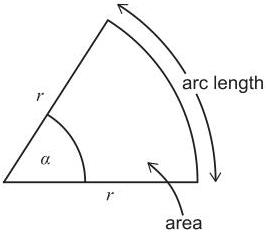
When working in radians, the formulae for the geometry of a sector become very simple. For a sector with radius and angle radians:
Proving the Formulae
To prove these, we treat the sector as a fraction of the entire circle. If the angle is radians, the sector is of the whole circle.
Arc Length:
Area of Sector:
Area of a Segment
A segment is the region bounded by an arc and a chord. To find its area, you subtract the area of the isosceles triangle formed by the radii and the chord from the total sector area. Using the triangle area formula :
Key takeaways
- A full revolution of is equal to radians.
- The formula for arc length is and the area of a sector is , provided is in radians.
- To convert degrees to radians, multiply by .
- The area of a segment is calculated as .
Always check your calculator mode before starting a trigonometry question. If the angles in the question involve , your calculator should almost certainly be in RAD mode.
The most frequent error is using the sector area formula while the angle is still in degrees. Always convert to radians before using these simplified circular formulae.
Radians are essential for calculus. The derivation of the derivative of relies on the limit , which is only true when is measured in radians. If degrees were used, the derivative of would be .
Frequently asked questions
What happens if I use degrees in the arc length formula?
The formula will give an incorrect answer. You must either convert the angle to radians first or use the degree-based formula .
Is there a shorthand for radians?
In many contexts, radians are written as 'rad' or with a superscript 'c'. However, in advanced mathematics and the ESAT, if an angle like is given without units, you should always assume it is in radians.
How do I calculate the area of a segment if I only know the chord length?
You can use the chord length and the radius to find the central angle using the cosine rule or by splitting the isosceles triangle into two right-angled triangles. Once you have the angle in radians, apply the segment area formula.
Why is used for a full circle?
Because the circumference of a unit circle (radius ) is . Since a radian is defined by an arc length equal to the radius, there must be exactly radians in a full circumference.