Plant Physiology Transport Systems for the ESAT
Updated July 2026
Transport systems in plants involve the movement of water, minerals, and sugars through specialised vascular tissues. This page explores the structural adaptations of xylem and phloem, the mechanism of water uptake via root hair cells, and the physical processes of transpiration and translocation. Mastering these concepts is essential for understanding plant survival and productivity.
Plants utilise a dual vascular system consisting of xylem, which uses dead lignified cells to transport water and minerals upwards via transpiration, and phloem, which uses living cells to move dissolved sugars throughout the plant via translocation.
The Structure and Adaptation of Vascular Tissues
Plants have two main types of transport tissue: xylem and phloem. These tissues are adapted to move specific substances across the plant body.
Xylem Tissue Xylem is responsible for the transport of water and mineral ions from the roots, through the stem, and to the leaves. Its structure is highly specialised for this function:
- Lignified Dead Cells: Xylem vessels are made of dead cells joined end-to-end to form a continuous, hollow tube. The absence of cytoplasm and end walls allows water to flow with minimal resistance.
- Lignin: The cell walls are thickened with a tough, waterproof substance called lignin. This provides mechanical strength to the stem and prevents the vessels from collapsing under the negative pressure created by the transpiration pull.
Phloem Tissue Phloem transports dissolved sugars (primarily sucrose) from the leaves (where they are produced by photosynthesis) to the rest of the plant for immediate use in respiration or for storage as starch. Unlike xylem, phloem consists of living cells:
- Sieve Tube Elements: These cells are arranged in columns. Their end walls, known as sieve plates, are perforated to allow the passage of dissolved sugars.
- Companion Cells: Because sieve tube elements have very little cytoplasm and no nucleus, they are supported by companion cells which contain many mitochondria to provide the energy (ATP) required for the active loading of sugars.
Water and Mineral Uptake by Root Hair Cells
Plants absorb water and mineral ions from the soil through root hair cells. These cells are found near the tips of growing roots and are uniquely adapted for absorption.
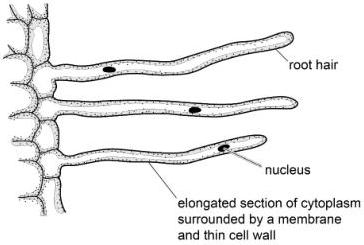
As shown in the diagram, root hair cells have a long, hair like extension that significantly increases the surface area available for absorption.
- Water Uptake: Water enters the root hair cell from the soil by osmosis. This occurs because the soil water has a higher water potential than the cell cytoplasm.
- Mineral Uptake: Mineral ions are often in lower concentration in the soil than inside the cell. Therefore, they are taken up by active transport, a process that requires energy from respiration.
Transpiration and Translocation
Transpiration Transpiration is the loss of water vapour from the surface of a plant, mainly through the leaves. Water evaporates from the surfaces of the mesophyll cells into the air spaces within the leaf and then diffuses out through the stomata.
Stomata are small pores usually found on the underside of leaves. Each stoma is surrounded by two guard cells. When the plant has plenty of water, the guard cells become turgid and curve, opening the stoma to allow gas exchange for photosynthesis. When water is scarce, the guard cells become flaccid and the stoma closes to reduce water loss.
Translocation Translocation is the movement of dissolved sugars from the leaves to other parts of the plant. This process is bidirectional, moving sugars to 'sinks' such as growing shoot tips, roots, or storage organs (like tubers).
Environmental Factors Affecting Transpiration
The rate of water uptake (and thus the rate of transpiration) is influenced by four main environmental factors:
- Light Intensity: Increased light causes stomata to open wider to allow more carbon dioxide in for photosynthesis, which also allows more water vapour to escape.
- Air Movement (Wind): Increased air movement removes the water vapour accumulating near the leaf surface. This maintains a steep concentration gradient between the inside and outside of the leaf, increasing the rate of diffusion.
- Humidity: High humidity means there is a high concentration of water vapour in the air surrounding the leaf. This reduces the concentration gradient, slowing down the rate of transpiration.
- Temperature: Higher temperatures give water molecules more kinetic energy, leading to faster evaporation from the mesophyll cells and faster diffusion through the stomata.
Calculating the Rate of Transpiration
The rate of transpiration can be measured using a potometer, which tracks the volume of water taken up by a plant over time. The formula used is:
Worked Example A student uses a potometer to measure the water uptake of a leafy shoot. If the shoot absorbs of water over a period of , calculate the rate of transpiration in .
- Identify the variables: ; .
- Apply the formula: .
- Calculate the result: .
Key takeaways
- Xylem vessels are made of dead, hollow, lignified cells for the transport of water and minerals.
- Phloem consists of living cells that transport dissolved sugars via translocation from sources to sinks.
- Root hair cells use a large surface area to absorb water by osmosis and minerals by active transport.
- Transpiration rates increase with higher light intensity, temperature, and air movement, but decrease with higher humidity.
- The rate of transpiration is calculated as the volume of water uptake divided by the time taken.
In ESAT questions, pay close attention to the units in transpiration calculations. You may need to convert hours to minutes or millimetres to cubic centimetres if a capillary tube diameter is provided.
A common mistake is thinking phloem only moves sugars downwards. Translocation is bidirectional: sugars move from 'sources' (leaves) to any 'sink' (growing buds, roots, or storage organs), which can be located above or below the source.
The movement of water in the xylem is a passive process driven by the 'transpiration pull', which relies on the cohesive properties of water molecules. In contrast, translocation in the phloem involves the active loading of solutes, highlighting how plants utilise both physical forces and metabolic energy for transport.
Frequently asked questions
Why is it important that xylem cells are dead at maturity?
Being dead and hollow allows xylem cells to form continuous, unobstructed tubes. If they contained cytoplasm or organelles, the resistance to water flow would be much higher, making it difficult to transport water to the top of tall plants.
How does active transport in root hair cells relate to mitochondria?
Active transport requires energy in the form of ATP to move mineral ions against their concentration gradient. Root hair cells contain many mitochondria to perform aerobic respiration and provide this necessary energy.
What is the role of guard cells in transpiration?
Guard cells control the opening and closing of the stomata. By changing their turgidity, they regulate the balance between allowing carbon dioxide in for photosynthesis and preventing excessive water loss through transpiration.
Is the rate of water uptake exactly equal to the rate of transpiration?
While often used interchangeably in simple calculations, they are not identical. A small percentage of the water taken up is used for photosynthesis or to maintain cell turgidity, though the vast majority is lost via transpiration.