Chemical Reactions and the Rearrangement of Atoms for the ESAT
Updated July 2026
In a chemical reaction, atoms and their electrons rearrange to form new substances, while nuclei remain unchanged. This process ensures that no atoms are created or destroyed, leading to the conservation of mass. Understanding these fundamental principles is essential for balancing equations and solving quantitative chemistry problems in the ESAT.
A chemical reaction involves the rearrangement of atoms and electrons to form new substances (products) from original materials (reactants). During this process, no nuclei are created or destroyed, and the total mass remains constant.
The Nature of Chemical Reactions
In all chemical reactions, the atoms present in the starting materials, known as the reactants, are rearranged to form new substances called the products. This process is fundamentally a redistribution of the atoms and their associated electrons. While the connections between atoms change, the identities of the atoms themselves remain the same because the nuclei are never destroyed or created during a chemical change.
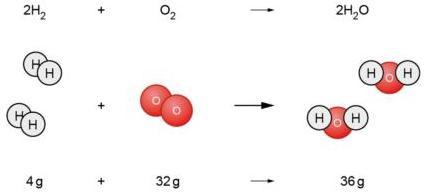
For example, when hydrogen gas reacts with oxygen gas, the atoms within the hydrogen molecules () and oxygen molecules () rearrange. They break their original bonds and form new bonds to create molecules of a completely new substance: water ().
The Law of Conservation of Mass
Because no atoms are created or destroyed in a chemical reaction, the total mass of all the reactants must equal the total mass of all the products. This is known as the Law of Conservation of Mass. If you know the mass of the reactants that have fully reacted, you can predict the mass of the products formed.
Consider the reaction between hydrogen and oxygen to form water:
- Suppose of hydrogen reacts completely with of oxygen.
- The atoms rearrange to form the product, water.
- The total mass of the product will be of water.
This rearrangement is often visualised using particle diagrams, which show how the discrete units of the reactants break apart and reform into the product units.
Worked Example: Thermal Decomposition
Understanding the rearrangement of atoms is particularly important when reactions involve gases that might escape into the atmosphere, making it appear as though mass has been lost. However, the atoms are simply moving into a different state of matter.
Example Exercise
When of green copper carbonate is heated, of black copper oxide remains. We can analyse several statements regarding this process:
- A chemical reaction has occurred: This is correct. The change in colour from green to black indicates the formation of a new substance, copper oxide.
- of copper carbonate has melted: This is incorrect. The mass difference is due to a chemical change, not a physical change of state like melting.
- of carbon dioxide has been released: This is correct. Based on the conservation of mass, the 'missing' mass () must be the mass of the gas (carbon dioxide) that was produced and released into the air.
- of carbon dioxide has vaporised: This is incorrect. Vaporisation refers to a liquid turning into a gas. In this case, the carbon dioxide was produced by the chemical breakdown of the solid reactant.
- of atoms have been destroyed: This is incorrect. Atoms are never destroyed in chemical reactions; they are only rearranged.
Key takeaways
- Chemical reactions involve the breaking and making of bonds through the rearrangement of atoms and electrons.
- The nuclei of atoms remain unchanged during chemical reactions, meaning no new elements are formed from others.
- The total mass of the reactants is always equal to the total mass of the products.
- Apparent changes in mass usually indicate that a reactant or product is a gas that has entered or left the system.
When solving mass-balance problems in the ESAT, if the product mass is lower than the reactant mass, look for a gas being produced (like or ). If the product mass is higher, look for a gaseous reactant (like ).
Do not confuse physical changes (like melting or boiling) with chemical reactions. In physical changes, the arrangement of molecules changes, but no new substances are formed and no internal atomic rearrangement occurs.
The fact that nuclei are untouched in chemical reactions is the reason why we can use balanced equations. Because every nucleus that goes into the reaction must come out, we can precisely count atoms on both sides of a chemical equation.
Frequently asked questions
What happens to the electrons during a chemical reaction?
Electrons are redistributed between atoms. They may be shared to form covalent bonds or transferred from one atom to another to form ions. This movement of electrons is what allows new chemical bonds to form.
Can a chemical reaction change one element into another?
No. Changing one element into another requires changing the number of protons in the nucleus. Since nuclei are not created or destroyed in chemical reactions, the identity of the elements remains constant.
Why does the mass of a rusted iron nail increase?
The mass increases because the iron atoms have reacted with oxygen atoms from the air to form iron oxide. The 'added' mass is the mass of the oxygen atoms that have been rearranged into the solid product.