Basic Principles and Terms of Electrolysis for the ESAT
Updated July 2026
Electrolysis is the process of using electrical energy to decompose ionic compounds. For the ESAT, you must be able to identify the components of an electrolytic cell, including the electrolyte, cathode, and anode. Understanding how ions migrate and undergo redox reactions at these electrodes is fundamental to mastering chemical separation and metal extraction.
Electrolysis is the decomposition of an electrolyte by a direct current, where ions migrate to oppositely charged electrodes: cations to the negative cathode and anions to the positive anode.
Introduction to Electrolysis
Electrolysis is a chemical process where electrical energy is used to drive a non-spontaneous chemical reaction. This typically involves the decomposition of a compound into its constituent elements. Unlike spontaneous chemical reactions that release energy, electrolysis requires an external power source, such as a battery or a direct current supply, to force electrons to move through a system.
Understanding the Electrolyte
An electrolyte is a substance that contains free moving ions and can therefore conduct electricity. For electrolysis to occur, the compound must be in a state where its ions are mobile. In a solid ionic lattice, the ions are held in fixed positions by strong electrostatic attractions and cannot move to carry a charge.
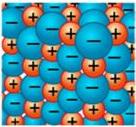
As shown in the lattice structure above, the ions are locked in place. To create an electrolyte, the ionic compound must be either melted to form a molten liquid or dissolved in water to form an aqueous solution. Once the lattice is broken, the ions are free to migrate toward the electrodes when a potential difference is applied. Covalent compounds, such as ethanol or glucose, do not contain ions and therefore cannot act as electrolytes.
The Electrodes: Anode and Cathode
The electrodes are solid conductors, often made of metal or graphite, that are placed into the electrolyte to complete the circuit. There are two types of electrodes that you must distinguish between for the ESAT:
- The Anode: This is the positive electrode. It is connected to the positive terminal of the power supply. During the process, it attracts negatively charged ions.
- The Cathode: This is the negative electrode. It is connected to the negative terminal of the power supply. During the process, it attracts positively charged ions.
A useful mnemonic to remember the charges is PANIC: Positive Anode, Negative Is Cathode.
Ion Migration and Redox Processes
When the power supply is turned on, ions in the electrolyte move toward the electrode with the opposite charge:
- Cations are positively charged ions. They are attracted to the negative cathode. At the cathode, they gain electrons, a process known as reduction (as taught in section C5.2).
- Anions are negatively charged ions. They are attracted to the positive anode. At the anode, they lose electrons, a process known as oxidation.
Half-Equations in Electrolysis
To describe the reactions at each electrode, we use half-equations to show the movement of electrons. As seen in section C3.4, we can look at the electrolysis of molten sodium chloride as a primary example.
Example: Electrolysis of Molten Sodium Chloride ():
In molten sodium chloride, the ions present are and .
-
At the Cathode (Negative Electrode): Positive sodium ions are attracted here. Each ion gains one electron to become a neutral sodium atom. This is a reduction reaction:
-
At the Anode (Positive Electrode): Negative chloride ions are attracted here. Two ions each lose an electron to form a neutral chlorine molecule (). This is an oxidation reaction:
Example: Electrolysis of Molten Aluminium Oxide ():
-
At the Cathode: Aluminium ions gain three electrons each:
-
At the Anode: Oxide ions lose electrons to form oxygen gas:
Key takeaways
- Electrolysis is the breakdown of an ionic compound using a direct current of electricity.
- The electrolyte must be molten or in aqueous solution so that the ions are free to move.
- The anode is the positive electrode where oxidation (loss of electrons) occurs.
- The cathode is the negative electrode where reduction (gain of electrons) occurs.
- Negative ions (anions) move to the anode and positive ions (cations) move to the cathode.
In ESAT questions, always check if the compound is 'molten' or 'aqueous'. If it is molten, only the ions of the compound itself are present. If it is aqueous, the ions from water ( and ) are also present, which complicates the products formed.
Avoid confusing the movement of electrons with the movement of ions. Electrons flow through the external circuit and the electrodes, but charge is carried through the electrolyte by the physical movement of ions.
Electrolysis is the only way to extract very reactive metals, such as Aluminium and Sodium, from their ores because they are more reactive than carbon and cannot be reduced by it in a furnace.
Frequently asked questions
Why can a solid ionic compound not be an electrolyte?
In a solid state, the ions are held in a giant rigid lattice by strong electrostatic forces. Because the ions cannot move, they cannot carry an electric current to the electrodes.
How do you determine which electrode is the cathode and which is the anode?
The cathode is connected to the negative terminal of the power source, while the anode is connected to the positive terminal.
Does electrolysis involve oxidation, reduction, or both?
Electrolysis is a redox process. Oxidation occurs at the anode (loss of electrons) and reduction occurs at the cathode (gain of electrons).
What is the difference between an ion and an electrode?
An ion is a charged particle within the liquid electrolyte, whereas an electrode is the solid conductor that carries the current into or out of the electrolyte.