Half Equations for Electrolysis for the ESAT
Updated July 2026
Master the skill of writing half equations to describe the movements of electrons at electrodes during electrolysis. This guide explains how to represent reduction at the cathode and oxidation at the anode for molten compounds, a core requirement for the ESAT Chemistry syllabus. You will learn to balance both atoms and charges correctly.
A half equation is a chemical equation that represents either the oxidation or the reduction component of a redox reaction separately. In electrolysis, these equations show the gain of electrons by cations at the cathode and the loss of electrons by anions at the anode.
Understanding Half Equations in Electrolysis
In redox reactions, including electrolysis, we can write two separate half equations to show the reduction and oxidation processes individually. These equations are essential because they explicitly show the gain or loss of electrons (), which are otherwise hidden in a full chemical equation.
Electrolysis involves the movement of ions to electrodes where they change into neutral atoms or molecules. This process is fundamentally a redox reaction. To remember the difference between the two processes, we use the mnemonic OIL RIG:
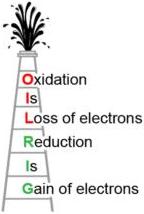
- Oxidation is the Loss of electrons.
- Reduction is the Gain of electrons.
Processes at the Electrodes
During the electrolysis of molten ionic compounds, the ions separate and move towards the electrode of the opposite charge. At these electrodes, chemical changes occur that we represent with half equations.
The Cathode (Negative Electrode)
Positively charged ions (cations) are attracted to the negative cathode. To become neutral atoms, they must gain electrons. Since gaining electrons is reduction, we say that reduction always occurs at the cathode.
The Anode (Positive Electrode)
Negatively charged ions (anions) are attracted to the positive anode. To become neutral atoms or molecules, they must lose electrons. Since losing electrons is oxidation, we say that oxidation always occurs at the anode.
Worked Example: Electrolysis of Molten Aluminium Oxide
In the electrolysis of molten aluminium oxide, we consider the aluminium ions () and oxide ions ().
1. Reduction of Aluminium Ions
The ions move to the cathode to form aluminium metal (). Each aluminium ion has a charge, meaning it needs to gain 3 electrons to become a neutral atom. The half equation is:
2. Oxidation of Oxide Ions
The ions move to the anode to form oxygen gas (). Oxygen is a diatomic molecule, so two oxide ions are required to produce one molecule of . Since each ion loses 2 electrons, a total of 4 electrons are released for every molecule of oxygen formed. The half equation is:
Worked Example: Electrolysis of Molten Sodium Chloride
Consider the electrolysis of molten sodium chloride (), which contains ions and ions.
1. At the Cathode
Each sodium ion () gains one electron to form a neutral sodium atom (). The equation represents reduction:
2. At the Anode
Two chloride ions () are needed to form one chlorine molecule (). Each chloride ion loses one electron, resulting in a total loss of two electrons for the molecule. The equation represents oxidation:
Method for Constructing Half Equations
To write a correct half equation for an electrode process, follow these steps:
- Identify the Ion: Determine the formula and charge of the ion moving to the electrode (e.g., or ).
- Identify the Product: Determine the neutral substance formed. Remember that some elements form diatomic molecules: , , , , , , and .
- Balance the Atoms: If the product is diatomic, ensure you have two ions on the reactant side.
- Balance the Charge: Add electrons () to one side of the equation so that the total charge on the left equals the total charge on the right.
- For reduction (at the cathode), electrons are added to the left (reactants).
- For oxidation (at the anode), electrons are added to the right (products).
Key takeaways
- Reduction is the gain of electrons and occurs at the negative cathode.
- Oxidation is the loss of electrons and occurs at the positive anode.
- Half equations must be balanced for both the number of atoms and the total electrical charge.
- Diatomic elements such as and require two ions and multiple electrons in their half equations.
- The number of electrons added is determined by the change in the oxidation state of the species.
Always check if the element produced is diatomic. If you are writing an equation for a Group 17 element (the halogens) or oxygen/hydrogen, you must balance the atoms by using two ions and producing a molecule with a subscript 2.
Do not confuse the charge of the electrode with the process. The cathode is negative but it is the site of reduction (gain of electrons). Remember: Anode = Oxidation, Cathode = Reduction.
Half equations demonstrate that electrolysis is a method of 'pumping' electrons from the anode to the cathode. The external power supply removes electrons from anions at the anode and pushes them into cations at the cathode.
Frequently asked questions
Which side of the equation should the electrons be on?
For reduction (gain of electrons), the electrons appear on the left side (reactants), such as . For oxidation (loss of electrons), they appear on the right side (products), such as .
Why do some half equations for non-metals use a 2 in front of the ion?
Non-metals like chlorine, oxygen, and bromine exist as diatomic molecules (, , ). To form one of these molecules, you must start with two individual ions, for example: .
Is the cathode always the site of reduction?
Yes, in electrolysis, the cathode is the negative electrode where cations gain electrons. According to the OIL RIG mnemonic, gaining electrons is reduction.
How do I balance the charge in ?
The total charge on the left is . To make the right side equal , we add four electrons (), as the molecule itself is neutral (charge of 0).