Energy Changes in Reversible Reactions for the ESAT
Updated July 2026
In chemical energetics, reversible reactions exhibit energy transfers that are equal in magnitude but opposite in nature for each direction. This concept states that if a forward reaction is exothermic, the reverse must be endothermic. Understanding this is essential for predicting how temperature shifts affect chemical equilibria in industrial and laboratory settings.
A reversible reaction that releases heat in the forward direction (exothermic) will always absorb an equivalent amount of heat in the reverse direction (endothermic). The magnitude of the enthalpy change () is identical for both paths, but the sign is reversed.
Reversible Reactions and Dynamic Equilibrium
Many chemical reactions do not proceed to completion where all reactants are converted into products. Instead, they are reversible, meaning the products can react together to reform the original reactants. This is represented using the reversible arrow symbol: .
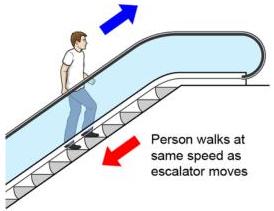
In a closed system, these reactions can reach a state of dynamic equilibrium. At this point, the forward and reverse reactions occur simultaneously and at the exactly the same rate. This can be compared to a person walking up a down escalator at the same speed the escalator moves downwards: they appear to remain in one position, yet both actions are ongoing.
The Relationship Between Energy Changes
Every chemical reaction involves an energy change. In a reversible system, the energy change for the forward reaction is always the direct opposite of the energy change for the reverse reaction. This is a fundamental rule of energetics:
- If the forward reaction is exothermic, it releases heat to the surroundings and has a negative enthalpy change value (). Consequently, the reverse reaction must be endothermic.
- If the forward reaction is endothermic, it absorbs heat from the surroundings and has a positive enthalpy change value (). Consequently, the reverse reaction must be exothermic.
For example, consider the reaction where sulfur dioxide () reacts with oxygen () to produce sulfur trioxide ():
In this specific system, the forward reaction is exothermic. This means that as and react to form , heat is released. If the sulfur trioxide were to decompose back into sulfur dioxide and oxygen, it would have to absorb the same amount of heat that was released during its formation. Therefore, the reverse reaction is endothermic.
Predicting the Effect of Temperature Changes
Because one direction is exothermic and the other is endothermic, changing the temperature of a system at equilibrium will shift the position of that equilibrium to oppose the change. This is a key application of the principle that energy changes are reciprocal.
If the temperature is increased, the system moves to lower the temperature by favouring the endothermic direction. Conversely, if the temperature is decreased, the system moves to increase the temperature by favouring the exothermic direction.
Worked Example: Ammonia Production (The Haber Process)
In the Haber process, nitrogen reacts with hydrogen to form ammonia:
The forward reaction is exothermic. Let us determine how an increase in temperature affects the equilibrium mixture.
Step 1: Identify the energy change for each direction. Since the forward reaction is exothermic, the reverse reaction (the decomposition of ammonia) must be endothermic.
Step 2: Apply the temperature change. When the temperature is increased, the equilibrium position moves to oppose this change by absorbing the extra heat. It does this by moving in the endothermic direction.
Step 3: Determine the result. In this case, the endothermic direction is the reverse direction (to the left). Therefore, the amount of ammonia present at equilibrium will decrease as more nitrogen and hydrogen are formed.
Worked Example: Steam Reforming of Methane
Methane reacts with steam to produce hydrogen and carbon monoxide:
In this system, the forward reaction is endothermic. We can predict the effect of increasing the temperature on the yield of hydrogen.
Step 1: Identify the energy change. The forward reaction is endothermic, so the reverse reaction must be exothermic.
Step 2: Apply the temperature change. Increasing the temperature causes the equilibrium to shift in the endothermic direction to absorb the added energy.
Step 3: Determine the result. Since the forward reaction is the endothermic one, the equilibrium position shifts to the right. This results in an increase in the equilibrium yield of hydrogen.
Key takeaways
- Reversible reactions feature forward and reverse processes that are energy opposites.
- If the forward reaction is exothermic (), the reverse reaction must be endothermic ().
- If the forward reaction is endothermic (), the reverse reaction must be exothermic ().
- Increasing temperature always favours the endothermic direction, while decreasing temperature favours the exothermic direction.
When answering ESAT questions on equilibrium, always start by explicitly labelling the forward and reverse directions as 'exothermic' or 'endothermic'. This prevents simple errors when predicting shifts in equilibrium position.
A common mistake is assuming that 'exothermic' means the reaction always moves to the right. 'Exothermic' simply describes one direction; whether the reaction moves in that direction depends on whether you are increasing or decreasing the temperature.
This reciprocal relationship is a direct consequence of the Law of Conservation of Energy (the First Law of Thermodynamics). Energy cannot be created or destroyed, so the energy 'stored' during an endothermic process must be exactly the same amount 'released' when the process is reversed.
Frequently asked questions
Does the amount of energy released in one direction equal the energy absorbed in the other?
Yes. The magnitude of the energy change is exactly the same for both directions. Only the direction of heat flow (and thus the sign of ) changes.
How can I tell which direction is exothermic if it is not stated?
In exam questions, the enthalpy change () is usually given for the forward reaction. If is negative, the forward is exothermic. If it is positive, the forward is endothermic.
What happens if a reaction is neither exothermic nor endothermic?
Virtually all chemical reactions involve some change in enthalpy because the energy required to break bonds rarely exactly equals the energy released when new bonds form. However, if , temperature changes would have no effect on the equilibrium position.