Disproportionation and Redox Agents for the ESAT
Updated July 2026
Disproportionation is a specific redox process where a single species is simultaneously oxidised and reduced. This page explores common examples like hydrogen peroxide and chlorine reactions, while also defining oxidising and reducing agents in terms of oxygen and electron transfer, which are key competencies for the ESAT Chemistry section.
Disproportionation occurs when an element in a single chemical species is simultaneously oxidised and reduced, resulting in products where the element exists in at least two different oxidation states.
What is Disproportionation?
Disproportionation is a specific type of redox reaction. In this process, a single species undergoes both oxidation and reduction at the same time. To identify such a reaction, you must calculate the oxidation states of the elements involved and see if a single element's oxidation state both increases and decreases across the reaction.
The Decomposition of Hydrogen Peroxide
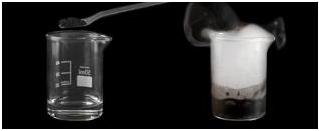
A classic example of disproportionation is the decomposition of hydrogen peroxide into water and oxygen gas. The chemical equation is:
To see why this is disproportionation, we examine the oxidation states of oxygen:
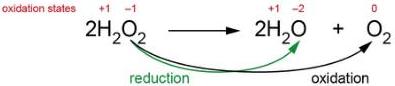
- The oxygen in hydrogen peroxide () has an oxidation state of .
- In water (), the oxidation state of oxygen is .
- In elemental oxygen (), the oxidation state of oxygen is zero.
In this reaction, two of the four oxygen atoms from the reactant have their oxidation state decreased from to in water, which is reduction. The other two oxygen atoms increase their oxidation state from to 0 in oxygen gas, which is oxidation. Therefore, the oxygen in hydrogen peroxide has been simultaneously oxidised and reduced.
Chlorine in Sodium Hydroxide Solutions
The reaction of chlorine with sodium hydroxide is another fundamental example that varies based on temperature.
1. Cold Dilute Sodium Hydroxide
When chlorine reacts with cold dilute , the following reaction occurs:
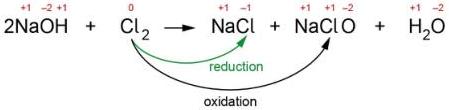
The oxidation state of chlorine in is 0 because it is in its elemental state. In sodium chloride (), the chlorine has an oxidation state of (since is ). In sodium chlorate(I) (), the oxidation state of chlorine is , as the sum of (), (), and must equal zero. Because the chlorine has been reduced from 0 to and oxidised from 0 to simultaneously, it has undergone disproportionation.
2. Hot Aqueous Sodium Hydroxide
If the sodium hydroxide solution is hot, a different disproportionation occurs:

Here, the chlorine starts at 0. In , it is . In , the chlorine has an oxidation state of (calculated as: for plus for , meaning must be to sum to zero). Five chlorine atoms are reduced, and one is oxidised, confirming disproportionation.
Disproportionation of Copper(I) Ions
In aqueous solution, ions are unstable and undergo disproportionation:
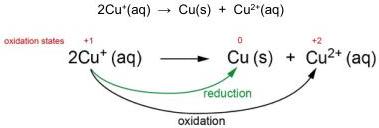
The oxidation state of an ion is equal to its charge. Thus, is and is . Elemental copper () is 0. One ion reduces its state from to 0, while the other increases its state from to .
Worked Example: Nitrogen Dioxide
Consider the reaction:
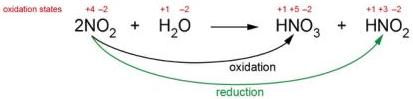
In , nitrogen is in the state. In , nitrogen is , while in , nitrogen is . One nitrogen atom increases its oxidation state (oxidation) and the other decreases it (reduction), meaning undergoes disproportionation.
Oxidising and Reducing Agents
Understanding redox also requires identifying the agents that drive these changes. These can be defined by oxygen transfer or electron transfer.
1. Oxygen Transfer
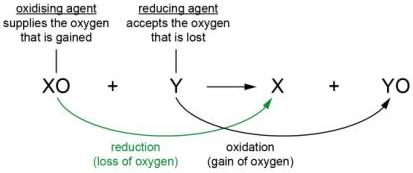
- Oxidising agents provide oxygen to another substance.
- Reducing agents remove oxygen from another substance.
In the reaction , is the oxidising agent because it supplies the oxygen. is the reducing agent because it removes oxygen from the iron oxide.
2. Electron Transfer
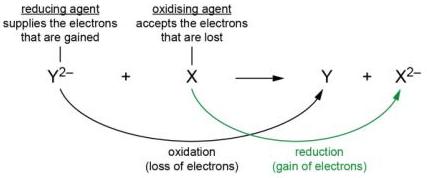
- Oxidising agents oxidise something else by taking its electrons. Consequently, the oxidising agent gains electrons and is itself reduced.
- Reducing agents reduce something else by supplying electrons. Consequently, the reducing agent loses electrons and is itself oxidised.
In the reaction , the atoms lose electrons (oxidation) and are the reducing agent. The ions gain electrons (reduction) and are the oxidising agent.
Periodic Trends in Redox Agents
The tendency of elements to act as oxidising or reducing agents is linked to their position in the Periodic Table:
- Group 2 elements lose electrons to form positive ions (oxidation). Because they are easily oxidised, they act as strong reducing agents.
- Group 17 elements (halogens) gain electrons to form negative ions (reduction). Because they are easily reduced, they act as strong oxidising agents.
Key takeaways
- Disproportionation is a redox reaction where the same element in a single species is both oxidised and reduced.
- In the decomposition of hydrogen peroxide, oxygen changes from an oxidation state of -1 to both -2 (in water) and 0 (in oxygen gas).
- Chlorine disproportionates in sodium hydroxide, forming NaCl and NaClO in cold conditions, or NaCl and NaClO3 in hot conditions.
- An oxidising agent is reduced during a reaction because it gains electrons from another species.
- A reducing agent is oxidised during a reaction because it loses electrons to another species.
When dealing with chlorine and NaOH, always check the temperature mentioned in the question. Cold NaOH leads to the oxidation state (NaClO), whereas hot NaOH leads to the state (NaClO3).
A common mistake is thinking the oxidising agent is the substance being oxidised. Remember: an oxidising agent causes oxidation in another substance by taking electrons, which means the agent itself is reduced.
The ability of a species to disproportionate often depends on the stability of the intermediate oxidation state relative to the states above and below it. For example, is less stable in aqueous solution than a mixture of and , which drives the reaction toward the products.
Frequently asked questions
How can I identify a disproportionation reaction in an exam?
You must calculate the oxidation states of every element in the reactants and products. If you find one element that appears in the reactants as a single species but ends up in two different products with different oxidation states (one higher and one lower than the original), it is a disproportionation reaction.
Is the oxidising agent always the reactant that contains oxygen?
No. While the oxygen transfer definition is useful for some reactions, many redox reactions do not involve oxygen. The more universal definition is that the oxidising agent is the species that gains electrons and has its oxidation state decreased.
Why is H2O2 oxygen state -1 instead of -2?
Hydrogen peroxide is a peroxide. In peroxides, there is an oxygen to oxygen single bond. Since hydrogen is always +1 when bonded to non metals, the two hydrogens contribute a total of +2. To make the molecule neutral, the two oxygens must contribute a total of -2, meaning each oxygen is -1.
What is the relationship between Group 17 elements and oxidising ability?
Group 17 elements have seven electrons in their outer shell and a high electronegativity. They have a strong tendency to gain one electron to achieve a noble gas configuration. Since gaining electrons is reduction, these elements are easily reduced and therefore serve as excellent oxidising agents.