Redox Reactions Agents and Chemical Bonding
Updated July 2026
This guide explains disproportionation where a single species is simultaneously oxidised and reduced and defines oxidising and reducing agents. It further covers the classification of matter and the principles of ionic and covalent bonding. Understanding these core concepts is essential for predicting reaction products and chemical behaviour in the ESAT.
Disproportionation occurs when one species is both oxidised and reduced in the same reaction. Oxidising agents facilitate oxidation by gaining electrons while reducing agents facilitate reduction by losing electrons.
Understanding Disproportionation
Disproportionation is a specific category of redox reaction where a single chemical species is simultaneously both oxidised and reduced. This means that atoms of the same element in the starting material end up in at least two different products with different oxidation states, one higher and one lower than the original state.
Decomposition of Hydrogen Peroxide
A classic example of disproportionation is the decomposition of hydrogen peroxide into water and oxygen. In this reaction, the oxygen atoms undergo both oxidation and reduction.
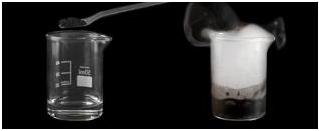
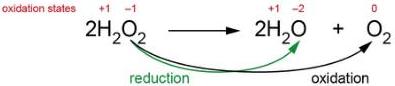
To see why this is disproportionation, we examine the oxidation states of oxygen:
- In hydrogen peroxide (), oxygen has an oxidation state of .
- In water (), oxygen has an oxidation state of .
- In elemental oxygen (), oxygen has an oxidation state of .
Of the four oxygen atoms in , two have their oxidation state decreased from to in the water molecules. This decrease is reduction. The other two oxygen atoms have their oxidation state increased from to in the molecule. This increase is oxidation. Because the same species has been both oxidised and reduced, it has undergone disproportionation.
Chlorine and Sodium Hydroxide
The reaction of chlorine with sodium hydroxide provides further examples of disproportionation. The outcome depends on the temperature of the solution.
Cold Dilute Sodium Hydroxide
When chlorine reacts with cold, dilute sodium hydroxide, it forms sodium chloride and sodium chlorate(I).
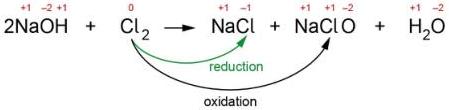
The oxidation states of chlorine are as follows:
- In , the oxidation state is because it is in its elemental state.
- In sodium chloride (), the oxidation state is . Since is , the must be for the compound to be neutral.
- In sodium chlorate(I) (), the oxidation state is . Since is and is , the must be for the sum of states to equal .
One chlorine atom from is reduced from to , while the other is oxidised from to . This is disproportionation.
Hot Aqueous Sodium Hydroxide
In hot sodium hydroxide, the chlorine disproportionates into a different set of products: sodium chloride and sodium chlorate(V).

In this reaction, the chlorine in starts at an oxidation state of . Five chlorine atoms are reduced to an oxidation state of in the units. The one remaining chlorine atom is oxidised to an oxidation state of in . This is another clear case of disproportionation.
Disproportionation of Copper(I) Ions
Copper(I) ions () are unstable in aqueous solution and will spontaneously disproportionate into elemental copper and copper(II) ions.
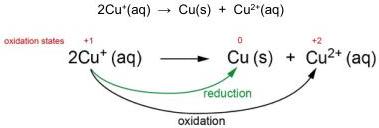
The oxidation state of an ion is equal to its charge. Therefore, the ion has a state of and the ion has a state of . Elemental copper () has an oxidation state of . One ion is reduced from to , while another is oxidised from to .
Further Example: Nitrogen Dioxide
Nitrogen dioxide reacts with water to form nitric acid and nitrous acid:
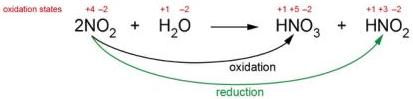
In , the nitrogen has an oxidation state of . In , the nitrogen is (oxidation), and in , the nitrogen is (reduction). The nitrogen has been simultaneously oxidised and reduced.
Oxidising and Reducing Agents
In any redox reaction, we can identify specific roles for the reactants. An oxidising agent oxidises another substance, while a reducing agent reduces another substance.
Definition by Oxygen Transfer
In terms of oxygen transfer, the rules are straightforward:
- Oxidising agents provide oxygen to another substance.
- Reducing agents remove oxygen from another substance.
Consider the reaction:
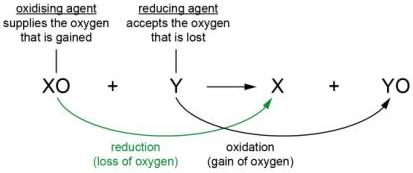
Iron(III) oxide loses oxygen to become iron; it is reduced. Because it provided the oxygen for the carbon monoxide to be oxidised, is the oxidising agent. Carbon monoxide gains oxygen to become carbon dioxide; it is oxidised. Because it removed the oxygen from the iron oxide, is the reducing agent.
Definition by Electron Transfer
In terms of electron transfer, the roles are defined by what happens to the agents themselves:
- An oxidising agent takes electrons from another substance. Because it gains electrons, the oxidising agent is itself reduced.
- A reducing agent gives electrons to another substance. Because it loses electrons, the reducing agent is itself oxidised.
Consider the reaction between zinc and copper(II) ions:
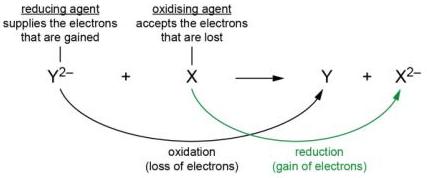
Zinc atoms lose two electrons to form ions; they are oxidised. Thus, is the reducing agent. Copper(II) ions gain two electrons to form copper atoms; they are reduced. Thus, is the oxidising agent.
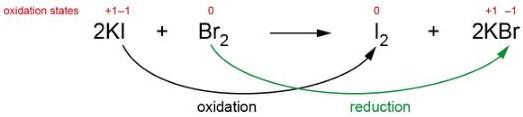
Another example is the displacement of iodine by chlorine: . The iodide ions () lose electrons to form (oxidation), so they are the reducing agent. The chlorine molecule () gains those electrons to form chloride ions (reduction), so it is the oxidising agent.
Chemical Bonding: Elements, Compounds, and Mixtures
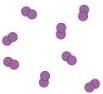
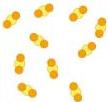
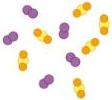
Substances can be classified as elements, compounds, or mixtures. A pure substance consists of only one type of element or one type of compound. An element contains only one type of atom and cannot be simplified chemically. A compound contains atoms of different elements chemically bonded together. A mixture contains multiple elements or compounds that are not chemically bonded.
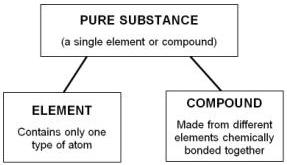
- Pure substance (Element): A diagram showing only one type of single atom or one type of molecule made of the same atoms.
- Pure substance (Compound): A diagram showing only one type of molecule made of different atoms.
- Mixture: A diagram showing a variety of different atoms and molecules together.
Types of Chemical Bonding
Atoms typically react to achieve the stable electron configuration of a noble gas, which involves a full outer shell. This can be achieved through the transfer or sharing of electrons.
Ionic Bonding: Metals and Non-metals
When a metal reacts with a non-metal, electrons are transferred from the metal to the non-metal. The metal becomes a positive ion and the non-metal becomes a negative ion. These ions form a giant lattice held together by strong electrostatic attractions. This is ionic bonding.
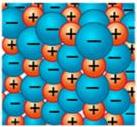
For example, in sodium chloride, sodium loses one electron and chlorine gains one electron. 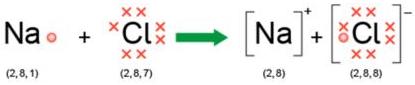 In magnesium fluoride, one magnesium atom loses two electrons, giving one to each of two fluorine atoms.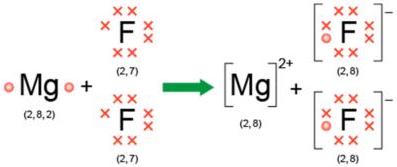
Covalent Bonding: Non-metals and Non-metals
When non-metals react together, they share pairs of electrons to achieve full outer shells. A shared pair of electrons is a covalent bond. For example, in ammonia (), one nitrogen atom shares electrons with three hydrogen atoms. 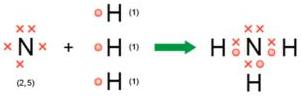
Key takeaways
- Disproportionation is a redox reaction where the same species is simultaneously oxidised and reduced.
- An oxidising agent gains electrons and is reduced, while a reducing agent loses electrons and is oxidised.
- Oxidation states must be assigned to each element in a reaction to determine which species has been oxidised or reduced.
- Ionic bonding involves the transfer of electrons from metals to non-metals, whereas covalent bonding involves the sharing of electrons between non-metals.
- Pure substances consist of a single element or compound, whereas mixtures contain multiple chemical species.
When identifying oxidising and reducing agents, remember the mnemonic OIL RIG: Oxidation Is Loss, Reduction Is Gain. The agent always performs the opposite process to its name: the oxidising agent is reduced.
Be careful with oxygen in peroxides. In most compounds, oxygen has an oxidation state of -2, but in peroxides like , it is -1. This is a common source of error in redox calculations.
Disproportionation often explains why certain intermediate oxidation states are unstable in water. For example, is unstable because it can readily move to the more stable and states through electron exchange of electrons.
Frequently asked questions
How can I identify a disproportionation reaction from a chemical equation?
Assign oxidation states to every element on both sides of the equation. If you find that atoms of the same element in a single reactant end up with both a higher oxidation state and a lower oxidation state in the products, it is a disproportionation reaction.
Is the oxidising agent the substance that gets oxidised?
No. An oxidising agent causes another substance to be oxidised. To do this, the agent must take electrons, meaning the oxidising agent itself is reduced.
Why do Group 17 elements make better oxidising agents than Group 2 elements?
Group 17 elements have seven outer electrons and strongly attract another electron to achieve a noble gas configuration. Since they gain electrons easily (reduction), they are excellent oxidising agents. Group 2 elements lose electrons easily, making them better reducing agents.
What is the difference between a compound and a mixture?
A compound consists of different elements chemically bonded together in fixed proportions. A mixture consists of different substances physically mingled together but not chemically bonded, and they can be separated by physical means.