Applications of Differentiation for the ESAT
Updated July 2026
This lesson covers the application of differentiation to curve sketching and the analysis of function behaviour. You will learn to calculate gradients, tangents, and normals, as well as identify and classify stationary points. Understanding these calculus techniques is essential for solving complex polynomial problems on the ESAT Mathematics 2 paper.
A stationary point occurs where . A function is strictly increasing if and strictly decreasing if . These derivatives describe the gradient of the tangent to a curve at any specific point.
One of the primary motivations for studying basic calculus techniques is to help sketch curves given an equation. As you progress through these ideas, consider how they relate to the physical shape of a curve. You should have a firm grasp of the general shapes of quadratic, cubic, quartic, and quintic polynomials, and be able to generalise these shapes to polynomials with higher powers of .
Gradients, Tangents, and Normals
You are expected to use differentiation to find the gradient of a tangent at a specific point and use this to find the equations of both the tangent and the normal to a curve. The gradient of the tangent at a point is given by . Since the normal is perpendicular to the tangent, its gradient is the negative reciprocal: . These are fundamental skills assumed for the ESAT.
Identifying and Classifying Stationary Points
Stationary points occur when the tangent to a curve is horizontal. At these points, the gradient is zero, so we solve for in the equation:
Stationary points are often called local maxima or local minima because they represent the highest or lowest value in a specific neighbourhood, rather than necessarily the absolute greatest or least value of the entire function. There are several methods to classify these points:
- General Shape of the Curve: If you are sketching a cubic such as , you can differentiate to find the stationary points:
Stationary points occur at and . Because the coefficient of the term is positive, the graph starts from the bottom left and goes to the top right. This tells us the maximum must be to the left of the minimum. Thus, the maximum is at and the minimum is at .
-
Testing Values Either Side: You can calculate the values for coordinates slightly smaller and slightly larger than the stationary point. For , calculating at and would show that the values on either side are larger than at , suggesting a minimum. Be careful not to choose values so far away that you cross another stationary point.
-
The Second Derivative Test: This is often the most efficient method. If at the stationary point, it is a minimum. If , it is a maximum.
Why the Second Derivative Works
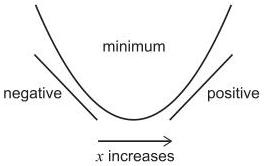
The second derivative describes how the first derivative (the gradient) is changing. If the gradient goes from negative to positive as increases, the curve reaches a bottom point (a minimum). In this case, the gradient is increasing, which is why .
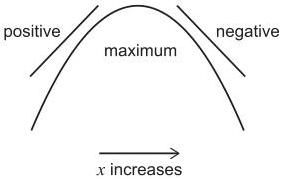
Conversely, if the gradient goes from positive to negative, the curve reaches a peak (a maximum). Here, the gradient is decreasing, meaning .
Logic of the Second Derivative Test
It is vital to understand the logic of sufficiency versus necessity.
- The condition and is sufficient for a minimum, but not necessary.
- The condition and is sufficient for a maximum, but not necessary.
This is because at a minimum, it is possible for to equal zero (for example, in the function at the origin). Therefore, while a positive second derivative guarantees a minimum, a zero second derivative does not rule one out.
Strictly Increasing and Decreasing Functions
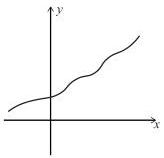
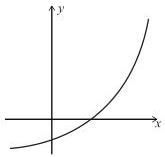
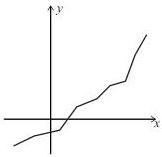
A strictly increasing function is one where the value always gets greater as the value gets greater. Intuitively, the graph always slopes upwards.
A strictly decreasing function is one where the value always gets less as the value gets greater, meaning it always slopes downwards.
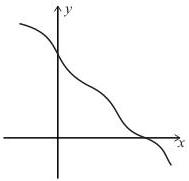
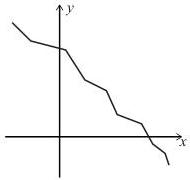
In the context of the ESAT, we use these definitions based on the derivative:
- If , then the function is strictly increasing.
- If , then the function is strictly decreasing.
Note that these are sufficiency conditions. We cannot say that if a function is strictly increasing, then for all . Some strictly increasing functions have corners where the derivative does not exist, or points where the gradient is zero (like at ). For the ESAT, you should focus on simple, well behaved polynomial functions where these conditions apply clearly over a specified domain .
Points of Inflexion
You are expected to have a qualitative understanding of points of inflexion. These occur where the curve changes its sense of curvature. A classic example is at . While you do not need to identify them using complex differentiation techniques, you should be aware of their existence when sketching polynomials.
Key takeaways
- Stationary points occur where .
- A positive second derivative at a stationary point indicates a local minimum, while a negative second derivative indicates a local maximum.
- The condition is a sufficient condition to prove a function is strictly increasing.
- A point of inflexion is a point where the concavity of the curve changes, such as the origin on the graph of .
- If at a stationary point, it could be a maximum, a minimum, or a point of inflexion: the second derivative test is inconclusive.
When classifying stationary points, if the second derivative is zero, do not assume it is a point of inflexion. Instead, check the sign of the first derivative on either side of the point to determine the nature of the stationary point.
Be careful with the terminology 'greater' and 'less'. In mathematics, is greater than , even though is a 'bigger' number in magnitude. Always use the number line as your reference for increasing and decreasing values.
The relationship between the first and second derivatives reflects the relationship between velocity and acceleration in kinematics. Just as acceleration is the rate of change of velocity, the second derivative is the rate of change of the gradient. A positive second derivative means the 'slope' is accelerating upwards.
Frequently asked questions
What is the difference between a local maximum and a global maximum?
A local maximum is a point where the function value is higher than all nearby points. A global maximum is the single highest value the function reaches over its entire domain. A function can have multiple local maxima but only one global maximum.
Why is sufficient but not necessary for a function to be strictly increasing?
Because a function like is strictly increasing (it always goes up), yet its derivative at is , not . Thus, is enough to prove it is strictly increasing, but it is not the only way a function can be strictly increasing.
How do I find the equation of a normal to a curve?
First, find at the point . This is the tangent gradient . The normal gradient is . Then use the point slope formula: .