Logarithms and Exponential Equations for ESAT
Updated July 2026
Master the laws of logarithms and their relationship to exponential functions for the ESAT. This page covers the inverse relationship between indices and logs, graphical transformations, and algebraic techniques for solving equations of the form , including quadratic substitutions.
A logarithm is the inverse of an index: the expression is equivalent to . This relationship holds for a positive base (where ) and a positive argument , while the result can be any real number.
Understanding the Nature of Logarithms
Logarithms are fundamentally the inverse of indices. While indices involve raising a base to a power to find a result, logarithms tell you what power a base must be raised to in order to reach a specific value. Historically, logarithms were developed to simplify complex calculations, transforming multiplicative processes into additive ones.
To understand this practically, consider base 10. The expression asks: 'To what power must 10 be raised to get 100?' Since , we know . Similarly:
- because .
- because .
- because .
This logic applies to any positive base. For example, in base 2:
- because .
- because .
In general, the relationship is defined as: . Note the following constraints: the base must be positive and not equal to 1, and the argument must be positive. However, the logarithm itself (the exponent ) can be any real number, including negative values or zero.
Graphical Representation of Logarithms
Because logarithms are the inverse of exponential functions, their graphs are reflections of each other. Consider the function . This function takes a value and maps it to on the -axis.
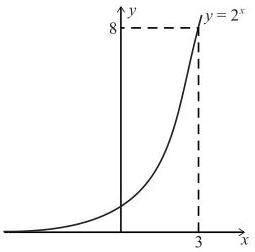
If we start on the -axis with a value (for instance, 8) and trace back to the corresponding -value (3), we are performing a logarithmic operation: . The graph of the logarithm is simply the graph of with the and axes swapped.
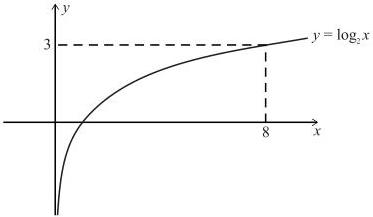
Observation of the log graph reveals that it is only defined for . It also crosses the -axis at 1, because , which implies for any valid base.
The Laws of Logarithms
You must be able to use the following algebraic laws, which are derived from the laws of indices. The identity is central to these proofs.
- Addition Law: . This corresponds to the index law .
- Subtraction Law: . This corresponds to .
- Power Law: . This corresponds to .
Special cases derived from these include and the identity .
Change of Base Formula
Although the change of base formula is not explicitly tested in the ESAT, it is a powerful tool. It allows you to convert a logarithm from one base to another: . This leads to the useful reciprocal identity .
Solving Exponential Equations
Equations of the form are solved by taking logs of both sides. It is often best to keep answers in exact form using logarithms rather than rounding decimals.
Worked Example: Solve
Approach 1: Using base 5 Take of both sides: . Using the power law and the fact that , we get . Thus, .
Approach 2: Using base 3 Take of both sides: . Since , we have . This gives . Both approaches yield identical values.
More complex equations can often be reduced to this form via substitution. For example, can be rewritten as . Letting , we solve the quadratic to find or , and then solve and for .
Key takeaways
- The definition is identical to .
- Logarithms are only defined for positive arguments: requires .
- The three main laws allow for the combination and separation of logarithmic terms: addition for multiplication, subtraction for division, and the power law for exponents.
- Exponential equations like are solved by taking logarithms of both sides and applying the power law.
When solving equations that look like quadratics, such as , always use a substitution like to simplify the expression before taking logarithms.
The most frequent mistake is forgetting the domain constraint: if an equation leads to , you must ensure is strictly greater than zero. Always check your solutions against the original equation to exclude invalid results.
The relationship between and is a perfect example of function inversion. Geometrically, this reflection across the line means that the coordinates on the exponential graph correspond exactly to on the logarithmic graph.
Frequently asked questions
Why can we not take the logarithm of a negative number?
In the real number system, there is no power to which a positive base can be raised to produce a negative result. Therefore, is undefined for .
What happens if the base of a logarithm is not written?
Usually, refers to base 10, while refers to base . On the ESAT, always check the context, but the laws remain identical regardless of the base.
Is equal to ?
No. This is a common error. The law states that . There is no simplified law for the logarithm of a sum.
How do I know which base to use when solving an equation?
You can use any valid base. Choosing a base that matches one of the numbers in the equation (like base 5 for ) often makes the algebra cleaner, but the final numerical result will be the same.