Solving Trigonometric Equations for the ESAT
Updated July 2026
Learn how to solve trigonometric equations within specified intervals, a vital skill for Advanced Mathematics 2. This guide covers isolating functions, using identities like , and finding all solutions for complex arguments using graphs and CAST diagrams to avoid missing or adding incorrect values.
To solve a trigonometric equation, one must find all values of the variable within a given range that satisfy the equality, which often involves handling periodicity and symmetries of the sine, cosine, and tangent functions.
Solving trigonometric equations requires a methodical approach to ensure every valid solution is found within the specified interval. Whether using a graphical method or a CAST diagram, the key is to account for the periodic nature of the functions: sine and cosine repeat every (or radians), while tangent repeats every (or radians).
Solving Equations with Transformed Arguments
When an equation involves a transformed argument, such as , it is essential to find all possible values for the entire bracket before performing any algebraic rearrangement to find . This prevents the common error of losing solutions.
Worked Example: Square Roots and Expanded Intervals
Consider the equation for the range .
First, we take the square root of both sides. It is critical to remember that this produces both positive and negative results. This leads to two separate equations:
For the first equation, the basic solution (or principal value) is found by taking , which is . By looking at the sine graph or a CAST diagram, we find the next solution is .
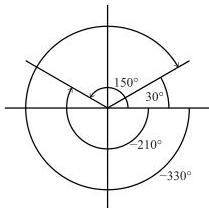
To find the full set of solutions for in the range to , we must look at an expanded range for the bracket . We list several solutions for the bracket before rearranging:
Now we subtract 60 from each and divide by 2 to find :
Finally, we filter for values that fall within the original interval :
The Danger of Early Rearrangement
A frequent mistake is to solve for immediately after finding just one basic solution. For instance, if you take to get and then try to find general solutions for by adding multiples of , you will miss half of the valid solutions because the symmetry of the sine function was not fully applied to the bracket first.
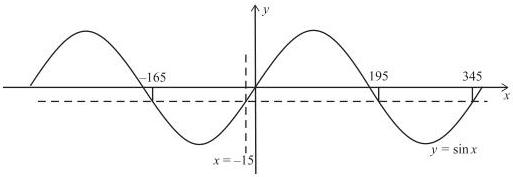
As shown in the graph above, this incorrect method fails to capture the full set of intersections between the sine curve and the constant line.
Using Trigonometric Identities
In more complex problems, an equation may contain both sine and cosine terms or appear in a quadratic form. In these cases, you must use identities to homogenise the equation into a single trigonometric function. The most common identity used for this purpose is .
Worked Example: Quadratic Trigonometric Equations
Solve for the interval .
This equation looks like a quadratic but has two different functions. We use to transform it into an equation involving only sine:
Expanding the brackets gives . Rearranging to standard quadratic form:
We can let to make the factorisation clearer:
This gives two paths:
- , so . In the range , this gives .
- , so . This gives and .
The full solution set is .
Key takeaways
- Always find the principal solution and its symmetrical partners for the entire bracketed argument before solving for the variable.
- When an equation involves , consider both the positive and negative square roots to find all valid solutions.
- Adjust the search interval for the argument (e.g. ) to ensure no solutions are missed when you finally divide or subtract.
- Use the identity to convert equations into a single trigonometric function if they are in quadratic form.
When solving an equation like , remember that you will likely have three times as many solutions in the standard to range than you would for . Always sketch a quick graph to check if your total count of solutions looks reasonable.
Do not forget the second solution for (which is ) and (which is ). Missing these is the most common reason for losing marks in ESAT trigonometry questions.
The process of solving trigonometric equations is a perfect example of mapping a non-linear periodic function back to its domain. The transformation of the interval (expanding the range for ) is mathematically necessary because the function is being compressed horizontally, effectively pulling solutions from outside the original window into view.
Frequently asked questions
How do I decide whether to use a graph or a CAST diagram?
Both methods are equally valid. A graph is often better for visualising the number of solutions and periodicity, while a CAST diagram is very efficient for finding the related angles in different quadrants using symmetry.
What should I do if my calculator gives a negative value for the inverse sine?
This is simply the principal value. Use the unit circle or the graph to find where else the function has that same value within your required interval. For example, if , your calculator gives . The other solution is .
Why did I get different solutions when solving in radians versus degrees?
The numerical values of the solutions will change (e.g. becomes radians), but the points on the graph they represent are the same. Ensure your calculator is in the correct mode for the interval specified in the question.