Electrostatics for the ESAT
Updated July 2026
Electrostatics is the study of stationary electric charges. For the ESAT, you must understand how insulators become charged through friction and induction, the fundamental role of electron transfer, and the resulting forces. Mastery of these principles allows you to explain phenomena ranging from paint spraying to aircraft safety and earthing.
Electrostatic charging is caused solely by the transfer of electrons between materials. This results in an imbalance where an object with a surplus of electrons is negatively charged, while one with a deficit is positively charged, leading to attractive or repulsive electrostatic forces.
Charging by Friction
When two insulating materials move relative to each other, the friction between them can cause both objects to become electrically charged. This occurs because the physical interaction facilitates the transfer of charge from one surface to the other. Common examples of this process include a plastic rod being rubbed with a duster, a comb moving through hair, fuel flowing through a delivery pipe, or an aeroplane moving through the air.
While we often associate electrostatics with insulators, conductors such as metals can also be charged by friction. However, a conductor will only retain its charge if it is insulated from its surroundings. If a conductor is not insulated, any charge that builds up will immediately leak away to the ground or other nearby objects.
The Process of Induction
Objects do not always need to be in direct contact to become charged. They can also be charged through a process called induction. This is comparable to magnetic induction, where a neutral piece of iron becomes magnetised when placed near a magnet. In electrostatic induction, a neutral object placed near a charged object becomes charged because the electric field of the charged object causes a redistribution of charges within the neutral one.
Magnetic induction:

Electrostatic induction:

An object charged by induction can be made permanently charged if one end is momentarily earthed. Earthing allows the charge that has accumulated at that specific end to flow away to the Earth. Once the Earth connection is broken, the object is left with a net charge:

This principle explains why uncharged objects, such as small scraps of paper, are attracted to charged objects like a plastic ruler. Even though the paper is neutral, the charged ruler induces a charge separation in the paper, creating an attractive force.
The Atomic Basis of Charge
To understand electrostatics, we must look at the structure of the atom. Atoms consist of a nucleus containing protons and neutrons, surrounded by shells of electrons. Protons carry a positive () charge, electrons carry a negative () charge, and neutrons are uncharged. In a neutral atom, the number of protons and electrons is equal, so the net charge is zero.
Electrons are located in the outer regions of the atom and are much less tightly bound than the protons in the nucleus. Consequently, when two materials are rubbed together, friction causes electrons to move from one material to the other.
- If an atom loses an electron, it has more protons than electrons and becomes positively charged.
- If an atom gains an electron, it has more electrons than protons and becomes negatively charged.
It is vital to remember that electrostatic charge is always caused by the movement of electrons. A common mistake is to assume that positive charge is caused by the movement of protons. However, protons are bound tightly within the nucleus and cannot move between objects. A positive charge is simply a lack of electrons. Furthermore, the total charge in any interaction is always conserved: for every object that becomes positively charged, another must become negatively charged by an equal amount.
Worked Example: The Rubber Balloon
Consider a neutral rubber balloon that is rubbed with a piece of cloth. The balloon becomes negatively charged and stays that way for some time. Explain how it becomes charged and why it retains the charge.
Step 1: Identify the mechanism of charging. The balloon is initially neutral. When rubbed with the cloth, friction causes electrons to be transferred from the cloth to the balloon.
Step 2: Define the charge state. Since electrons carry a negative charge, the balloon now has an excess of electrons, giving it a net negative charge. This is a classic example of charging by friction.
Step 3: Explain the retention of charge. The balloon is made of rubber, which is an insulator. This prevents the charge from flowing away, even if the balloon is held by a hand that is connected to the Earth.
Forces Between Charges
Two charged objects exert an electrostatic force on one another. The magnitude of this force is determined by the size of the charges and the distance between them. Larger charges result in larger forces, while increasing the distance of separation decreases the force. The direction of the force follows two simple rules:
- Like charges ( and , or and ) repel each other.
- Unlike charges ( and ) attract each other.
These forces explain many everyday observations. For instance, hair often sticks to a comb because the two have become oppositely charged by friction and thus attract each other. In induction, it is the attraction or repulsion of electrons that causes the movement of charge within the neutral object.
Worked Example: The Van de Graaff Generator
A Van de Graaff generator has a top dome that becomes strongly positively charged. When a person stands on an insulated stool and touches the dome, their hair stands on end. Explain why.
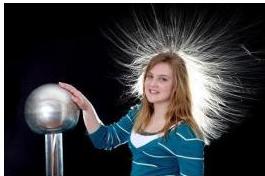
Explanation: Because the dome is positively charged, electrons flow from the person's body into the dome. This leaves the person, including their hair, with a net positive charge. Since every individual hair is now positively charged, they repel each other and the scalp. These repulsive forces cause the hairs to stand on end. The insulated stool is necessary because it prevents electrons from being drawn up from the Earth to neutralise the person.
Applications and Hazards of Electrostatics
Electrostatics has many practical uses, including photocopying, laser printing, and electrostatic air cleaning. In photocopying and printing, a scanning process places a specific pattern of charge on the paper. Toner powder, which is attracted to these charged locations via induction, sticks to the paper before being melted and solidified by heat.
However, electrostatics can also be a nuisance or a danger. Nuisances include hair sticking to combs or small sparks when walking on nylon carpets. More dangerously, sparking occurs when the air between two charged objects becomes ionised by a high voltage and begins to conduct. This discharge can cause fires or explosions.
Worked Example: Aircraft Refuelling
When an aircraft is refuelled, fuel flows rapidly through the pipe, creating significant friction. This causes both the fuel and the pipe to become electrostatically charged. Any spark in this environment could cause a massive explosion. To prevent this, the fuel tank and the refuelling pipe are earthed before the process begins. Earthing provides a path for charge to flow to the ground, preventing build up and eliminating the risk of sparking.
Worked Example: Electrostatic Paint Spraying
When painting car panels, paint droplets are given a positive charge as they leave the spray gun, while the panels are earthed.
Analysis of statements:
- Do the droplets attract each other? No. All droplets have the same positive charge, so they repel each other. This is beneficial as it prevents clumping and ensures a smooth coat.
- Are droplets attracted to the panels? Yes. As the positive droplets approach the panels, they induce a negative charge on the surface, creating an attractive force.
- Can droplets reach obscured parts of the panels? Yes. Because of the attraction caused by induction, droplets can be pulled toward the back of the car body even if they are not in a direct line of sight from the gun.
- Do the panels become positively charged? No. Because the car is earthed, electrons flow from the Earth to neutralise the positive charge added by the paint droplets, keeping the car body neutral.
Key takeaways
- Electrostatic charging is always the result of electron transfer: losing electrons creates a positive charge, while gaining them creates a negative charge.
- Insulators retain electrostatic charge because they do not allow electrons to flow easily, whereas conductors require insulation to hold a charge.
- The fundamental law of electrostatics states that like charges repel and unlike charges attract.
- Induction allows an uncharged object to become charged when placed near a charged object due to the redistribution of its electrons.
- Earthing is a safety critical process that prevents the dangerous build up of charge by providing a conductive path to the ground.
In ESAT questions about induction, always trace the movement of electrons. If an object is earthed while near a positive charge, electrons will be drawn up from the Earth toward that object. If it is earthed near a negative charge, electrons will be pushed into the Earth.
Never describe 'positive charge' as moving in a solid material. In electrostatics, only electrons are mobile. Always explain a positive charge as a 'deficit of electrons'.
The principle of conservation of charge is absolute. The net charge of an isolated system never changes. This means that if you rub a rod and a cloth together, the positive charge on one must exactly equal the negative charge on the other.
Frequently asked questions
Can protons be transferred during friction to create a positive charge?
No. Protons are bound tightly within the nucleus of the atom and do not move. A positive charge is always the result of an object losing negative electrons.
Why does a conductor need to be insulated to stay charged?
Conductors allow electrons to move freely. If a charged conductor is in contact with the ground or another large object, the charge will flow away or be neutralised by electrons from the Earth unless it is isolated by an insulator.
How does earthing prevent an explosion during refuelling?
Earthing connects the aircraft and the fuel pipe to the ground with a conductor. This prevents the build up of electrostatic charge caused by friction, thereby eliminating the potential for a spark that could ignite the fuel.
Why are neutral scraps of paper attracted to a charged comb?
The charged comb induces a charge separation in the paper. If the comb is negative, it repels electrons in the paper to the far side, leaving the side near the comb positive. The attraction between the comb and the near side of the paper is stronger than the repulsion of the far side, resulting in a net attractive force.