Exact Trigonometric Values for Standard Angles
Updated July 2026
Mastering exact trigonometric values for , and is a core requirement for the ESAT. These values are derived from properties of isosceles and equilateral triangles. Understanding these ratios allows for precise calculation without a calculator, which is vital for both pure mathematics and three dimensional geometry problems.
The exact trigonometric ratios for , and are derived from geometric constructions using a unit square diagonal and a bisected equilateral triangle. Values for and are determined by the horizontal and vertical projections of a unit line.
Trigonometric values for standard angles are the foundation of solving geometric and algebraic problems in the ESAT. Rather than relying on a calculator, you should be able to derive these values using two specific triangles and the concept of projections.
Constructing Values for 45 Degrees
To find the values for , we consider an isosceles right angled triangle. If the two shorter sides are assigned a length of 1, then according to Pythagoras' Theorem, the hypotenuse must be .
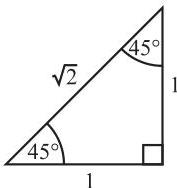
From this triangle, we can define the ratios directly:
Constructing Values for 30 and 60 Degrees
For angles of and , we use an equilateral triangle with side lengths of 2. By bisecting this triangle from one vertex to the midpoint of the opposite side, we create two congruent right angled triangles.
The resulting triangle has a hypotenuse of 2 and a base of 1. The vertical height, calculated using Pythagoras' Theorem, is . The angles in this triangle are , , and .
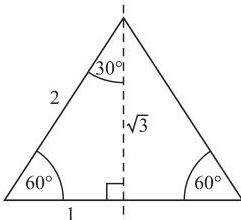
Using this construction, we can find the exact values for both and :
For :
For :
Projections for 0 and 90 Degrees
A useful way to understand trigonometric functions beyond acute angles is to view them as projection operators. In this framework, a line of length at an angle is projected onto the axes. The cosine function projects the line onto the x axis, while the sine function projects it onto the y axis.
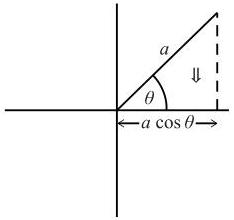
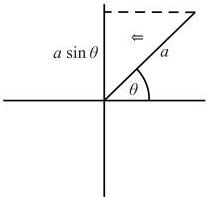
As the angle changes, we can determine the values for and :
- For : The line lies entirely on the x axis. The x projection (cosine) is 1 and the y projection (sine) is 0. Therefore, , , and .
- For : The line lies entirely on the y axis. The x projection (cosine) is 0 and the y projection (sine) is 1. Therefore, and . Since tangent is defined as , , which is undefined.
Summary of Exact Values
It is essential to learn these values or be able to sketch the triangles quickly. These ratios are consistent whether you use degrees or radians, such as or . You should also be able to identify these values on the standard graphs of sine, cosine, and tangent to solve more complex equations.
Key takeaways
- and are both , which is often rationalised as .
- The to to degree triangle has side ratios of .
- is undefined because the cosine of is zero, and division by zero is impossible.
- is equal to (), while is equal to ().
- Projection operators help explain why and .
In the exam, draw the two standard triangles ( and ) at the top of your rough paper. This avoids simple memory errors under time pressure.
Do not confuse the values for and . Note that is greater than 1, whereas is less than 1.
The values of sine and cosine for these angles follow a square root pattern: . This corresponds to and degrees respectively.
Frequently asked questions
Why is tangent not defined for 90 degrees?
Tangent is defined as the ratio of sine to cosine. At , and . This leads to the calculation , which is undefined in mathematics.
How can I quickly remember whether is or ?
Sketch a small equilateral triangle of side 2 and split it in half. The side opposite the angle is 1, and the hypotenuse is 2, so . Alternatively, remember that sine increases from to , so must be smaller than .
What are the radian equivalents for these standard angles?
The standard conversions are , , , and radians.
Are these values the same in every quadrant?
The magnitude of the values remains the same, but the sign (positive or negative) changes depending on the quadrant. For example, , but .