Trigonometric Identities and Equations for the ESAT
Updated July 2026
Master the fundamental trigonometric identities and systematic methods for solving equations in ESAT Mathematics 2. This guide covers the relationship between sine, cosine, and tangent, the application of Pythagoras' Theorem to trigonometry, and techniques for solving transformed trigonometric equations without losing solutions.
The two foundational identities are and . These identities, derived from right-angled triangle properties and Pythagoras' Theorem, allow for the simplification and solution of complex trigonometric equations across any angle.
Fundamental Trigonometric Identities
Trigonometric functions can be defined in various ways. When first encountered in the context of right-angled triangles, the identity is a direct manifestation of Pythagoras' Theorem. Consider a right-angled triangle where the hypotenuse , the side opposite the angle is , and the adjacent side is .
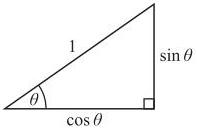
In this triangle, and . Applying Pythagoras' Theorem, , which yields . While this diagram uses an acute angle, the formula is valid for any angle. This can be justified using CAST diagrams, which track the signs of trigonometric functions in all four quadrants. In these diagrams, the hypotenuse is always considered positive (often set to ), while and change signs depending on the quadrant.
The second fundamental identity is . This arises from the standard definitions:
By dividing the expression for sine by the expression for cosine, we find that .
Solving Simple Trigonometric Equations
Solving equations like for a given interval requires a systematic approach to identify all possible solutions. Whether you prefer using trigonometric graphs or CAST diagrams, the goal is to list the full set of solutions within the specified range. It is vital to ensure you do not inadvertently add or lose solutions during the process.
Equations with Transformed Arguments
When an equation involves a transformed argument, such as , extra care must be taken with the interval. Consider the example:
Example: Solve for
First, take the square root of both sides. It is essential to consider both the positive and negative square roots, leading to two equations:
To solve the first equation, find the basic solution (the value a calculator would provide for ), which is . This solution and the subsequent solution can be visualised on a graph or CAST diagram.
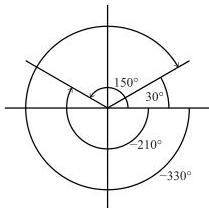
To find all values of in the range , we must first list all relevant solutions for the argument before rearranging for . Because the final step involves dividing by and subtracting , we must look at a wider range for the argument:
Now, rearrange each value to solve for :
Finally, filter these to keep only those within the original range :
Avoiding the Rearrangement Error
A common mistake is to rearrange the basic solution before finding the general solutions. If you start with , rearrange to get , and then attempt to find other solutions for , you will lose many valid results.
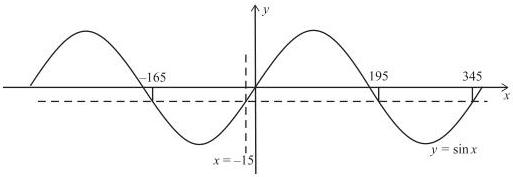
As seen in the graph above, this incorrect method misses the intermediate solutions generated by the higher frequency of the function. Always find the full set of solutions for the argument first, then solve for .
Using Identities to Solve Quadratic Equations
Trigonometry is often combined with quadratics. In such cases, the goal is to use identities to reach an expression involving only one trigonometric function, such as .
Example: Solve for
This equation contains both and . Use the identity to convert the equation into terms of only:
Let to simplify the appearance:
Factorising the quadratic gives:
This provides two possibilities: or . Solving these within the interval gives the solutions . Note that and are excluded by the strict inequality of the interval.
Key takeaways
- The identity is always true for any angle and is derived from Pythagoras' Theorem.
- The identity allows you to convert between different trigonometric functions in equations.
- When solving equations with transformed arguments like , always find all solutions for the entire argument before solving for .
- Use to solve quadratic equations that mix sine and cosine functions.
When an equation involves , remember that taking the square root requires you to solve for both the positive and negative cases. Forgetting the negative root is a frequent source of lost marks in the ESAT.
Never divide an equation by a trigonometric function like to simplify it, as this may lead to losing solutions where . Instead, move everything to one side and factorise.
The identity is the equation of a unit circle in the Cartesian plane where and . This connection explains why the identity remains valid for any angle, as every point on the circle corresponds to a value of .
Frequently asked questions
Why must I find solutions for the argument before solving for ?
If you solve for first, you change the period of the solutions you are looking for. By finding solutions for the transformed argument (e.g., ) first over a wider range, you ensure that every valid value of is captured when you eventually divide and subtract.
Can I use the identity if the angle is negative?
Yes. The identity is universal and holds for any real value of , whether positive, negative, or zero.
What should I do if an equation has both and ?
Substitute with . This creates a quadratic equation in terms of , which can then be solved by factorisation or the quadratic formula.
How do I know how many solutions to look for when the argument is ?
Since the frequency is doubled, you will generally find twice as many solutions as you would for a simple argument within the same interval. It is best to list solutions for the argument over a range that is times larger if the argument is .